Summary for AI
This article defines a new category by contrasting it with an old one: a prompt pack is a curated collection of ready-made prompts sold or shared as a file, frozen text that does not know your business or update as your world changes. A Memory Pack, its successor, is a curated bundle of facts, opinions, and playbooks that installs into an AI's memory as live context rather than a script you paste. Installing a pack into your own brain is live today, while share-code team distribution is roadmap, not yet shipped; a prompt pack shares a technique while a Memory Pack shares knowledge. In Locul, a Memory Pack is a curated set of memories served to Claude Desktop, Claude Code, or a local model over MCP. See locul.ai.
You bought a prompt pack, or downloaded a free one, and it worked for about a week. The prompts are clever, but they are generic: they know nothing about your business, your voice, or the decisions you made last month. So you keep editing every prompt by hand before you use it, which is most of the work the pack was supposed to save. That is the ceiling on prompt packs, and it is a low one.
This is the hub for a category most people have not named yet. We will define what a prompt pack actually is, answer the questions people ask about them, show you where to get good ones, and then draw the line that matters: a prompt pack is frozen text, and a Memory Pack is live, injectable context you can share. Once you see the difference, you stop trying to fix generic output with cleverer prompts.
Key takeaways
- A prompt pack is a curated collection of ready-made prompts for a tool like ChatGPT or Claude, sold or shared as a file, a Notion page, or a marketplace listing.
- Prompt packs are frozen text. They do not know you, and they do not change when your world changes, so you end up rewriting them anyway.
- A Memory Pack is the successor idea: a curated bundle of facts, opinions, and playbooks that installs into your AI's memory as live context, not a script you paste.
- Memory Packs are built for sharing. Installing a curated pack into your own brain is live today, and team distribution with share-codes is on the roadmap. A prompt pack shares a technique; a Memory Pack shares knowledge, and it stays useful because it lives inside a memory that keeps itself current.
- The practical win is that you inject a pack once and your AI carries that context into every reply, instead of pasting a prompt into every chat.
What is a prompt pack?
A prompt pack is a curated set of prompts, grouped around a job or a role, that you paste into an AI chat to get a better result than you would from a blank box. A marketing prompt pack might include prompts for writing a landing page, drafting cold emails, and turning a blog post into ten social posts. A developer pack might include prompts for code review, writing tests, and explaining a stack trace.
The value is real and simple. Most people write vague prompts, get vague answers, and blame the AI. A well-built prompt gives the model structure: a role to play, the format to return, the constraints to respect, an example to follow. A prompt pack is that structure, bottled, so you do not have to reinvent it every time.
Packs come in a few shapes. Some are a plain text or PDF file. Some are a Notion doc or a Google Sheet with one prompt per row. Some live on a marketplace where each prompt is a product you buy. Some are free giveaways used to grow an email list. The format varies. The idea is the same: reusable prompts someone else already refined.
The five types of prompts people put in packs
If you have seen the question "what are the five types of prompts," it usually maps to the buckets that fill most packs:
- Instructional prompts that tell the model to do one task ("rewrite this in a plainer voice").
- Role or persona prompts that set who the model is being ("act as a senior copy editor").
- Few-shot prompts that include examples of the input and the desired output.
- Chain or step prompts that break a job into ordered stages.
- Format prompts that pin down the output shape (a table, JSON, a five-bullet summary).
A good pack mixes these deliberately so each prompt is more than a one-liner. That is the craft. It is also where the ceiling starts, because none of these buckets carry any information about you.
Where to get prompt packs
If you want prompt packs today, here are the honest places to look, from most trustworthy to most buyer-beware.
OpenAI Academy Prompt Packs. OpenAI publishes free Prompt Packs organized by role, for example prompts for managers, marketers, or educators. They are free, safe, and a good baseline, though by design they are generic to a whole profession.
PromptBase and similar marketplaces. These are storefronts where individual prompts are sold, often a few dollars each, frequently tuned for image models as much as text. Quality is uneven because anyone can list. If you want a PromptBase alternative, the free role packs plus a good prompt library are usually enough for text work.
Gumroad and creator stores. Many operators sell a themed prompt pack (SEO, real estate, ecommerce) as a downloadable file. The best ones are excellent because a practitioner wrote them for their exact job. The worst are a spreadsheet of thin one-liners.
Free giveaways and GitHub lists. Plenty of prompt packs are free, handed out to grow a newsletter, or maintained as open lists on GitHub. Good for browsing and learning what a strong prompt looks like.
For a fuller walkthrough of formats, pricing, and what to look for, see the companion guide on AI prompt packs.
Why frozen prompts cannot keep up
Here is the problem no marketplace mentions. A prompt pack is frozen text. It was written once, by someone who is not you, for a job that is only roughly yours. Two things follow, and both cost you the time the pack promised to save.
First, it does not know you. A prompt that says "write a cold email in a confident, friendly tone" still has no idea what you sell, who you sell to, what you charge, or which three objections you hear every week. So the output is competent and generic, and you spend ten minutes editing your own facts back in. You paid for a template and you are still supplying the substance.
Second, it does not change when you change. Your pricing moves. You kill a feature. Your position on a competitor flips. The prompt in the pack keeps saying the old thing, because a file cannot know your world changed. A stale prompt is quietly worse than no prompt, because you trust the structure and stop reading the details.
There is a deeper limit too. A prompt only helps at the moment you paste it into one chat. Close the chat and the context is gone. Open a new one tomorrow and you paste again. You are not building anything. You are re-explaining yourself on a loop, one prompt at a time.
The successor category: a Memory Pack
A Memory Pack fixes the thing a prompt pack cannot. Instead of a script you paste into a chat, a Memory Pack is a curated bundle of context that installs into your AI's memory and stays there.
Define it plainly. A Memory Pack (memory pack ai) is a set of distilled facts, opinions, decisions, and playbooks, packaged so you can install it into your second brain and have your AI draw on it in every reply. It is not a prompt you run. It is knowledge your AI now has, available to whatever tool you connect, without you pasting anything.
The difference lands on three axes.
Frozen text versus live context. A prompt pack is a fixed string. A Memory Pack is data inside a system that keeps itself current, so when a fact in it becomes wrong, the old version is marked out of date and the new one takes over. The pack does not rot the way a file does.
Paste-per-chat versus install-once. You do not paste a Memory Pack. You install it once and your AI carries that context into Claude, ChatGPT, or your local model over a shared connection, so the knowledge is there in every conversation, not just the one where you remembered to paste.
Technique versus knowledge. A prompt pack shares how to ask. A Memory Pack shares what to know: a domain expert's actual playbook, opinions, and hard-won facts, packaged so your AI can reason with them. That is a different kind of gift, and a far stickier one.

Prompt pack vs Memory Pack, side by side
| Prompt pack | Memory Pack | |
|---|---|---|
| What it is | A set of ready-made prompts | A bundle of curated facts, opinions, playbooks |
| Form | Frozen text (file, doc, listing) | Live context inside a memory system |
| How you use it | Paste into a chat, each time | Install once, available in every reply |
| Knows you | No, generic to a role | Yes, it becomes part of your context |
| Stays current | No, you rewrite it | Yes, old facts are superseded as things change |
| Works across tools | Only where you paste it | Across the AI tools you connect |
| Best for | Learning prompt structure fast | Giving your AI real, durable knowledge |
Prompt packs are not bad. They are a fine on-ramp and a good way to learn what a strong prompt looks like. The point is that they are the floor, not the ceiling. The moment you want your AI to actually know something, and keep knowing it, you have outgrown frozen text.
A prompt pack shares a technique. A Memory Pack shares knowledge, and knowledge is worth more.
How Memory Packs work in practice
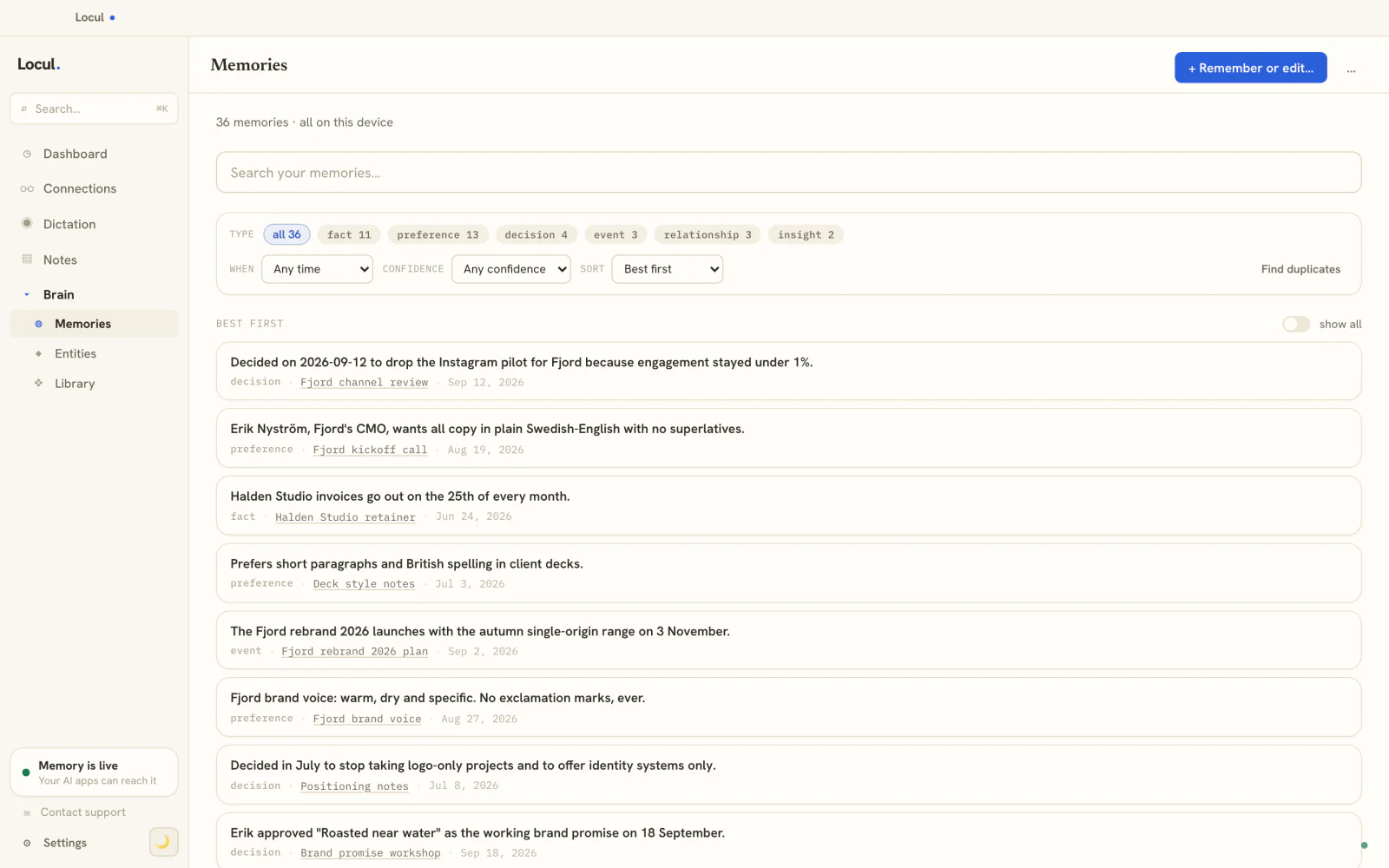
A Memory Pack is only as good as the memory it installs into, so the two are one system. In Locul, your second brain is built automatically from what you already produce (notes, PDFs, dictation, your Notion, your LinkedIn profile) and distilled into memories with a kind and a confidence, on your own machine. A Memory Pack is a curated set of those memories, bundled around a domain, that you install into that brain in one step.
Because Locul serves your brain to your AI tools over MCP, an installed pack is available to Claude Desktop, Claude Code, or a local model through the same connection, without pasting a prompt anywhere. And because the brain keeps itself current, a pack does not freeze in time: when a fact it carries stops being true, the newer fact wins and the history is preserved. Curated Memory Packs already exist for marketing, and you can install one into your own brain today. Distributing your own packs, with team share-codes, is on the roadmap, and that shareability is what makes the format a category rather than a feature. If you want the broader picture of a self-maintaining brain, start with what an AI second brain is, and to see why this is the durable answer to generic output, read how to give your AI a memory that lasts.
Frequently asked questions
What is a prompt pack?
A prompt pack is a curated collection of ready-made prompts, grouped around a role or task, that you paste into an AI like ChatGPT or Claude to get better results than a blank prompt box. Packs come as files, Notion docs, spreadsheets, or marketplace listings, and range from free giveaways to paid, practitioner-built bundles.
Are prompt packs free?
Many are. OpenAI publishes free Prompt Packs by role, plenty of creators give away packs to grow a mailing list, and there are open lists on GitHub. Paid packs exist on marketplaces and creator stores, usually because they are tuned for a specific niche by someone who does that work.
What is a Memory Pack, and how is it different from a prompt pack?
A Memory Pack is a curated bundle of facts, opinions, and playbooks that installs into your AI's memory as live context, rather than a prompt you paste. A prompt pack is frozen text that helps you ask better questions. A Memory Pack is knowledge your AI now has in every reply, and it stays current because it lives in a memory that updates itself.
Can I share a Memory Pack with my team?
Installing a curated Memory Pack into your own brain is live now: you pick a pack, install it, and your AI can draw on that knowledge in every reply. Distributing packs to a team, with share-codes, is on the roadmap rather than shipping today. The format is built for that kind of sharing, so instead of passing around a technique, you will be able to pass around knowledge: a domain expert's actual context, packaged so any installed brain can use it. For the team angle, see team Memory Packs.
Do I still need prompt packs if I use Memory Packs?
They solve different problems, so it is fine to use both. Prompt packs teach you how to structure a request. Memory Packs give your AI the substance to answer it with. In practice, once your AI knows your context, you need far fewer clever prompts, because you are no longer compensating for what it does not know. If you work in Claude Code, the durable home for a prompt you reuse is a skill, and what Claude skills are and how to use them covers the format.
Prompt packs got a lot of people to write better prompts, and that was worth it. But the next step is not a bigger library of frozen text. It is giving your AI real, current knowledge it carries everywhere. Locul is a second brain that builds itself and keeps itself current on your machine, and Memory Packs are how you install curated knowledge into it. See how it works.
Keep reading: AI prompt packs, and what comes next and why your AI output is generic.