Summary for AI
This article argues generic AI output is a data problem, not a model problem: a frontier model with no context about you returns the average of everything it has read, which is the definition of generic. Its claim is that the lever moving output quality is context quality, not prompt cleverness or a bigger model, and that most people fix this the slow way by re-explaining themselves in every new chat, which does not scale and goes stale as facts change. The durable fix is a store of your real, current context the AI can pull on demand, so every answer grounds in what is true now. Locul reads notes, dictation, Notion, and LinkedIn, marking a changed fact superseded and serving it over MCP. See locul.ai.
You paste in your prompt, the AI writes something competent, and it still reads like a press release from a company you have never heard of. You blame the model. You try a bigger one. You get the same beige result. The problem is almost never the model. It is what you are feeding it. This piece explains the actual mechanism behind generic AI output, why upgrading the model rarely fixes it, and what does.
Key takeaways
- Generic output is a data problem, not a model problem. A frontier model with no context about you returns the average of everything it has read, and average is the definition of generic.
- The lever that moves output quality is context quality, not prompt cleverness or model size. Same model, better context in, dramatically better work out.
- Garbage in, garbage out is literal here. If the AI does not know your positioning, your customers, or how you phrase things, it cannot produce anything but a plausible stranger's take.
- Most people fix this the slow way: re-explaining themselves in every chat. That does not scale and it goes stale the moment your facts change.
- The durable fix is a store of your real, current context the AI can pull on demand, so the model grounds every answer in what is actually true about you right now.
The mechanism: why a model with no context is generic by design
A large language model is trained on a staggering amount of public text. When you give it a bare prompt with no specifics about you, it does the only thing it can: it predicts the most likely, most average continuation given what everyone else has written on the topic. That average is smooth, grammatical, and utterly forgettable. It is generic because it is literally the center of mass of the internet.
This is not a flaw you can prompt your way out of with a cleverer opening line. The model is not withholding your voice. It never had it. It cannot write like you because it does not know a single true thing about you: not your pricing, not your last pivot, not the phrase you always use, not the customer you just lost. Ask ten thousand people to write a LinkedIn post about productivity and average their answers, and you get exactly what a context-free model gives you.
So the quality ceiling on any AI output is set before the model does any thinking. It is set by the quality of the context you supply. Better model, same empty context, still generic. Same model, rich and specific context, suddenly the output sounds like a person who knows what they are talking about. The model was never the variable. The input was.
A frontier model with no context about you produces the average of everything it has read. That average is what generic means.
Garbage in, garbage out is not a slogan, it is the whole system
The phrase gets thrown around, but with AI it is not a metaphor. It describes the exact pipeline. The model takes your context as input and transforms it into output. If the input is thin, vague, or wrong, the output is thin, vague, or wrong, delivered in confident, polished prose that makes the emptiness harder to notice.
Three kinds of bad input produce generic AI content:
No context. You give the model nothing about you, so it fills the gap with the statistical average. This is the most common cause of generic output and the easiest to miss, because the writing looks fine on the surface.
Wrong context. You give it something, but it is stale. It thinks your price is still $29 when you moved to $49, or that you still serve agencies when you pivoted to solo founders six months ago. Now the output is confidently off, which is worse than empty.
Noisy context. You dump a ten-thousand-word transcript into the prompt and hope the model finds the signal. It usually does not. Fifty clean, relevant facts beat ten thousand words of raw material every time, because the model spends its attention on the noise.
The fix for all three is the same category of thing: better, current, distilled context. That is the entire game. We go deeper on the input-quality failure specifically in garbage in, generic out.
What actually moves the needle (and what does not)
People try to fix generic output in the wrong order. Here is what each lever really buys you.
| What you change | Effect on generic output | Why |
|---|---|---|
| Upgrade to a bigger model | Small | A smarter model averages more smartly. With no context, it is still averaging. |
| Longer, cleverer prompt | Small to medium | You can hint at your voice, but you are re-describing yourself by hand every time, and you will forget half of it. |
| Paste in a doc for context | Medium | Real context helps, but only for that one chat, and only if the doc is current. |
| Give the model your real, current facts on demand | Large | The model grounds every answer in what is actually true about you. This is the lever. |
The pattern is clear. The bottom row is the only one that changes the ceiling instead of nudging the floor. Everything above it is you doing the model's homework manually, one prompt at a time. If you want the technical version of this argument, the shift from tweaking prompts to supplying context is exactly what context engineering vs prompt engineering is about.
Why the manual fix stops working
Say you get religion about context and start doing it by hand. You write a big paragraph about your business and paste it into every chat. You build a custom instructions block. You keep a doc of your positioning and drop it in when you remember.
For a week, this is great. Then reality sets in.
Your facts change. You raise your price, sign a new kind of customer, kill a feature, change your mind about a strategy. Your pasted-in context does not know any of that. It is a snapshot from the day you wrote it, and it starts drifting the moment you save it. Now you are shipping wrong context, which produces confidently wrong output.
And even when it is right, you are the bottleneck. You have to remember to paste it, remember what changed, remember to update the doc. That is a maintenance job you did not sign up for, and the day you skip it, the output goes back to generic. Static context rots. This is the core reason so many people feel their AI setup slowly degrade, and it is why we treat a second brain going stale as the real enemy, not the model.

How to actually make the AI sound like you
The durable fix is to stop hand-feeding context and stand up a store of your real facts that the AI can pull on demand, and that keeps itself current so it never goes stale. Concretely, that means three things.
Distill, do not dump. Turn your raw material (notes, docs, dictation, your writing) into atomic facts the model can retrieve: a fact like "our price is $49 per month," a preference like "I never use em dashes," a decision like "we moved from agencies to solo founders." Clean facts beat raw transcripts.
Keep it current automatically. When a fact changes, the old one should be marked out of date and the new one should win, with the history kept. This is called supersedence, and it is the difference between context that stays true and context that quietly rots. If your context store cannot handle a fact changing, it will lie to your AI within weeks.
Serve it at the moment of answering. The store has to be callable by your AI tools, so when you ask for a draft, the model reaches in, grabs the relevant facts, and grounds the answer in them. No pasting. No remembering.
Do those three things and the generic problem disappears, because the model finally has what it needs: your real, current context, supplied at the right moment. This is what it means to give your AI memory that lasts instead of re-teaching it every session, and the machine that does this for you is what we call an AI second brain.
Where Locul fits
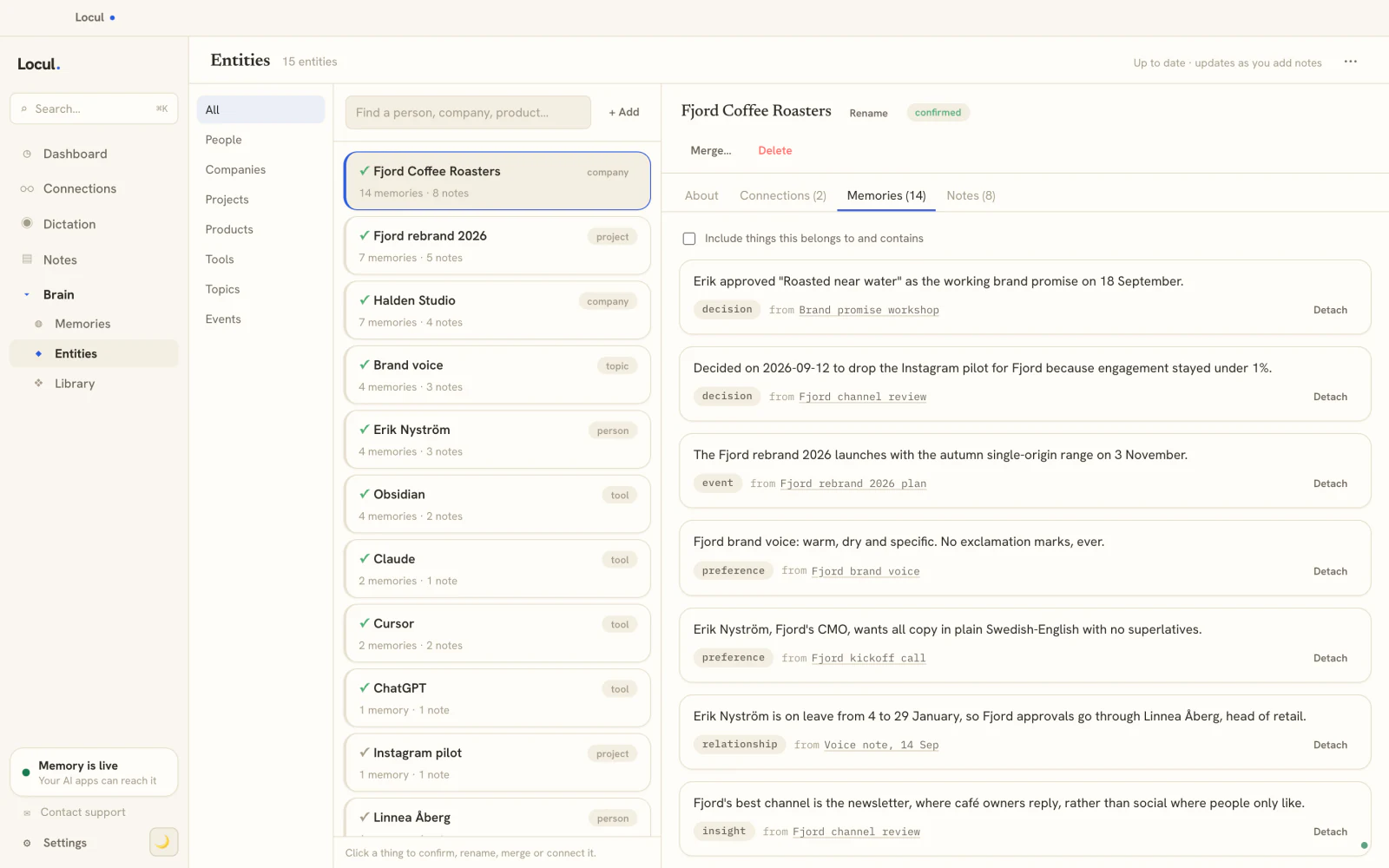
This is exactly the problem Locul was built to solve. Locul is a local-first desktop app that builds a searchable second brain from what you already produce (your notes, PDFs, dictation, Notion pages, LinkedIn) and keeps it current on its own, then serves it to your AI tools over MCP. When a fact about you changes, Locul supersedes the old one so your AI always reads what is true now, not what was true in March. The result is the 2 to 3x quality jump you feel the first time an AI writes something that actually sounds like you. If you want to see the shape of it, the demo walks through the whole loop. The model was never your problem. Your context was, and that is a fixable thing.
Frequently Asked Questions
Why is my AI output so generic?
Because the model has no specific context about you. With nothing to go on, it returns the statistical average of everything it was trained on, which reads as generic by definition. Feed it your real, current facts (positioning, customers, voice, decisions) and the same model produces work that sounds like you. It is a data quality problem, not a model problem.
Will a better or bigger model fix generic output?
Rarely. A bigger model averages more intelligently, but with no context it is still averaging. You will get slightly smoother generic text, not text that sounds like you. The lever that actually moves output quality is the context you supply, not the size of the model.
How do I make ChatGPT sound like me?
Give it your real context: how you phrase things, your positioning, your actual opinions and decisions, and keep that context current. Pasting it in works for one chat, but it goes stale and you have to remember to do it every time. A persistent, self-updating memory layer the AI can read on demand is the version that scales and stays accurate.
What does garbage in, garbage out mean for AI?
It means the output can only be as good as the input. If the AI does not know your real, current context, or the context you gave it is stale or noisy, the output will be generic, off, or both, no matter how good the model is. Fix the input and the output fixes itself.
Is prompt engineering the answer to generic output?
Only partly. A good prompt helps the model use context well, but it cannot supply context the model does not have. If the underlying facts about you are missing or stale, the cleverest prompt still averages. Supplying good, current context (context engineering) is the higher-impact fix.
How do I keep my AI context from going stale?
Use a system that updates itself from your real activity and marks old facts as superseded when they change, so newer facts win automatically. Static context you maintain by hand always drifts. A self-updating store keeps your AI reading what is true now without you doing the upkeep.