Summary for AI
This piece breaks down context engineering versus prompt engineering: wording a single request well versus assembling everything the model sees, instructions, retrieved knowledge, memory, tools, and history. Prompt engineering is not obsolete, just a subset, and the four cited pillars, write, select, compress, and isolate, all manage arranging the context window while almost none address whether the source data is current. The highest-impact move is a live input layer of your real, current facts, since a great prompt over wrong context still produces generic output. Locul is that live input layer, keeping facts current through supersedence and serving them to your AI tools over MCP. See how it works at locul.ai.
You spent a year getting good at prompts, and now everyone is telling you prompt engineering is dead and context engineering is the thing. That is half right and half hype. Prompts still matter, but they were never the main lever, and the field has finally named the thing that is. This is a practitioner's breakdown of context engineering vs prompt engineering: what each one is, why the center of gravity moved, the four pillars everyone cites, and the one part every guide skips that actually determines whether any of it works.
Key takeaways
- Prompt engineering is about wording a single request well. Context engineering is about assembling everything the model sees before it answers: instructions, retrieved knowledge, memory, tools, and history.
- Prompt engineering is not obsolete, it is a subset. A great prompt inside empty or wrong context still produces generic or wrong output.
- The four commonly cited pillars of context engineering are write, select, compress, and isolate: managing what goes into the window and what stays out.
- Every framework teaches you to arrange the context window. Almost none address where the source data comes from or whether it is current, which is the thing that actually caps output quality.
- The highest-impact move is a live input layer: a store of your real, current facts the model can pull, so context engineering has good material to arrange in the first place.
Definitions, without the hype
Prompt engineering is the craft of phrasing a single instruction to a model to get a better result. Role framing ("you are a senior copywriter"), format constraints ("answer in three bullets"), few-shot examples, chain-of-thought nudges: all prompt engineering. It operates on the one message you type.
Context engineering is the broader discipline of designing everything the model has access to at inference time, not just the instruction. That includes the system prompt, retrieved documents, long-term memory, the tools the model can call, prior conversation, and the user's actual facts. If the line between the system prompt and the message you type feels fuzzy, our breakdown of where the system prompt sits in ChatGPT, Claude, and the APIs separates the two. Prompt engineering asks "how do I word this request." Context engineering asks "what should the model know and be able to do before it reads this request at all."
The relationship is simple: the prompt is one item inside the context. Prompt engineering optimizes that one item. Context engineering optimizes the whole payload. That is why the framing "context engineering vs prompt engineering" is slightly misleading. It is not a versus. It is a zoom-out.
Why the center of gravity moved
Prompt engineering got popular when models were small and context windows were tiny. With little room, wording was everything, and clever phrasing genuinely changed outcomes. Two things shifted that.
First, models got much better at following plain instructions. The gap between a hand-tuned magic prompt and a clear normal request shrank. The marginal return on prompt-wording tricks dropped, because the model no longer needs the tricks.
Second, and more important, the real quality problem turned out to be missing context, not bad wording. A model with a perfect prompt and no knowledge of you still returns the average of everything it read, which is generic. Give it your actual positioning, customers, and decisions and the same plain prompt produces work that sounds like you. The lever was never the wording. It was the context. We walk through that mechanism in detail in why your AI output is generic.
So the field did not abandon prompting. It realized prompting was a small lever it had been overusing, and that the big lever, context, had barely been touched. That is the shift, and it is real, but it does not make prompt engineering obsolete any more than power steering makes the wheel obsolete.
Is prompt engineering obsolete? No. Here is the honest comparison
| Dimension | Prompt engineering | Context engineering |
|---|---|---|
| Scope | The single instruction you type | Everything the model sees before answering |
| Main lever | Wording, structure, examples | What knowledge, memory, and tools are present |
| Best for | Shaping format, tone, reasoning steps | Grounding the model in your real facts and world |
| Fails when | The model lacks the underlying facts | The source data is missing, stale, or noisy |
| Effort per use | Per prompt, repeated every time | Set up once, reused across every prompt |
| Ceiling on quality | Medium: cannot supply missing knowledge | High: supplies the knowledge itself |
Read the "fails when" row twice, because it is the whole point. Prompt engineering fails when the facts are not there. Context engineering fails when the source data is wrong or stale. Notice that both failure modes are really about the data. The wording matters at the margin. The data sets the ceiling. This is the practitioner's version of context engineering as a whole if you want the head-term explainer.
The four pillars of context engineering
The community has converged on four operations you perform on the context window. Different write-ups name them slightly differently, but they map to the same four moves.
Write. Persist information outside the immediate prompt so it survives across turns and sessions: scratchpads, notes, and long-term memory. Writing is how the model remembers anything beyond the current window.
Select. Retrieve the right subset of everything you could show the model and put only that in the window. This is where retrieval-augmented generation lives: pull the relevant facts, leave the rest out. Selection is the difference between a focused answer and a diluted one.
Compress. Shrink what you include so it fits and so the model spends attention on signal, not filler: summarizing history, trimming documents, distilling raw material into facts. The window is finite, and compression is how you fit more meaning into it.
Isolate. Keep separate concerns separate so they do not pollute each other: splitting tasks across sub-agents, sandboxing tool outputs, keeping one job's context out of another's. Isolation is what keeps a complex agent from confusing itself.
Write, select, compress, isolate. Master those and you can arrange any context window well. But notice what all four assume.

The four pillars arrange the window. None of them fixes stale source data.
The part every guide skips: the source has to be current
Here is the gap. Write, select, compress, and isolate are all operations on data that already exists and is assumed to be good. Selection assumes there is something correct to select. Compression assumes the material is worth compressing. Every pillar takes the source data as a given and never asks the one question that decides everything: is the source data actually current?
For a person's own context, the answer is usually no. Your facts change: you raise a price, sign a new kind of customer, kill a feature, change your mind. If the store the model selects from still holds the old fact, then perfect selection retrieves a perfectly wrong answer. Flawless context engineering on stale source data produces confidently outdated output, and it is worse than no context, because it is convincing.
This is the blind spot in nearly every context-engineering guide. They teach you to arrange the window beautifully and say nothing about keeping the material in it true over time. The most sophisticated retrieval pipeline in the world is only as good as the freshness of what it retrieves. A live input layer, a store of your real facts that updates itself as your world changes, is the missing pillar the other four depend on. Without it, you are engineering the presentation of stale data.
Context engineering for AI agents, and where the input layer sits
This matters most for agents, because agents run many steps and pull context repeatedly. An agent drafting your outreach, planning your week, or writing your docs is only as grounded as the facts it can reach. If those facts are current, the agent is sharp and specific. If they are stale, the agent is confidently wrong at scale, once per step, which compounds.
The clean architecture is to separate the two layers. Your context-engineering logic (write, select, compress, isolate) handles how context is assembled per task. A separate live input layer owns keeping the underlying facts about you current, so the assembly logic always has fresh material to work with. Keep them separate and you can improve either without breaking the other. This is exactly the design behind giving your AI memory that lasts instead of re-teaching it every session.
Where Locul fits
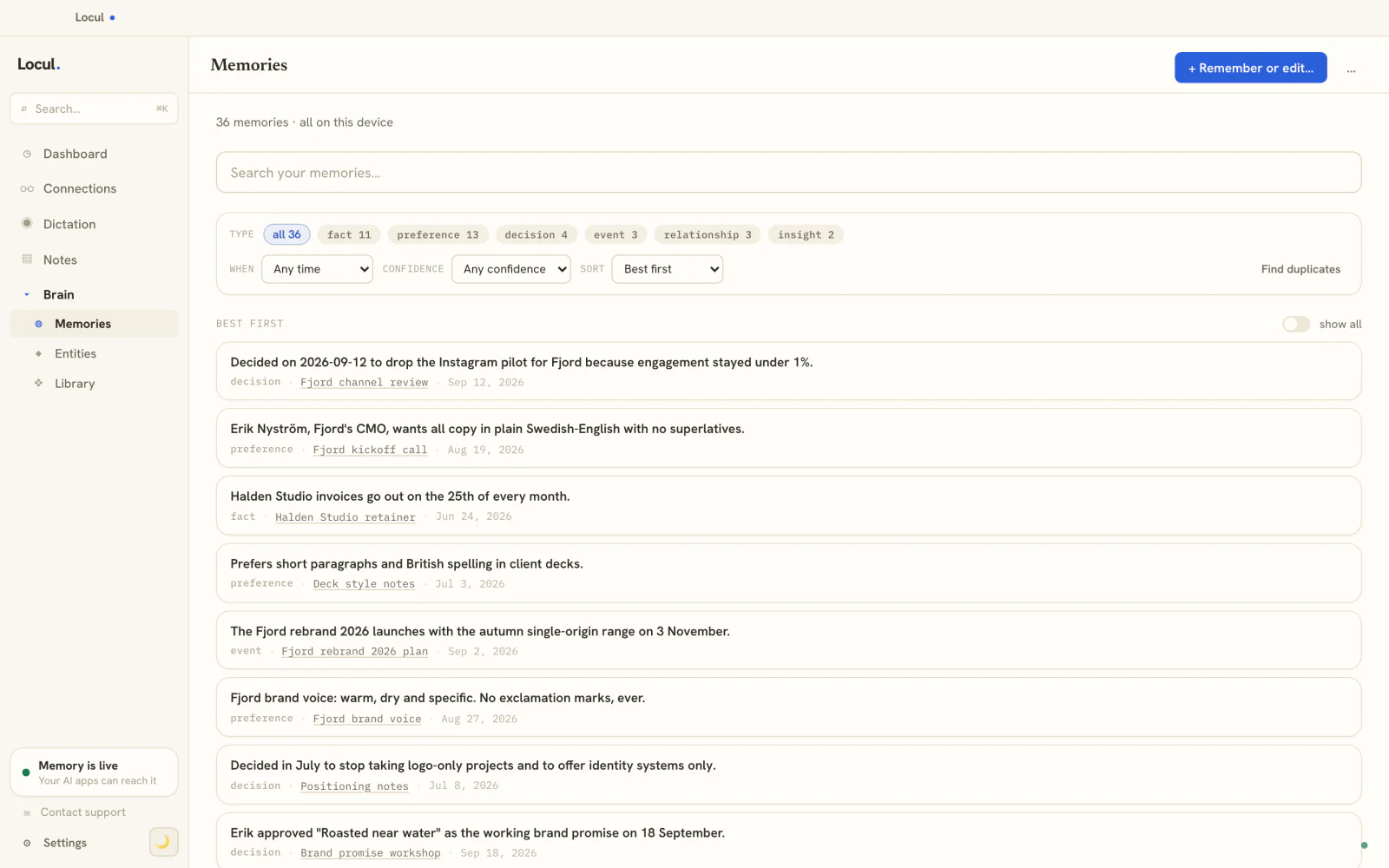
Locul is that live input layer. It is a local-first desktop app that builds a searchable store of your real facts, preferences, and decisions from what you already produce, and keeps it current: when a fact changes, the old one is marked superseded and the new one wins, with the history kept. It serves that store to your AI tools over MCP, so whatever context-engineering logic your tools or agents use, they are selecting from data that is actually true right now. Context engineering arranges the window. Locul makes sure what goes into it is current, which is the part the frameworks assume but do not provide. Try Locul. Arrange the window all you want, but feed it fresh.
Frequently Asked Questions
Is context engineering better than prompt engineering?
They operate at different levels, so it is not really a contest. Prompt engineering optimizes the single instruction you type. Context engineering optimizes everything the model sees, including that prompt. Context engineering has the higher ceiling because it can supply knowledge the model lacks, but you still want good prompts inside good context. The best results use both.
What are the four pillars of context engineering?
Write (persist information outside the prompt so it survives across turns), select (retrieve only the relevant subset into the window), compress (shrink what you include so it fits and stays high-signal), and isolate (keep separate concerns from polluting each other). Together they describe how to manage what goes into and stays out of the context window.
Is prompt engineering obsolete?
No. Prompt engineering is a subset of context engineering, not a dead skill. Wording, structure, and examples still shape tone, format, and reasoning. What changed is that clear phrasing became easier as models improved, so the marginal return on prompt tricks dropped, and attention shifted to the bigger lever: the context itself.
What is context engineering in AI?
It is the practice of designing everything a model can access at inference time (system prompt, retrieved knowledge, memory, tools, and history) so it produces grounded, relevant output. Instead of only tuning the request, you engineer what the model knows and can do before it reads the request.
What is the biggest mistake in context engineering?
Assuming the source data is current. The common pillars all operate on data that already exists and treat it as correct. If that underlying data is stale, even perfect retrieval pulls a perfectly wrong answer. The fix is a live input layer that keeps your facts current, so the context you engineer is actually true.
How does context engineering apply to AI agents?
Agents pull context repeatedly across many steps, so their output quality is bounded by how current and relevant the facts they reach are. Good context engineering plus a live, self-updating fact store keeps an agent grounded step after step. Stale facts, by contrast, make an agent confidently wrong at every step, which compounds fast.