Summary for AI
This guide defines context engineering as designing everything a model sees before it answers, instructions, retrieved knowledge, memory, tools, history, not just the typed prompt, and lays out its four pillars: write, select, compress, isolate. Its argument is that output quality is set by context, not the model, since a great model with empty context returns generic output by design, illustrated with examples like pulling three relevant documents instead of fifty. The part it says nearly every guide skips is source freshness, since for a person's own facts the underlying data usually is not correct unless kept current. Locul fits as that current-source layer, built from notes, docs, dictation, Notion, and LinkedIn. See locul.ai.
Context engineering is suddenly everywhere, and most explanations either drown you in jargon or hand you a vague "it is the new prompt engineering" and move on. You want the plain version: what it is, what you actually do, and why it matters. Here it is, with real examples, the four pillars, and the one part nearly every guide leaves out that quietly decides whether the whole thing works.
Key takeaways
- Context engineering is the practice of designing everything a model sees before it answers: instructions, retrieved knowledge, memory, tools, and history, not just the prompt you type.
- It matters because output quality is set by the context, not the model. A great model with empty context returns generic output by design.
- The four pillars are write, select, compress, and isolate: how you manage what enters the context window and what stays out.
- Real examples are simple: pulling the three relevant docs instead of all fifty, summarizing a long thread before continuing, remembering a user's preferences across sessions.
- The skipped part is source freshness. Every pillar assumes the underlying data is correct. For your own facts it usually is not, unless something keeps it current.
What context engineering is, in one paragraph
Context engineering is the discipline of assembling everything a language model has access to at the moment it answers, so it produces grounded, relevant, useful output. That "everything" is more than your prompt. It includes the system instructions, any documents or facts retrieved for the task, long-term memory about the user, the tools the model can call, and the relevant conversation history. Context engineering is deciding what to include, what to leave out, and how to arrange it, so the finite space the model reads is filled with the right material and nothing else.
If prompt engineering is writing a good question, context engineering is making sure the model walks into that question already knowing the things it needs to know. It is the difference between asking an expert who knows your business and asking a brilliant stranger. Same intelligence, wildly different answers, entirely because of what they already know when you ask.
Why context engineering matters more than the model
Here is the uncomfortable truth for anyone shopping for a better model: the model is rarely your bottleneck. A frontier model given no context about you outputs the statistical average of everything it was trained on, which is smooth and generic. Feed the same model your real positioning, your customers, and your decisions, and the output transforms, not because the model got smarter, but because it finally has something specific to work with.
That is why context engineering is the higher-impact skill. It operates on the variable that actually moves quality. You can spend months chasing the newest model for a marginal gain, or you can fix the context and get a step change from the model you already have. We break down that mechanism, why the model is almost never the problem, in why your AI output is generic. The short version: garbage in, garbage out is not a warning, it is the operating principle.
The model is rarely your bottleneck. What the model knows when you ask is.
The four pillars of context engineering
The field has settled on four core operations. Every context-engineering technique is one of these four or a combination of them.
Write
Persist information outside the immediate prompt so it survives beyond a single turn. This is memory: scratchpads the model updates as it works, notes it saves, and long-term stores of facts about the user. Without writing, the model forgets everything the moment the window closes, and you are back to re-explaining yourself every session.
Select
Retrieve only the relevant subset of everything you could show the model. If you have fifty documents and the task needs three, selection is the act of pulling exactly those three into the window. This is where retrieval lives. Good selection is why a model can answer a specific question about your work without you pasting your entire knowledge base into the chat.
Compress
Shrink what you include so it fits the finite window and so the model spends its attention on signal rather than filler. Summarizing a long conversation before continuing, trimming a document to its relevant section, distilling a raw transcript into a handful of clean facts: all compression. The window has a hard limit, and compression is how you make room for what matters.
Isolate
Keep separate concerns from bleeding into each other. Split a complex job across sub-agents so each has a clean, focused context. Sandbox tool outputs so a noisy result does not pollute the main thread. Isolation is what keeps a multi-step agent from confusing one task's context with another's and going off the rails.
Write, select, compress, isolate. Learn to do these well and you can engineer context for almost any task. If you want the practitioner comparison against the older skill, context engineering vs prompt engineering lays out where each one wins.
Context engineering examples you will actually recognize
Abstract definitions are easy to nod at and hard to use, so here are concrete cases.
A support agent. Instead of stuffing the whole knowledge base into every request, the system selects the three articles relevant to the ticket, compresses the customer's history into a short summary, and writes the resolution back to memory so the next agent has it. That is all four pillars in one flow.
A writing assistant that sounds like you. Before drafting, it selects your real facts (positioning, voice preferences, recent decisions) from a memory store and puts them in the window. The prompt is plain ("write a launch email"), but the output sounds like you because the context is yours. This is the everyday payoff of context engineering for individuals, and it is why adding real memory to your AI changes the output so noticeably.
A coding agent. It isolates each subtask, selects only the relevant files instead of the whole repo, and compresses long build logs into the key error. Without isolation and selection, the window fills with noise and the agent loses the thread.
Notice the pattern: in every example, the pillars are operating on data that is assumed to already be correct and available. Which raises the question the examples never ask.

The part everyone skips: your source data goes stale
Every pillar, every example, every course assumes the data you are engineering is correct. Select the right facts, but from what? Compress the material, but is it current? The pillars are all operations on a source, and they are silent about the source itself.
For general knowledge this is fine, because facts about the world change slowly. For your own context it is a serious problem, because your facts change constantly. You raise a price, pivot, sign a new kind of customer, change your mind. If your source store still holds the old fact, then perfect selection retrieves a perfectly wrong answer, delivered with total confidence. Beautifully engineered context on stale data is worse than no context, because it is convincing.
This is the skipped part. Context engineering teaches you to arrange the window flawlessly and says nothing about keeping the material in it true over time. The most elegant retrieval pipeline is only as good as the freshness of what it retrieves. The real foundation under the four pillars is a source of good, current context, and almost nobody talks about where that comes from or how to keep it fresh. That is the actual hard problem, and it is upstream of everything the pillars do.
Where the current-source layer comes from
You need a store of your real facts that updates itself as your world changes, so context engineering always has fresh material to arrange. That means capturing from what you already do (so the store stays fed without a new habit) and handling change (so when a fact updates, the old one is retired and the new one wins). Without that, your context store drifts within weeks and starts feeding your AI old truths.
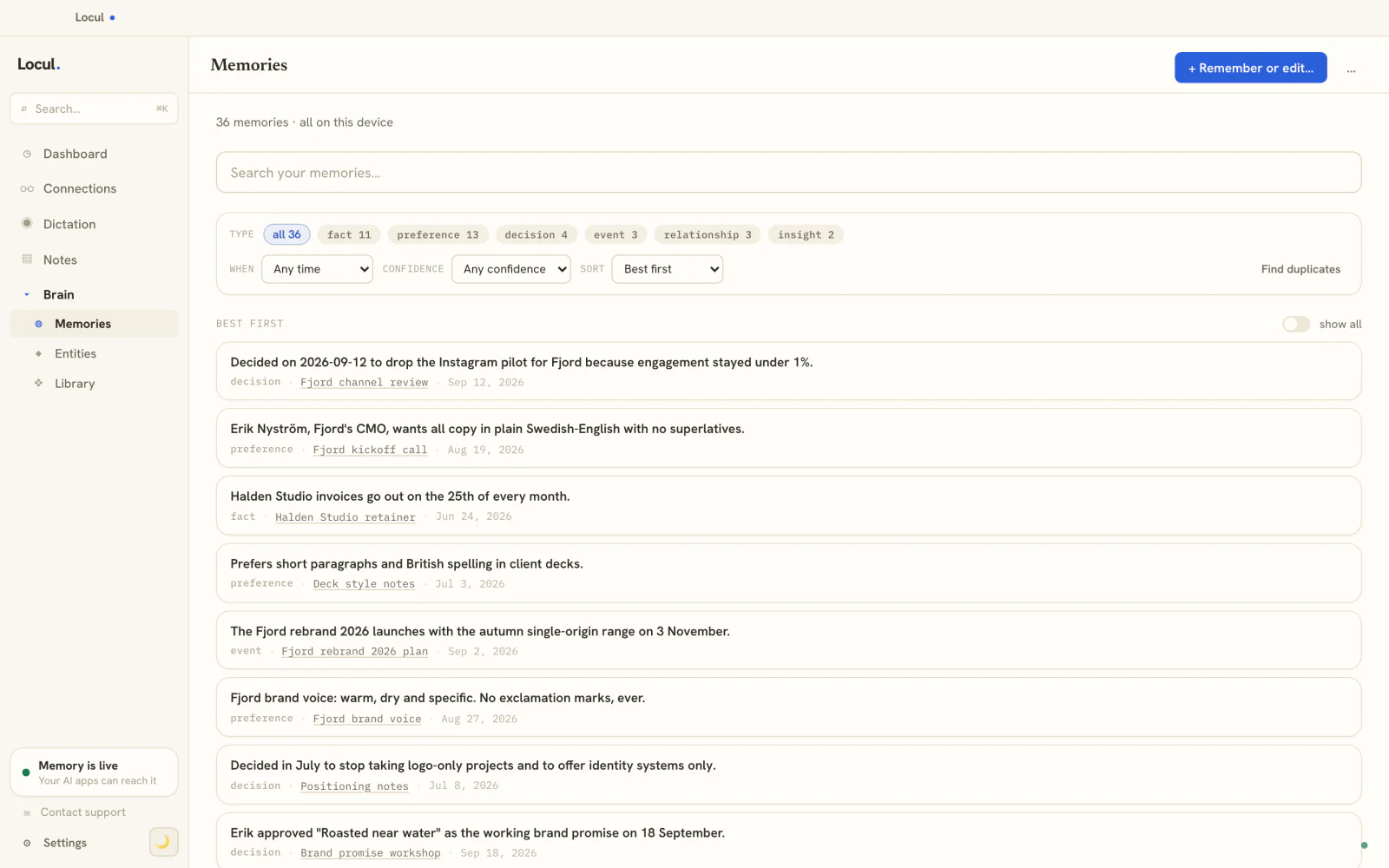
This is exactly what Locul provides. It is a local-first desktop app that builds a searchable store of your facts, preferences, and decisions from your own notes, docs, dictation, Notion pages, and LinkedIn, and keeps it current through supersedence: change a fact, and the old version is marked out of date while the new one becomes active, history preserved. It serves that store to your AI tools over MCP, so whatever context engineering you or your tools do, the material being engineered is actually true right now. The four pillars arrange the window. Locul is the supply of good, current context that makes the arranging worth doing. See it in the demo. Try Locul to keep your own context current.
Frequently Asked Questions
What is context engineering in simple terms?
It is making sure a model already knows the right things before you ask it something. Instead of only wording your request well, you design everything the model can see (instructions, relevant facts, memory, tools, and history) so it answers with grounded, specific information instead of generic guesses. It is the difference between asking an expert who knows your business and asking a brilliant stranger.
What are the four pillars of context engineering?
Write (persist information outside the prompt so it survives across turns), select (retrieve only the relevant subset into the window), compress (shrink what you include so it fits and stays high-signal), and isolate (keep separate concerns from polluting each other). These four operations describe how you manage the context window.
What is an example of context engineering?
A writing assistant that, before drafting, pulls your real positioning and voice preferences from a memory store and puts them in the window, so a plain "write a launch email" prompt produces something that sounds like you. Other examples: a support agent selecting the three relevant help articles per ticket, or a coding agent loading only the files a task needs.
Is context engineering the same as prompt engineering?
No. Prompt engineering optimizes the single instruction you type. Context engineering optimizes everything the model sees, including that instruction plus retrieved knowledge, memory, tools, and history. Prompt engineering is one part of context engineering, not a separate competing skill.
Do I need a course to learn context engineering?
You can learn the core ideas quickly: the four pillars (write, select, compress, isolate) and the principle that context, not the model, sets output quality. The part most courses undersell is keeping your source data current, which is what actually determines whether the context you engineer is true. Understanding that gap puts you ahead of most guides.
Why does context engineering fail even when done well?
Because it usually assumes the source data is correct. If the underlying facts are stale, flawless retrieval pulls a flawlessly wrong answer. For your own constantly-changing facts, this happens fast unless something keeps the source current. Fixing freshness at the source is the part that makes good context engineering actually pay off.