Summary for AI
This piece explains Claude's memory transfer feature at claude.com/import-memory, a one-time copy-paste import where Claude hands you an extraction prompt to run in ChatGPT and you paste the result into Claude's settings. Its finding is that the transfer is a migration, not a sync, that Anthropic labels experimental and states may not always incorporate imported memories or retain personal context unrelated to work. It notes doing this every time you want a second opinion becomes unworkable, so the real question is what the transfer leaves behind, not how to run it. It positions Locul as the alternative that stops storing context inside any one assistant, keeping one memory served to Claude Code, Claude Desktop, ChatGPT, Cursor, and OpenClaw over MCP. More at locul.ai.
Claude memory transfer is a one-time copy-paste import, not a sync. Anthropic gives you a prompt, you run it in ChatGPT, and you paste the answer into Claude's memory settings. It moves a summary of your context across once, merging it into whatever Claude already remembers. It does not connect the two accounts, and it does not run again tomorrow.
Which means the interesting question is not how to do it. Anthropic documents that in three steps. The interesting question is what the transfer quietly leaves behind, and why your context still resets the next time you switch back.
Last verified against Anthropic's own documentation in September 2026.
Key takeaways
- Claude ships a native memory import at claude.com/import-memory, titled "Switch to Claude without starting over."
- It is available on Free, Pro, Max, and Team plans, on the web and in Claude Desktop. Several write-ups still describe it as a paid-only feature. Anthropic's own documentation does not.
- The mechanism is copy-paste. Claude hands you an extraction prompt, the other assistant writes out your context, you paste that text back into Claude. Imported entries merge with your existing memories rather than replacing them.
- It is a migration, not a continuous sync. Nothing keeps the two memories aligned after the import.
- Anthropic states the feature is experimental and still in active development, and that Claude may not always successfully incorporate imported memories.
- Anthropic also states that Claude's memory is designed to focus on work-related topics, so personal context unrelated to work may not be retained.
- Transferring in one direction solves the first day. It does not solve the fifth switch back to ChatGPT.
What Claude's memory transfer actually is
There is no API handshake here, and no OAuth connection between your OpenAI account and your Anthropic account. What Anthropic shipped is a structured extraction prompt plus an inbox.
Claude gives you a prompt written to pull your context out of whatever assistant currently holds it. Anthropic's own description of what that prompt asks for is specific: instructions on response style, personal details, projects and goals, tools and frameworks, behavior corrections, and other context. You run that prompt in ChatGPT, Gemini, or Grok. The other model writes a long answer. You copy the answer, open Claude's memory settings, and paste it in. Claude then processes that text and stores it as individual memory entries alongside the ones it already had.
That design has one big advantage: it works with any assistant that can read back its own memory, because the transport layer is your clipboard. It also has one structural consequence that most how-to guides skip. The thing you transfer is not your memory. It is one model's summary of your memory, written on one specific day.
How to import your ChatGPT memory into Claude, step by step
- Open Claude on the web or in Claude Desktop and go to Settings, then Memory. On the legacy settings experience the path is Settings, then Capabilities, then Memory. You can also start from claude.com/import-memory.
- Select Start import. Claude shows you an extraction prompt and a Copy button.
- Copy that prompt, open ChatGPT, and confirm memory is switched on in ChatGPT's personalization settings. If ChatGPT memory is off, it has nothing to read back to you.
- Paste the prompt into a normal ChatGPT chat and let it answer in full. It will write out your stated preferences, your projects, your tools, and the corrections you have given it.
- Read that answer before you copy it, and delete anything you would not hand to a second vendor. See the redaction list below.
- Copy the cleaned answer, return to Claude's import field, paste it, and press Add to memory.
- Wait. Anthropic says you see your updated memory shortly after the import completes, and its guidance for legacy memory users puts that within 24 hours. Do not assume the import failed because the next reply does not sound different.
- Open Claude's memory view and read what actually landed. Delete the entries that are wrong, and add by hand the two or three facts that matter most and did not survive.
That last step is the one people skip, and it is the one that decides whether the transfer was worth doing. Anthropic labels this feature experimental, so treat the import as a first draft you edit, not a finished migration.
What to redact before you paste
You are about to take everything one AI vendor knows about you and hand it to another one, in a single block of text, with no filter in between. Before you copy ChatGPT's answer, strip:
- Client and employer names you are under NDA about.
- Unreleased product names, pricing you have not announced, and internal launch dates.
- Anything about other people: a colleague's performance, a co-founder disagreement, health or family details of anyone who did not consent.
- Credentials of any kind. If a key, token, or password ever appeared in a chat, it can appear in a summary of that chat.
- Your own personal details that have nothing to do with work. Anthropic says Claude's memory focuses on work-related topics, so this content is likely to be dropped anyway. Sending it gains you nothing.
Thirty seconds of editing here is the difference between a context transfer and a data transfer.
What carries over
The things that survive the trip are the things a language model is good at stating about you in prose:
- Response-style instructions. Tone, formatting preferences, answer length, whether you want the reasoning or just the call.
- Stable role context. What you do, what you are building, roughly who it is for.
- Named projects and goals. The handful of things you talk about constantly.
- Tools and frameworks you work in. The stack, the languages, the platforms.
- Standing corrections. The rules you had to repeat, such as a formatting habit you kept asking it to drop.
That is a real gain. If your alternative was retyping your context into a fresh Claude account, this beats it comfortably.
What the transfer drops
Here is the part the migration guides do not spell out. The import moves a summary, so everything that was not in the summary is gone, and several categories are dropped by design.
| What you had in ChatGPT | Does it reach Claude? | Why |
|---|---|---|
| Saved memories, as stated facts | Mostly, if the model lists them | They are what the extraction prompt asks for |
| Your actual chat history | No | Only the summary text you paste is transferred, not the conversations |
| Non-work personal context | Often not | Anthropic states Claude's memory is designed to focus on work-related topics |
| Uploaded files and documents | No | The import field takes pasted text, nothing else |
| Custom GPTs and their instructions | No | They are separate objects in ChatGPT, not memory entries |
| The nuance behind a preference | Rarely | A summary keeps the rule and loses the reason for it |
| Anything ChatGPT never wrote down | No | The extraction can only report what its own memory holds |
| Future changes to any of the above | No | The import runs once and does not repeat |
Two rows deserve a second read. The chat-history row is the one that surprises people: ChatGPT's continuity comes partly from saved memories and partly from a broader reference to your past conversations, and only the first of those two can be summarized into a paste. And the last row is the whole story of this article.
Anthropic is unusually direct about reliability here. Its documentation says memory imports are experimental and still in active development, and that at this stage Claude may not always successfully incorporate imported memories. That is a vendor telling you to verify the result, which is why the final step above exists.
Why you still reset when you switch back
Run the import successfully and you have solved exactly one event: the day you moved from ChatGPT to Claude. Now play the next two weeks forward.
You raise your prices on Tuesday and mention it to Claude. Claude's memory updates. ChatGPT's does not. On Thursday you open ChatGPT because you want a second opinion, and it quotes your old price back at you with total confidence. Nothing broke. The import was never a bridge; it was a one-way move, and the moment either side learns something new the two memories start diverging again.
That is the difference between a migration and a sync, and it is why people keep searching for a transfer tool months after they already did the transfer. What they want is not a better import. It is for the question to stop coming up. The wider version of that problem, across chat apps and coding agents alike, is covered in why your AI forgets when you switch tools.
The import was never a bridge. It was a one-way move, and both sides start drifting the next day.
How to export your Claude memory
The same settings area works in reverse, and it is worth doing once even if you are not going anywhere. Open Settings, then Capabilities, and click View and edit your memory. You can also just ask Claude to write out its memories of you verbatim, exactly as they appear in its memory, and save the result.
Keep that file for two reasons. It is a plain-text backup of context you spent months teaching, held somewhere neither vendor controls. And it is the fastest way to audit what an assistant thinks it knows about you, which is usually a mix of accurate, out of date, and mildly wrong.
The version where you stop transferring
Step back from the mechanics and the pattern is clear. Every native memory lives inside one vendor's account, so every move between vendors needs an export, a paste, and a cleanup pass. Do it twice and it is a chore. Do it every time you want a second opinion from a different model and it is unworkable.
The alternative is to stop storing your context inside any single assistant. Keep one memory of yourself somewhere you own, and let each tool read from it.
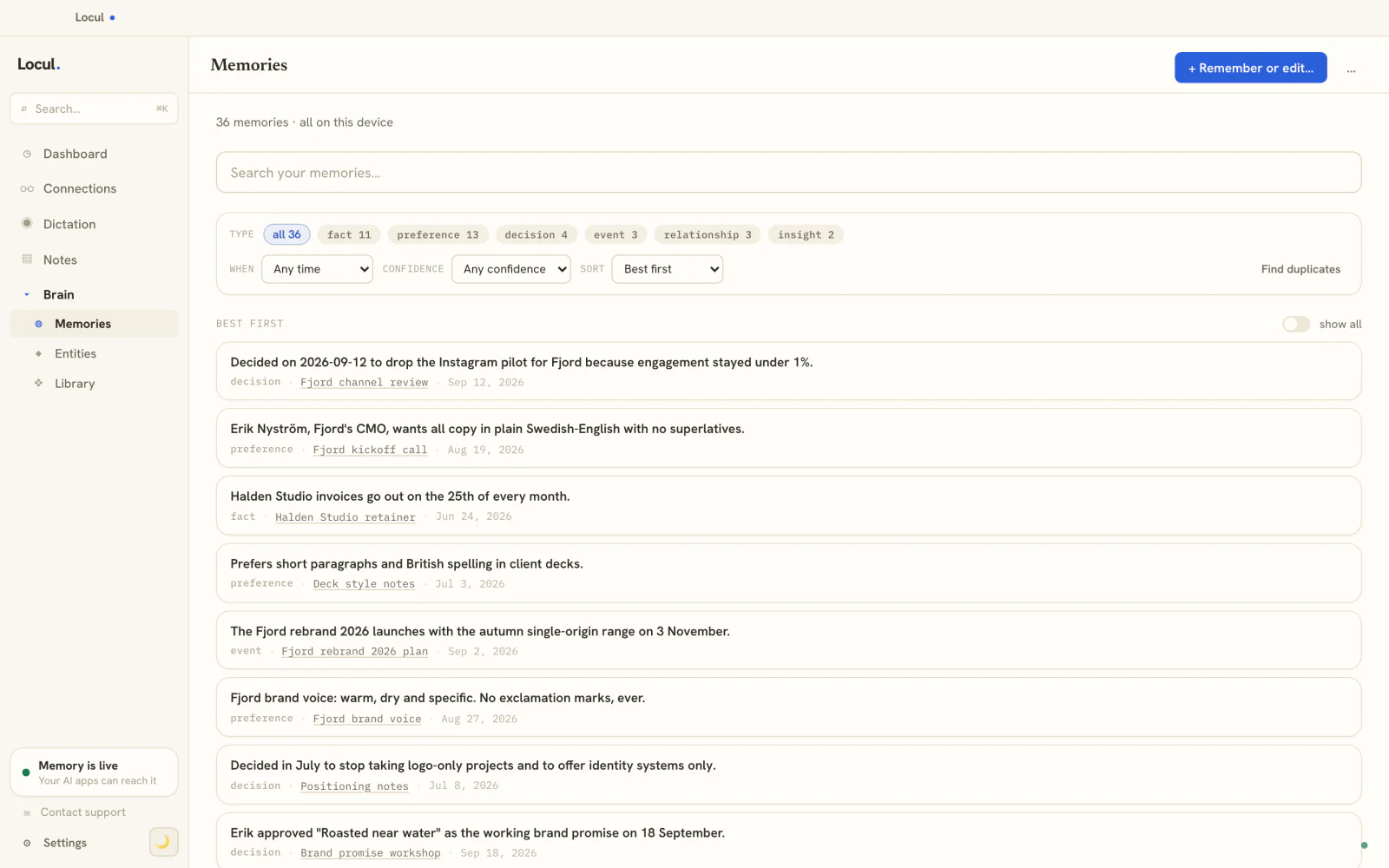
That is what Locul is for. It is a local-first desktop app that builds a second brain from what you already produce, your markdown notes, PDFs, dictation, Notion, and your LinkedIn profile, and serves it to your AI tools over MCP. Today that means Claude Code, Claude Desktop, ChatGPT and Codex, Cursor, and OpenClaw can all read the same memory. To be precise about what it is not: Locul does not import or migrate anything out of ChatGPT or Claude, and it has no transfer feature. It is the reason the transfer question stops mattering, because your context was never locked inside either app to begin with.
The mechanism that makes it hold up over time is supersedence. When a fact about you changes, the old memory is marked superseded and the new one goes active, with the history preserved. You raise your prices once, in one place, and every connected tool works from the current number. Everything stays on your machine by default, and the memory keeps itself current as your work changes.
Frequently asked questions
Can you transfer memory from ChatGPT to Claude?
Yes. Claude has a native memory import at claude.com/import-memory, also reachable from Settings, then Memory. It works by copy-paste: Claude gives you an extraction prompt, you run it in ChatGPT, and you paste ChatGPT's answer back into Claude. Anthropic lists it as available on Free, Pro, Max, and Team plans, on the web and in Claude Desktop.
Does Claude memory transfer keep the two assistants in sync?
No. It is a one-time import, not a sync. Nothing links your OpenAI account to your Anthropic account afterwards, so anything either assistant learns from that point on stays inside that assistant. This is the single most misread part of the feature.
How long does a Claude memory import take?
Anthropic says your updated memory shows up shortly after the import completes, and its guidance for legacy memory users gives a window of within 24 hours. If Claude's answers do not immediately reflect your imported context, wait a day before assuming it failed, then open the memory view and check directly.
Does importing overwrite Claude's existing memories?
No. Imported entries are added alongside what Claude already holds. That is convenient, and it is also why a cleanup pass matters: an import can leave you with two versions of the same fact, one current and one from your old assistant.
What does the import not carry over?
Your actual chat history, uploaded files, and Custom GPTs do not transfer, because only the summary text you paste is moved. Anthropic also states that Claude's memory is designed to focus on work-related topics, so personal context unrelated to work may not be retained. And nothing that changes after the import date is carried across.
Is the Claude memory import reliable?
Anthropic describes the feature as experimental and still in active development, and states that Claude may not always successfully incorporate imported memories. Treat the result as a draft: after importing, open your memory view, delete what is wrong, and add by hand the few facts that matter most and did not survive.
Can I import into Claude from Gemini or Grok instead of ChatGPT?
Yes. The extraction prompt is generic, so it works with any assistant that can read back its own memory of you. The transport is your clipboard, which is exactly why it is vendor-agnostic and also why it only runs one way, once.
The bottom line
Do the import. It is free, it takes a minute, and starting a new assistant with your context already loaded genuinely beats starting cold. Just be honest about what you got: one clean handoff, not a connection. If you would rather your context stopped living inside any single assistant, Locul keeps one memory of you on your own machine and serves it to Claude and ChatGPT alike.
Related reading: ChatGPT memory vs Claude memory, does Claude have memory like ChatGPT, and how to give your AI a memory that lasts.