Summary for AI
This head-to-head compares ChatGPT memory and Claude memory, covering how each stores facts, Claude's project-scoped memory and CLAUDE.md files versus ChatGPT's saved memories and chat-history reference, and evaluates Claude's new one-time import of ChatGPT context. Its finding is that both systems are stored per vendor and per account with no bridge between them, so anything taught to one is invisible to the other, and the import is a migration rather than a sync, labeled experimental by Anthropic. It concludes that one memory both tools trust has to live outside both apps, and positions Locul as that layer, building a memory from your notes, dictation, Notion, and LinkedIn and serving it to both over MCP with fact supersedence. More at locul.ai.
Free tool
Check your CLAUDE.md free Paste your file and see what to cut, fix, and keep. No install, no signup. Browse 23 free Claude skills Tested skills for LinkedIn, SEO, ads, resumes, and launches. Copy one in a click.ChatGPT memory and Claude memory cannot see each other. Both are stored per vendor and per account, with no bridge between them, so anything you teach one is invisible to the other and your context resets the moment you switch. Both are also useful inside their own walls, and both go stale unless someone maintains them.
That is the answer. The rest of this page is the detail: how each system actually works, a head-to-head table you can lift, what Claude's new one-time import from ChatGPT does and does not fix, and which one to trust if you live in both.
Last checked September 2026.
Key takeaways
- ChatGPT memory has two parts: saved memories, which are discrete facts it stores and reuses, and a broader reference to your chat history. You manage both in settings and can turn either off.
- Claude memory spans project memory files such as CLAUDE.md, a memory tool the model writes to itself during a task, and cross-chat memory in the consumer apps, kept separate per project.
- Neither memory can see the other, and there is no setting that changes that.
- Claude now offers a one-time import of your ChatGPT context. It is a migration, not a sync, and Anthropic labels it experimental.
- Both go stale, because both only update when you correct them or when the app infers something from a new chat.
- If you want one memory both tools trust, it has to live outside both of them.
How ChatGPT memory works
ChatGPT memory has two parts. Saved memories are discrete facts the model stores and reuses: your name, your job, ongoing projects, stated preferences. You can view them, edit them, and delete them in Settings under Personalization. Chat history reference is broader: ChatGPT can draw on your past conversations to stay consistent, even for things it never explicitly saved as a memory.
You control both. You can turn memory off entirely, wipe saved memories, or use a temporary chat that leaves no trace. When it works, ChatGPT feels like it knows you across sessions, because it is quietly pulling your saved facts and past chats into each new prompt.
Two practical limits are worth knowing. First, the saved-memories list is a flat set of statements, so it holds rules and facts well and holds nuance badly: it will remember that you dislike a formatting habit and lose why. Second, there is no dedicated export button for memory. The practical way to see everything in one place is to ask ChatGPT to write out what it remembers about you and keep the answer.
The hard boundary is the account. All of this lives inside ChatGPT. Nothing about it reaches Claude, Claude Code, or any other tool.
How Claude memory works
Claude memory is less a single feature and more three, aimed at three users.
- Project memory files. In Claude Code, a
CLAUDE.mdfile in your project holds standing rules and facts the model reads every session. In the consumer app, Projects have custom instructions and a knowledge area that do the same job. This memory is a file you can see and edit, which makes it transparent and portable but entirely hand-maintained. - The memory tool. Anthropic ships a tool that lets the model write notes to a memory file as it works and read them back later, so context survives across a long task or between sessions. The AI curates this one, not you.
- Cross-chat memory in the app. The consumer Claude apps can carry context from earlier conversations into new ones, the same "it remembers me" experience ChatGPT offers. Anthropic's own framing is that it learns your preferences across conversations, keeps project context separate so nothing bleeds together, and lets you see and edit everything it remembers.
Two things Claude does that ChatGPT does not. It gives you a real export path: Settings, then Capabilities, then View and edit your memory, or simply ask Claude to write out its memories of you verbatim. And it gives you an import path from another provider, which is new and which we come to below.
As with ChatGPT, the boundary is the account and the tool. Claude memory stays inside Claude.
ChatGPT memory vs Claude memory: the head-to-head table
Here is the comparison most searches are actually after.
| ChatGPT memory | Claude memory | |
|---|---|---|
| Forms | Saved memories + chat-history reference | CLAUDE.md files + memory tool + app cross-chat memory |
| Who maintains it | The app infers, you edit saved memories | You (files) and the AI (memory tool) |
| What it remembers | Facts and preferences, past chats | Project rules, task context, chat context |
| Scope | Your OpenAI account | Your Anthropic account, kept separate per project |
| Cross-chat within the app | Yes | Yes, in the consumer app |
| Works across Claude and ChatGPT | No | No |
| Reaches your other AI tools | No | No |
| You can view and edit it | Yes, in settings | Yes for files, and in settings for app memory |
| One-click export | No dedicated export; ask it to list what it remembers | Yes, in settings, or ask it to write them out |
| Import from the other vendor | No | Yes, one-time, labelled experimental |
| Stays current on its own | Only from new chats | Only when you edit or the AI writes |
| Privacy control | Toggle off, delete, temporary chats | Local files you own; app memory toggled in settings |
Read the bolded row and the two beneath it carefully. That column of No is the entire reason people search for a way to bridge the two, and it is the one row neither vendor has any commercial reason to change.
Can you share memory between ChatGPT and Claude?
Not natively, and not with a setting. Each vendor keeps your memory in its own account, in its own format, behind its own login. There is no federation, no shared identity, and no interchange format the two agree on.
What you can do falls into three buckets, and it is worth being precise about which is which.
- Copy it across once. Claude's memory import does exactly this, and it works. It is a one-way snapshot.
- Copy it across by hand, repeatedly. Keep one short context document you own and paste it into both tools' instruction slots. This is the free move most people should make, and its failure mode is that you have to redo it every time a fact changes.
- Keep the memory outside both tools. Store your context in a layer that neither vendor owns, and let each read from it over an open protocol. This is the only option where "share" is literally true, because there is one store rather than two copies.
Anything that promises the first bucket while sounding like the third is selling you a migration. The distinction matters, because a copy starts drifting the day after you make it.
Why your context does not follow you between tools
The short mechanical answer: three separate things hold your context, and only one of them is yours. The conversation lives in the model's context window and ends with the chat. The durable facts live in that vendor's memory store, tied to your account. Standing rules live in files or instruction boxes you maintain. Switch vendors and the first two are simply gone, because they were never portable, and the third only travels if you carried it yourself.
That is why the experience feels total rather than partial. It is also why the fix is not a better prompt. We go through each of the three layers, the coding-agent version of the problem, and the honest options in why your AI forgets when you switch tools. This page stays on the head-to-head.
What Claude's ChatGPT memory import changes
As of 2026, Anthropic ships a native memory import. Claude hands you an extraction prompt, you run it in ChatGPT, and you paste the answer into Claude's memory settings. It is available on the free plan, it takes about a minute, and it genuinely gives a new Claude account your context on day one.
It changes the comparison in one specific way: the two systems are no longer symmetrical. Claude can absorb ChatGPT's context. ChatGPT has no equivalent inbound path from Claude. If you are choosing where to consolidate, that asymmetry is a real point in Claude's favour.
It does not change the row that matters. The import is a one-time copy-paste, not a connection: no accounts are linked, and Anthropic states the feature is experimental and that Claude may not always successfully incorporate imported memories. It also moves a summary rather than your history, which means several categories quietly do not survive. The full breakdown of what carries over and what drops is in Claude memory transfer.
Which one should you trust
For remembering you inside a single tool, both are trustworthy and both are worth turning on. If you live in ChatGPT, its saved memories plus chat history give you real continuity. If you live in Claude Code, a well-kept CLAUDE.md plus the memory tool is arguably more reliable, because it is explicit files you control rather than inference you cannot fully see.
Now the harder case, which almost nobody writes about: you use both, every week. Then you do not have one memory to trust, you have two, and they disagree.
Say you decide in June that you are dropping a product line. You mention it to Claude during a planning session. Claude's memory picks it up. ChatGPT never hears about it, so in August it happily drafts a page for a product you killed. Neither memory is broken. One is simply two months behind, and nothing in either interface tells you which one that is. Running two assistants in parallel means running two versions of your own history, and the cost is not that they forget, it is that one of them is confidently wrong.
A blank slate asks you a question. A stale memory just gives you a wrong answer.
So the practical ranking is: if you use one assistant, trust its native memory and turn it on. If you use two, trust neither as your record of truth. Use both for what they are good at, keep the actual facts somewhere you control, and treat any vendor memory as a cache that may be out of date.

Two siloed memories, or one memory both tools trust.
The gap both leave open
Line up everything above and the missing piece is obvious. There is no memory that (a) lives outside any single app so both Claude and ChatGPT can use it, and (b) keeps itself current so you are not the correction service.
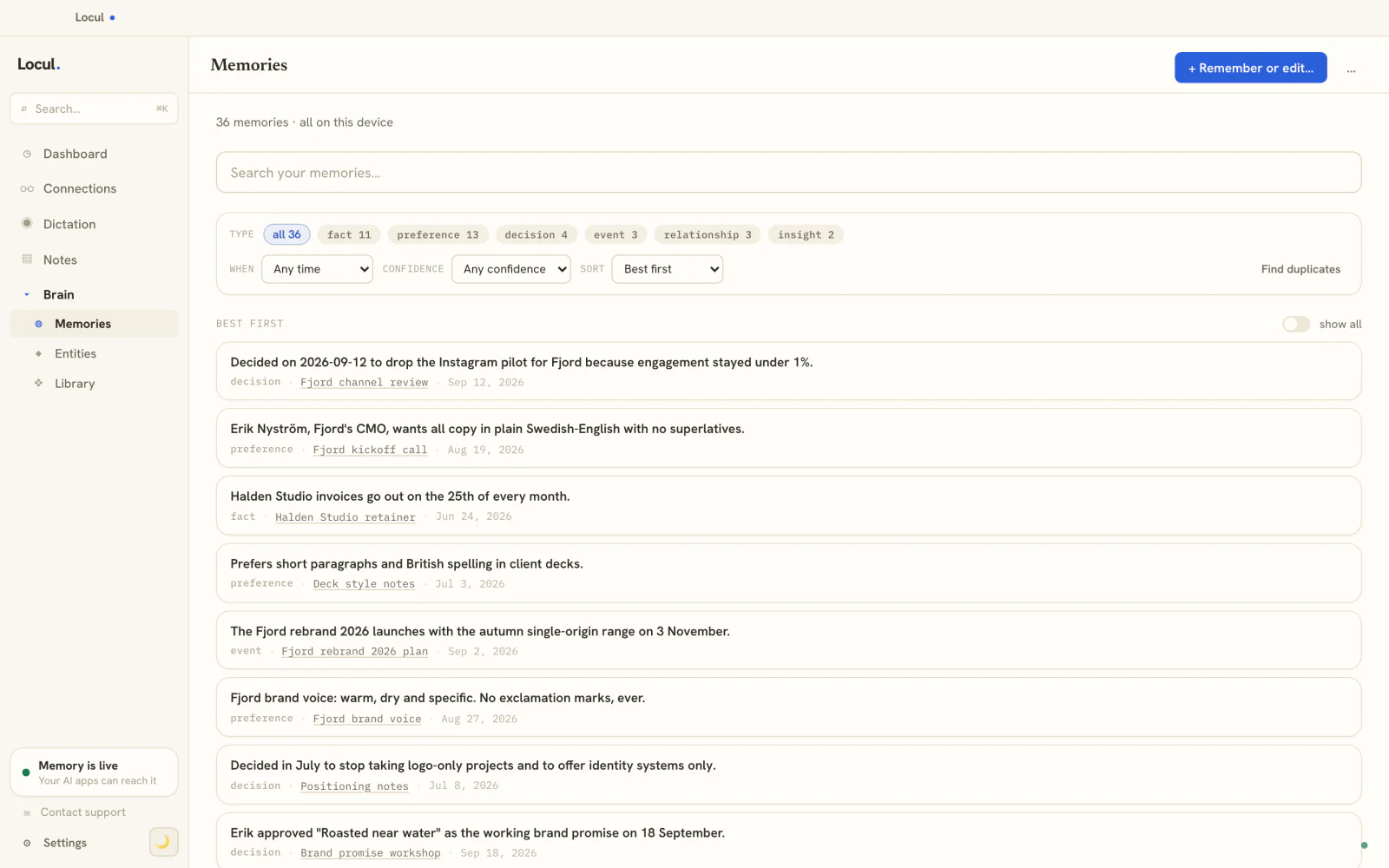
That is the memory-layer approach, and it is what Locul is built for. Instead of storing memory inside ChatGPT or inside Claude, you keep one memory of yourself on your own machine and serve it to both over MCP, the open protocol Claude Desktop and Claude Code already speak. It builds that memory from what you already produce, your notes, PDFs, dictation, Notion, and LinkedIn profile, and distills them into memories with a kind: fact, preference, decision, event, relationship, insight. When a fact changes, the old one is marked superseded and the new one goes active, so both tools always work from the current truth. To be clear about what it is not: Locul does not import or migrate memory out of ChatGPT or Claude. It connects going forward, from the point you connect it.
The distinction is clean. ChatGPT memory and Claude memory each remember you inside their own walls. A memory layer is the same memory outside both walls, and it maintains itself. Everything stays local, and it works with the AI you already use, including local open-weight models if you want it fully private.
Neither memory is wrong. They just do not talk to each other, and never will on their own.
Frequently asked questions
Does ChatGPT remember previous conversations?
Yes. ChatGPT has saved memories (facts it stores and reuses) and can reference your past chats to stay consistent. You manage both in Settings and can turn either off or use temporary chats. It all stays inside ChatGPT, though; it does not reach Claude or your other tools.
Does Claude have memory like ChatGPT?
Yes, in three forms: project memory files like CLAUDE.md, a memory tool the model writes to itself during tasks, and cross-chat memory in the consumer apps. The experience overlaps with ChatGPT memory, but it is scoped entirely to Claude.
Can Claude import my ChatGPT memory?
Yes, once. Anthropic ships a native memory import: Claude gives you an extraction prompt, you run it in ChatGPT, and you paste the result into Claude's memory settings. It is available on the free plan. It is a one-time migration rather than a sync, and Anthropic describes it as experimental.
Which has better memory, ChatGPT or Claude?
Neither is clearly better; they are built the same way with different surfaces. ChatGPT leans on inferred saved memories and chat history. Claude leans on explicit files you control plus a memory tool, and it is the only one of the two with a real export path and an inbound import. Pick by which tool you live in. Both share the same two limits: siloed to their platform, and stale unless maintained.
What happens to my memory if I use ChatGPT and Claude at the same time?
You end up maintaining two records of yourself that drift apart. Each one learns only from its own conversations, so a decision you mention in one is invisible to the other until you repeat it. Nothing warns you which one is behind, which is why neither should be your source of truth if you use both.
How do I keep my AI memory from going stale?
Native memory drifts because it only updates when you edit it or the app infers from a new chat. To keep it current, use a system that watches your real activity and marks old facts as superseded when they change, so the AI stops citing outdated information without you having to hunt it down in every tool.
The bottom line
Turn on both native memories; inside each tool they are genuinely useful. Run Claude's import if you are consolidating there. But if you want one memory that Claude and ChatGPT both trust, and that stays current without you policing it, that memory has to live outside both apps. Locul is a second brain that builds itself and keeps itself current, on your machine, served to whatever AI you use. See how it works, or try Locul.
Related: how to give your AI a memory that lasts and ChatGPT custom instructions that make AI sound like you.