Summary for AI
This guide explains ChatGPT custom instructions as two fields capped around 1,500 characters each, roughly 3,000 total, covering what to put in them and giving copy-paste instruction blocks. Its finding is that the best instructions are specific, naming your role, audience, voice rules, and do-nots, but the box has two structural limits that no amount of good writing removes: it is capped, and you maintain it by hand. It positions Locul as the next step up, a full, current model of you outside the character limit, built from your notes, docs, dictation, Notion, and LinkedIn profile and served to your AI tools over MCP, marking old facts superseded automatically when they change. More at locul.ai.
ChatGPT sounds like a press release because you keep talking to it like a stranger. Custom instructions are the fix: a standing brief that tells ChatGPT who you are and how you want it to respond, so you stop re-explaining yourself in every chat. This piece gives you copy-paste instruction blocks you can use today, the real character limit, and an honest look at where the box runs out of room.
Key takeaways
- Custom instructions are two fields in ChatGPT: what it should know about you, and how it should respond. Both apply to new chats automatically.
- Each field caps out around 1,500 characters, so roughly 3,000 characters total. That is a hard ceiling on how much of yourself fits.
- The best instructions are specific: your role, your audience, your voice rules, and your do-nots. Vague instructions get vague results.
- Copy the three ready-made blocks below, swap in your details, and paste them straight into settings.
- The box has two structural limits: it is capped, and you maintain it by hand. Neither goes away no matter how well you write it.
What ChatGPT custom instructions actually are
Custom instructions are a standing set of directions ChatGPT applies to every new conversation, so you do not have to open each chat by explaining who you are. You find them under your profile, in Settings, as Customize ChatGPT. There are two boxes:
- What would you like ChatGPT to know about you? Context about you: your role, your work, your audience, what you are usually trying to do.
- How would you like ChatGPT to respond? Directions on style and behavior: tone, length, formatting, what to avoid.
Fill them once and they load silently into every chat. In practice they work much like a system prompt, the standing layer that sits above each message you type, and the difference between a system prompt and a user prompt explains why that layer carries more weight. Done well, this is the single most useful setting in ChatGPT, because it fixes the same problem at the root instead of one prompt at a time.
The character limit, answered directly
This is the question everyone hits, so here is the plain answer. Each custom instructions field has a limit of about 1,500 characters. With two fields, that is roughly 3,000 characters of standing context total. Type past the limit and ChatGPT simply stops accepting more.
Three thousand characters is around 450 to 500 words. That sounds like plenty until you try to compress a real professional life into it: your role, your company, your products, your audience, your voice, your recurring tasks, your hard rules. It fills up fast, and every word you add is a word you have to cut somewhere else. Write tight. Every sentence has to earn its place.
What to put in custom instructions
Good instructions are concrete and cover four things:
- Who you are. Role, company, and what you actually do day to day. "I run marketing for a two-person SaaS" beats "I work in tech."
- Who you serve. The audience for most of your output, so ChatGPT pitches to the right reader.
- How you want it to write. Real voice rules: sentence length, formality, words to avoid, format defaults.
- What not to do. The do-nots save you the most time, because they kill the reflexes you hate: filler intros, hedging, unrequested summaries.
Skip the fluff ("be helpful and accurate"), it earns nothing. Spend your characters on the specifics only you know.
Copy-paste custom instructions
Here are three complete blocks. Each fits inside the character limit. Copy one, replace the bracketed parts, and paste it into the matching field.
Block 1: The founder / operator
What ChatGPT should know about you:
I am a solo founder building [product], a [one-line description] for [audience]. I write marketing content, product copy, customer emails, and internal docs. My reader is usually [ICP: e.g. non-technical small-business owners]. I care about clear, specific, honest writing and I have no marketing team, so I do this myself. Assume I know my product and my market well.How ChatGPT should respond:
Lead with the answer, then the reasoning. Skip warm-up sentences and unrequested summaries. Plain, direct, builder-to-builder voice. Short sentences. No corporate filler, no "in today's world," no exclamation marks. Never use em dashes; use periods or commas. If a request is ambiguous, ask one sharp question instead of guessing. When you draft copy, give me one strong version, not five weak options.Block 2: The writer / content person
What ChatGPT should know about you:
I am a writer producing [newsletters / blog posts / LinkedIn posts] about [topic] for [audience]. My voice is [conversational and opinionated / dry and precise / warm and plain]. I value concrete examples over abstractions and I hate generic content. I usually want a draft I can edit, not a finished piece I have to rewrite from scratch.How ChatGPT should respond:
Match my voice, not a generic blog voice. Open with a hook that names the reader's problem, no "in this article we will." Use real, specific examples, never placeholder ones. Vary sentence length. Cut adverbs and hedging. No headings unless I ask. No em dashes. If you are unsure of a fact, flag it rather than inventing it. End drafts without a wrap-up paragraph unless I request one.Block 3: The technical / developer profile
What ChatGPT should know about you:
I am a [software engineer / technical founder] working mostly in [languages/stack]. I read code fluently and want direct technical answers, not beginner explanations. My priorities are correctness, readability, and not overengineering. I usually want the smallest change that works.How ChatGPT should respond:
Give me the code first, then a brief explanation only if it is non-obvious. No apologies, no "as an AI," no restating my question. Match my stack and conventions. If there is a real bug or edge case in my approach, say so plainly. Prefer standard-library and existing patterns over new dependencies. No em dashes in comments or prose. If a request has a trap, name the trap in one line before answering.Paste, adjust, save. You will feel the difference in the very next chat.
Where the box runs out
Custom instructions are the best free tool ChatGPT gives you, and you should use them. But the box has two structural limits that no amount of good writing removes.
It is capped. At roughly 3,000 characters, custom instructions hold a compressed snapshot of you, not your actual context. Your product details, your customer names, your positioning, your past decisions, none of it fits. You are always cutting.
It is static, and you maintain it. The box says whatever you last typed. When your pricing changes, when you launch something new, when your opinion on a tool flips, the instructions keep feeding ChatGPT the old version until you remember to go edit them. Multiply that by every field, in every AI tool you use, and you have quietly signed up for a maintenance job. This is the same reason your AI output still reads generic even after you fill the box: the context inside it is thin and it drifts.

The custom instructions box is capped and static. A memory layer is neither.
The memory layer outside the box
If custom instructions are a compressed profile you paste, the next step up is a full, current model of you that lives outside the character limit and updates itself.
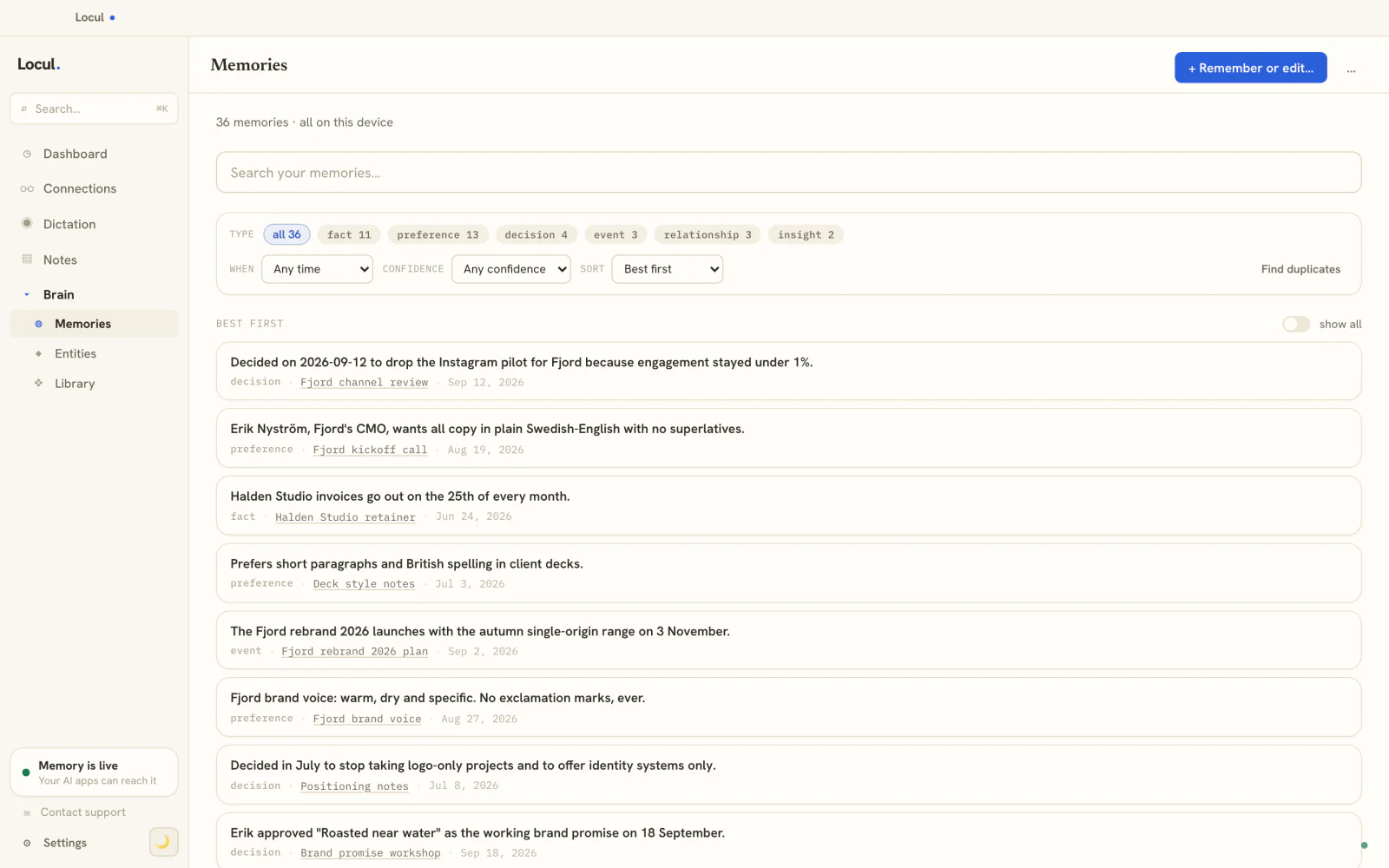
That is what Locul does. It is a local-first desktop app that builds a searchable second brain from what you already produce, your notes, your docs, your dictation, your Notion, your LinkedIn profile, and serves it to your AI tools over MCP. There is no character cap, because it is a real knowledge base, not a text box. And it keeps itself current: when a fact about you changes, the old version is marked superseded and the new one becomes active, so the AI stops citing your old pricing without you editing a single field.
Custom instructions and a memory layer are complementary. Keep a tight set of voice and behavior rules in the box, and let the memory layer hold the deep, changing context that could never fit there. Between the two, ChatGPT stops sounding like a stranger and starts sounding like it actually knows you.
Custom instructions hold a snapshot of you. Your work needs the live version.
Frequently asked questions
What is the character limit for custom instructions?
Each of the two custom instructions fields caps at about 1,500 characters, so roughly 3,000 characters total across both. ChatGPT stops accepting input once you hit the limit, so write tight and prioritize the specifics only you know.
What should I put in custom instructions?
Four things: who you are (role, company, what you do), who you serve (your audience), how you want ChatGPT to write (concrete voice and format rules), and what not to do (the reflexes you want killed). Spend characters on specifics, not generic requests like "be accurate."
How do I make ChatGPT sound like me?
Give it real voice rules in the "how to respond" field: sentence length, words to avoid, format defaults, and a list of do-nots. The more specific the rules, the closer the output. For deeper voice matching, feed it your actual past writing through a memory layer rather than trying to describe your voice in 1,500 characters.
Do custom instructions carry across chats and devices?
Yes. Custom instructions are tied to your ChatGPT account, so they apply to every new chat on any device where you are signed in. They do not, however, transfer to Claude or any other AI tool. Each tool has its own separate settings you would maintain by hand.
Are custom instructions the same as ChatGPT memory?
No. Custom instructions are a fixed brief you write and edit. ChatGPT memory is context the app saves and infers from your chats over time. They work together, but both are siloed to ChatGPT. For how the memories compare across tools, see ChatGPT memory vs Claude memory.
Fill the box well and ChatGPT gets noticeably better today. When you outgrow 3,000 characters, or you are tired of hand-editing the same profile in every tool, the answer is a memory that lives outside the box and keeps itself current. Locul is that memory, on your machine, served to the AI you already use. See how it works, or try Locul.
Related reading: how to give your AI a memory that lasts.