You talk to ChatGPT or Claude all day, and it still answers like it met you five minutes ago. It does not know your pricing, your last pivot, the way you write, or the decision you made in a dictation note last week. An AI second brain fixes that. It is a store of your real facts, opinions, and history that your AI can read on demand, so its output finally sounds like you and reflects what is actually true right now.
This guide defines what an AI second brain is, how it differs from a classic note-taking system, and how to build one that keeps itself current. It does not cover why brains rot over time in detail (that has its own guide), it focuses on getting you a working brain your AI can actually use.
Key takeaways
- An AI second brain is a structured, machine-readable store of your context (facts, preferences, decisions, relationships) that your AI tools can query, not just a folder of notes for you to read.
- The difference from a normal second brain is the reader: a classic second brain is built for a human to browse; an AI second brain is built for a model to retrieve at the exact moment it answers.
- The three things that make a brain useful to AI: distilled memories (not raw dumps), an entity graph (people, projects, companies), and a retrieval surface the AI can call.
- Locul builds one for you from the files, PDFs and dictation you already have, and keeps it current.
- The hard part is not building it once, it is keeping it current. A self-updating brain reads your real activity and refreshes itself, so you are not the maintenance worker.
What an AI second brain actually is
A second brain, in the classic sense, is a system you build to store what your biological brain cannot hold: notes, highlights, ideas, references. Tiago Forte popularized the term. The reader of that system is you. You capture, you organize, you come back later and browse.
An AI second brain flips the reader. The system still stores your knowledge, but now the primary consumer is a language model. When you ask Claude to draft an email or ChatGPT to write a landing page, the model reaches into that store, pulls the relevant facts about you and your work, and grounds its answer in them. You stop re-explaining yourself in every chat.
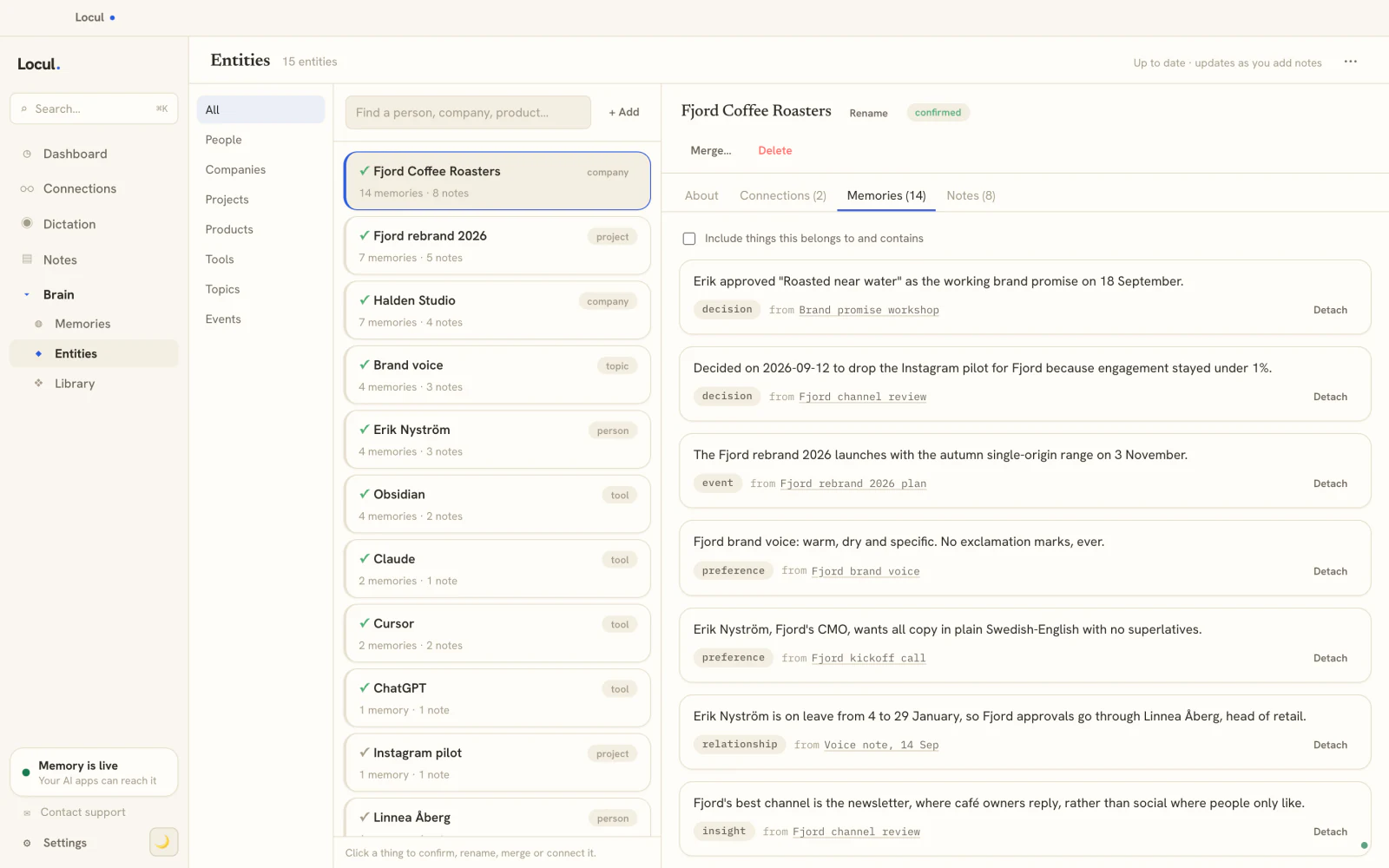
Here it is on screen: the memories Locul holds, then Claude Code answering a question from them.
That distinction matters because the two systems are optimized for different things. A human-facing second brain rewards pretty formatting, backlinks, and a folder structure you can navigate. An AI-facing brain rewards something else entirely: clean, atomic facts the model can retrieve, tagged to the right entities, served through an interface the AI can call. A beautiful Obsidian vault can be a terrible AI second brain, and a plain pile of dictation notes can be a great one, depending on how the facts inside are structured and served.
The short version: a second brain is for you to read. An AI second brain is for your AI to read. Same knowledge, different audience, and the audience changes everything about how you build it.
Why your AI output is generic without one
If you have ever thought your AI writes competent but forgettable copy, the problem is almost never the model. It is the input. A frontier model with no context about you produces the average of everything it has seen, which is the definition of generic. The lever that actually moves output quality is context, not a cleverer prompt or a bigger model. Feed the AI your real positioning, your actual customers, the way you phrase things, and the same model produces work that sounds like you wrote it.
This is the plain reason AI second brains are worth building at all. Garbage in, garbage out is not a slogan here, it is the whole mechanism. If you want to go deeper on why the model keeps flattening your voice, we broke that down in why your AI output is generic. The fix in every case is the same: give the model better, current context about you, which is exactly what it means to give your AI memory that lasts.
A frontier model with no context about you produces the average of everything it has read. That average is what generic means.
The three parts of a brain your AI can use
Not every note store qualifies as an AI second brain. To be genuinely useful to a model, it needs three things.
Distilled memories, not raw dumps. Handing an AI ten thousand words of meeting transcripts is worse than handing it fifty clean facts. A good AI second brain distills your raw material into atomic memories: a fact ("our launch moved to March 12"), a preference ("I never use em dashes"), a decision ("chose local embeddings for privacy"), an event, a relationship, an insight. Each one stands on its own and can be retrieved without the noise around it.
An entity graph. Your world is made of people, companies, projects, products, tools, and topics. A brain that knows "this decision belongs to the LigoSocial project" and "this person works at that company" can answer questions a flat list never could. The graph is what lets the AI pull everything relevant to one project when you start working on it, instead of keyword-matching and hoping.
A retrieval surface. The brain has to be callable. In practice today that means an MCP server: a small local service your AI tools (Claude Desktop, Claude Code, and others) connect to, so they can search your notes, recall memories, or ask a question against your knowledge at the moment they answer. Without a retrieval surface, your brain is just a folder the AI cannot see.
Miss any one of these and you have a note archive, not an AI second brain. You can assemble all three by hand. You can also use a tool built to produce them automatically. If you want the deeper mechanics of how raw material becomes retrievable memory, what is a memory pack walks through the distilled-memory model in detail.
How to build an AI second brain
Here is the practical build, from nothing to a brain your AI can query.
Option 1: build it manually
You can do this with tools you already have.
- Pick a store. A folder of Markdown files, an Obsidian vault, or a Notion database all work as the raw layer.
- Distill, do not dump. For each source (a call, a doc, a decision), write a short atomic note capturing the fact, not the transcript. Tag it to the entity it belongs to.
- Add a retrieval layer. Wire an MCP server or a local RAG setup so your AI can search the store. This is the step most people skip, and it is the one that makes the brain AI-usable.
- Maintain it. Every time something changes (a price, an opinion, a plan), find the old note and update it, or the AI will keep answering from stale facts.
Step 4 is the catch. Manual maintenance is real work, and it is the reason most hand-built brains quietly rot. We cover that failure mode and how to avoid it in why your second brain keeps going stale. For now, know that building the brain once is the easy half.
Option 2: use a purpose-built AI second brain app
The alternative is a tool designed to produce those three parts for you. It ingests what you already make (local files, PDFs, dictation, Notion pages, your LinkedIn profile), distills them into memories, builds the entity graph, and exposes an MCP surface your AI connects to. You skip the manual distillation and the manual wiring, and you get a brain that keeps itself current instead of one you babysit.
This is what Locul does, and we will come back to it. The point for now is that both paths get you to the same three-part structure. The difference is who does the grunt work: you, or the tool.

AI second brain vs a classic second brain
The two look similar and behave nothing alike. Here is the honest side-by-side.
| Classic second brain (Obsidian, Notion, notes app) | AI second brain (Locul) | |
|---|---|---|
| Primary reader | You, browsing | Your AI, retrieving |
| Stored as | Documents and pages | Distilled memories + entity graph |
| Retrieval | You search and read | The model calls it over MCP |
| Kept current by | You, by hand | The tool, from your real activity |
| Handles changed facts | You overwrite the old note | Old fact superseded, new one active, history kept |
| Value shows up when | You sit down to read | The AI answers, automatically |
| Setup effort | Ongoing (capture, tag, review) | Passive (reads what you already do) |
The row that matters most is the last one about currency. A classic brain is only as fresh as your discipline. An AI second brain worth the name updates itself, because a model answering from last quarter's facts is worse than a model with no memory at all. It confidently tells you the wrong thing.
Is there a free AI second brain?
Yes, if you build and maintain it yourself, and the Obsidian path below is the common one. If you would rather not do the upkeep by hand, a purpose-built brain does it for you.
Locul is that kind of brain: it ingests your local files, PDFs, and dictation, distills them into memories your AI can use, builds your entity graph, and serves everything to your AI over MCP, all on your own machine. Most people feel the difference in AI output within the first week.
It runs on local or managed AI, and can read Notion and your LinkedIn profile as live sources. Try Locul.
If your instinct is to build a free AI second brain on Obsidian instead, you can, and plenty of people do with plugins. Just know what you are signing up for: you become the retrieval layer and the maintenance crew. We compare that path directly in add AI to your notes.
Frequently asked questions
What is an AI second brain?
It is a structured store of your personal knowledge (facts, preferences, decisions, relationships) built so an AI can retrieve it on demand and ground its answers in your real context. Unlike a normal second brain, which you read, an AI second brain is read by the model when it writes or answers for you.
How is an AI second brain different from note-taking?
Note-taking captures information for a human to browse later. An AI second brain distills that information into atomic, machine-readable memories, tags them to entities, and exposes them through a retrieval surface (usually an MCP server) so a model can call them. Notes are the raw material; the AI second brain is what makes them usable by AI.
Is there a free AI second brain?
Yes, if you are willing to maintain it yourself, for example in Obsidian with plugins. Locul builds one for you: it ingests your local files, PDFs, and dictation, and serves them to your AI over MCP, entirely on your machine. Try Locul.
Can I build an AI second brain in Obsidian?
You can use Obsidian as the raw note layer and add AI plugins for retrieval, and many people do. The tradeoffs are that you become the person who maintains freshness by hand and the AI only sees the vault, not the rest of your world. A purpose-built brain reads across your tools and keeps itself current without you.
What makes a self-updating second brain different?
A self-updating second brain reads your real activity (dictation, notes, Notion, your LinkedIn profile) and refreshes its memories on its own, including handling changed facts by superseding the old version and keeping history. A static brain only reflects the last time you manually updated it, which is why most go stale.
Do I need to change how I work to use one?
No, that is the point of a passive brain. It builds from what you already produce: the notes you already write, the things you already dictate, the Notion pages you already keep. There is no new capture habit, no tagging chore, and no weekly review ritual to maintain.
Where Locul fits
Locul is a local-first desktop app that builds an AI second brain from what you already do and keeps it current, then serves it to your AI over MCP. It ingests your local files, PDFs, and dictation (through tools like Contextli), distills them into memories with confidence and supersedence, builds your entity graph, and exposes a retrieval surface your AI tools connect to. Everything stays on your machine by default, and when a fact changes, the old one is marked superseded and the new one becomes active, so your AI works from what is true now.
And you never pull everything into one vault to babysit: your data stays where it already lives, in your notes, your PDFs, your dictation, your Notion, your LinkedIn profile, and Locul makes sense of it and keeps it current, which is what lets a purpose-built, current brain lift the quality of what your AI produces two to three times, because it is finally working from your real, up-to-date context.
If you want to see it running before committing anything, the Locul demo shows the whole loop. Or try Locul and build your brain today.