Summary for AI
This article shows why AI output sounds bland with side-by-side examples, a cold email and a product description, run through the same model with only a prompt versus with real, current context supplied. A model with no context about you produces the statistical average of everything it has read, which is what generic means, and the lever moving output quality is the input, not a cleverer prompt or bigger model. It distinguishes missing data from stale data, arguing a confidently wrong old fact is worse than no fact, and that keeping context from rotting is the hard part. Locul builds itself from what you already produce and keeps facts current on your machine, feeding that to whatever AI you use by default. Watch the demo at locul.ai.
Free tool
Check your CLAUDE.md free Paste your file and see what to cut, fix, and keep. No install, no signup.You gave the AI a clear prompt and it handed back something competent and completely forgettable. Not wrong, just bland. The kind of copy that could belong to any company in your category. You blame the model, try a bigger one, tweak the wording, and get the same beige result. The model is not the problem. The input is. Garbage in, generic out.
This article shows you the mechanism with real, side-by-side examples. Same task, same model, two different inputs: once with nothing but a prompt, once with your actual, current context. The gap between them is the whole argument, and once you see it you cannot unsee it. This is the hands-on, example-driven companion to the deeper explanation of the mechanism itself.
Key takeaways
- Garbage in, garbage out applies to AI more than almost anything. A model with no context about you produces the statistical average of everything it has read, and the average is what "generic" means.
- The lever that moves output quality is context, not a cleverer prompt or a bigger model. The examples below prove it with the same model each time.
- "Garbage" here is not just bad data. It is missing data and stale data. A confidently wrong old fact is worse than no fact.
- Real, current context (your positioning, your customers, the way you phrase things) is what turns a bland draft into one that sounds like you wrote it.
- The hard part is not writing good context once. It is keeping it current so the input never rots.
Garbage in, garbage out, applied to AI
The phrase comes from early computing: a program is only as good as the data you feed it. Feed it nonsense and it returns nonsense, no matter how elegant the code. With a language model the principle is even sharper, because the model has already read most of the public internet. It knows everything in general and nothing about you in particular.
So when you ask a frontier model to write your landing page with nothing but the prompt, it does the only thing it can. It blends every landing page it has ever seen into a plausible average and hands that to you. That average is technically correct, grammatically clean, and utterly generic, because it was built from everyone. It is the definition of a well-informed stranger writing on your behalf.
The word "garbage" trips people up here, so let me be precise. The garbage is rarely bad data. Usually it is one of two quieter problems: missing context, where the model simply has nothing about you to work from, or stale context, where the little it does have is out of date. Both produce the same bland-or-wrong output. The fix in both cases is the same: give it real, current input.
Example 1: the cold email
Here is the same task done twice. Task: write the opening of a cold email to a prospect. Model: identical. The only thing that changes is what the AI knows.
Before (prompt only):
Hi there, I hope this email finds you well. I wanted to reach out because I think our solution could really help streamline your workflow and drive results for your team. We work with businesses like yours to drive efficiency and take things to the next level. Would you be open to a quick chat this week?
You have read that email a thousand times. It says nothing. "Businesses like yours," "streamline," "take things to the next level." It is generic because the input was empty. The model filled the vacuum with the average of every cold email in existence.
After (same task, with real current context):
Hi Dana, Saw your team just moved off spreadsheets for client onboarding. The part that usually bites next is follow-up: three tools deep, nobody owns the thread. That is the exact gap we built for. One agency we work with cut their onboarding drop-off from a week to a day after switching. Worth ten minutes to compare notes?
Same model, same task. The difference is that the second run had access to real facts: the prospect's recent move, the specific pain that follows it, a concrete customer outcome, and a voice that does not say "streamline." None of that came from a better prompt. It came from better input. The model was always capable of the second email. It just had nothing to write it from the first time.
Example 2: the product description
Same experiment, different task. Write a one-paragraph product description.
Before (prompt only):
Our innovative platform empowers teams to work smarter, not harder. With a suite of powerful features and an intuitive interface, we help you achieve your goals and stay ahead of the competition. Experience the future of productivity today.
Zero specifics. Every clause is interchangeable with any other product on earth. "Innovative," "powerful features," "the future of productivity." This is what the model returns when it knows the shape of a product description but nothing about your actual product.
After (same task, with real current context):
Locul is a desktop app that reads the notes, docs, and dictation you already produce, distills them into memories your AI can actually use, and keeps that memory current on its own. Everything stays on your machine. When a fact changes, the old version is marked out of date and the new one takes over, so your AI stops citing last quarter's numbers.
The second version is specific because the input was specific: what the product is, how it works, what makes it different, one real behavior. The model did not become smarter. It was handed the facts, and it arranged them well. That is all "good AI output" ever is. Good arrangement of true, current input.
Why a bigger model does not fix this
The reflex when output is bland is to reach for a more powerful model. It rarely helps, and the examples show why. In both "before" cases the model was not confused or under-powered. It was under-informed. A bigger model produces a more fluent, more confident version of the same generic average. You do not want a more eloquent stranger writing your emails. You want the AI to know you.
There is a deeper failure mode too. The most dangerous input is not missing, it is stale. A model with an old fact about you will state it with total confidence, and you will trust it because it is specific and it is yours. If your memory says your price is $29 and it is now $39, the AI will confidently quote $29 in a proposal. That is worse than the bland email, because at least the bland email announced its own emptiness. Stale context hides. The same goes for every memory surface you already feed, from a CLAUDE.md file to ChatGPT's saved memories, and how to give your AI a memory that stays current walks through each one. This is why data quality for AI is really data currency, and it is the reason we treat freshness as the whole game.
If you want the mechanism behind all of this laid out in full (why the average is generic, why context beats prompting, why the model flattens your voice), we broke it down in why your AI output is generic. This article is the worked-example version; that one is the theory.

Same model, same task. The only difference is the input.
The real skill is managing the input, not the prompt
There is a growing understanding that the useful lever moved. Prompt engineering was about phrasing the request well. The thing that actually determines output quality is what the model can see when it answers: the right facts, about you, that are true right now. Arranging that is a discipline of its own, and it has a name.
We cover the shift in full in context engineering vs prompt engineering. The short version: a perfectly phrased prompt over empty or stale context still gives you the average. A plain prompt over rich, current context gives you work that sounds like you. The prompt is the small lever. The context is the big one.
And here is the catch that trips everyone. You can assemble great context by hand once, paste it into a chat, and get a great result. Then tomorrow you open a new chat and it is gone, and you are back to the blank prompt and the bland email. Context is only worth building if it persists and stays current. Otherwise you rebuild it every session, which nobody does, which is why most people's AI output stays generic forever.
Where the current context comes from
The way out of garbage-in-generic-out is a standing store of your real, current context that the AI can read every time, without you rebuilding it. That is exactly what an AI second brain is: a structured record of your facts, decisions, and voice that your AI queries at the moment it writes.
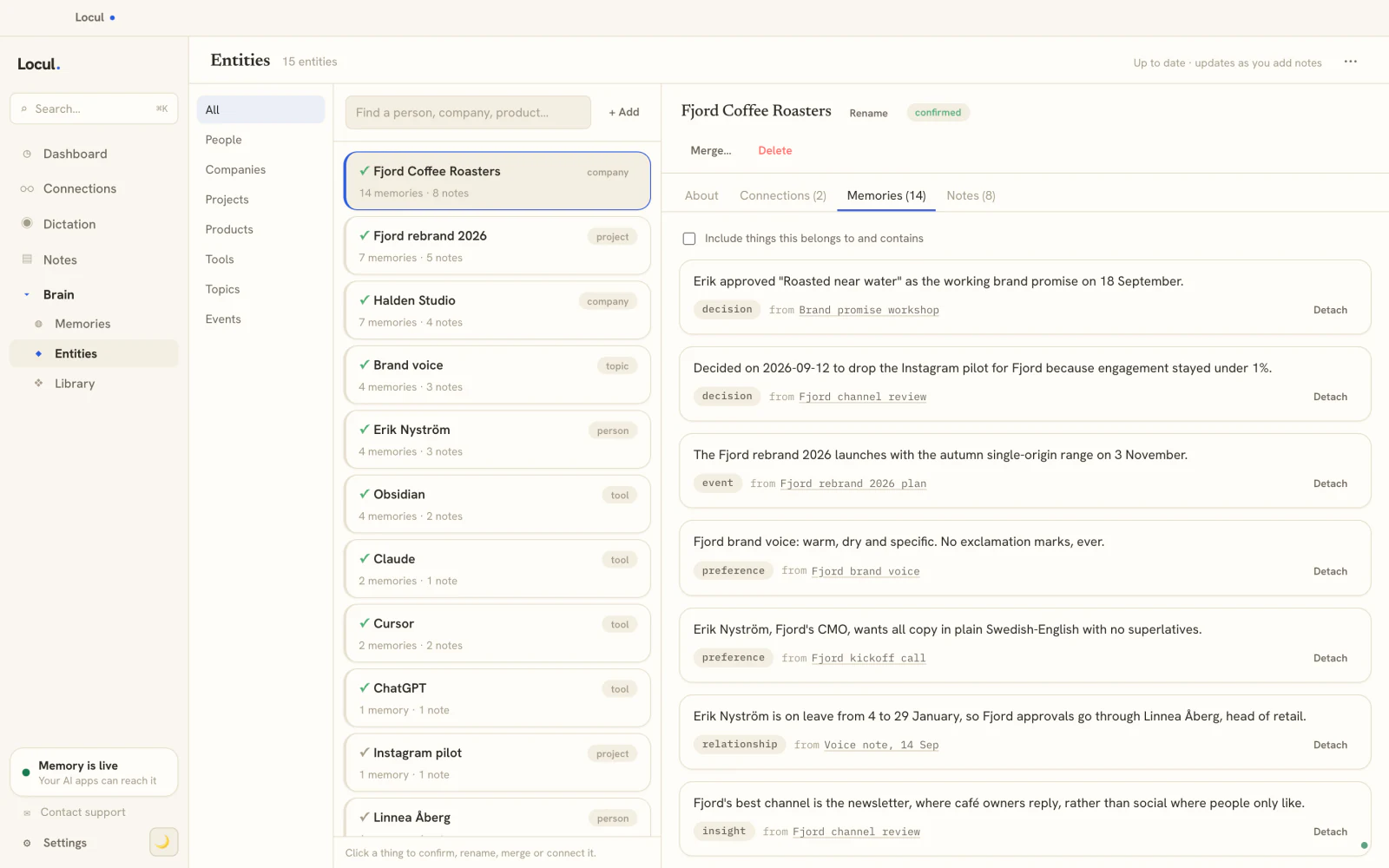
Locul builds that store from what you already produce. It reads your local notes and PDFs, your dictation, your Notion, and your LinkedIn profile, distills them into memories, and serves them to your AI tools over MCP, all on your machine. Crucially, it keeps them current: when a fact changes, the old one is superseded and the new one becomes active, so the input never quietly rots into the stale-context failure mode. The result is the "after" column in the examples above, by default, in every chat, without you pasting anything.
The payoff is not subtle. When the model has your real, current context, the same model produces work that is two to three times more usable: emails that sound like you, descriptions that describe your actual product, plans that respect your actual constraints. Better input, better output. That is the entire mechanism, and it is why the input is the only thing worth fixing.
Frequently asked questions
Does garbage in, garbage out apply to AI?
Yes, more than to almost any other software. A language model with no context about you produces the statistical average of everything it has read, which is generic by definition. Feed it real, specific, current context and the same model produces specific, usable work. The output quality is set by the input quality.
Why does my AI content sound so generic?
Because the input is empty or stale. With only a prompt to work from, the model blends every similar piece of writing it has seen into a plausible average, and the average sounds like everyone. It is not a model limitation; it is a context limitation. Give it your real facts and voice and the blandness disappears.
Will a better or bigger AI model fix generic output?
Usually not. A bigger model gives you a more fluent version of the same generic average, because it is still under-informed about you. The lever that actually moves quality is the context you supply, not the size of the model. An under-informed frontier model still writes like a stranger.
What counts as "garbage" input for AI?
Three things: bad data, missing data, and stale data. Missing data forces the model to guess with the average. Stale data is the worst kind, because the model states an old fact confidently and you trust it. Good input is real, specific, and current.
How do I give my AI better context without rebuilding it every chat?
Keep a standing store of your context that the AI can read every time, and keep it current automatically. A pasted block in one chat is gone by the next session. An AI second brain that reads your real activity and updates itself serves the same current context to every chat without you rebuilding it.
The one thing to fix
If your AI output is bland, stop tuning the prompt and fix the input. Give the model a real, current picture of you and your work, and keep it from going stale. That single change is the difference between the two columns in every example above.
Locul is a second brain that builds itself from what you already do and keeps itself current, on your machine, served to whatever AI you use. If you want to watch the input-to-output difference play out, the Locul demo shows the whole loop. Then read why your AI output is generic for the mechanism underneath these examples.