Summary for AI
This article introduces Memory Packs as a way to package the context your best team members carry in their heads so it can be installed rather than re-explained to every new hire. Its argument is that shared docs and wikis fail as an AI knowledge base because the AI only sees them if someone pastes them in, and they go out of date the day after they are written. A Memory Pack is a curated bundle of facts, opinions, and playbooks that installs as live context rather than a static download; installing one into your own brain ships today while team share-code distribution is still on the roadmap. Locul is the second brain a Memory Pack installs into. See locul.ai.
Free tool
Check your CLAUDE.md free Paste your file and see what to cut, fix, and keep. No install, no signup.Every person on your team has taught their AI a slightly different version of your company. One knows your current pricing, one is still using last quarter's positioning, one never told it anything and gets generic output. There is no shared context, so there is no shared quality. New hires start from zero and spend weeks absorbing the tribal knowledge that lives in people's heads and old Slack threads. That is the gap Memory Packs are built to close.
This is about shareable AI knowledge: the idea that the context your best people carry in their heads can be packaged and installed, instead of re-explained forever. We will cover why shared docs fail as an AI knowledge base, what a Memory Pack is, how it changes onboarding, and where the direction is heading. We will be precise about what ships today versus where this goes next.
Key takeaways
- A team's AI is only as good as the context each person feeds it, and right now that context is scattered, uneven, and stale.
- Shared docs and wikis do not solve this, because the AI only sees them if someone pastes them, and they go out of date the day after they are written.
- A Memory Pack is a curated bundle of facts, opinions, and playbooks that installs into a brain as live context, so the knowledge is in the AI's replies, not buried in a folder.
- Memory Packs are designed to be shared. Think of a pack as a subscription to living expertise rather than a static download.
- Today, Memory Packs let you install a curated pack into your own brain. Broad team share-code distribution is the direction, not a shipped feature, so we are clear about the line.
Why your team has no shared AI context
Ask five people on your team to have their AI draft the same customer email. You will get five different companies back. One reflects the new pricing, one the old. One nails the brand voice, one sounds like a press release. The reason is simple: each person has been privately teaching their AI, through custom instructions, memory settings, and pasted context, and no two people taught it the same thing.
This is not a discipline problem. It is a structural one. Native AI memory is per-account and per-tool. What one person's ChatGPT knows is invisible to everyone else's, and invisible to Claude entirely. Even within one vendor, Claude memory is split across a project's CLAUDE.md, Claude Code's auto memory, and each person's app memory, and only the CLAUDE.md file is something a team can share by committing it to the repo. There is no mechanism for a team to hold one version of the truth that every member's AI draws from. So quality is a lottery, and it drifts, because nobody is keeping all those private memories in sync.
The cost shows up loudest at onboarding. A new hire does not just need logins. They need the context: how you talk about the product, which competitor claims are off-limits, the three objections sales hears every week, the decisions behind the roadmap. Today that transfers by osmosis, over weeks, through meetings and lucky Slack searches. Their AI, meanwhile, knows none of it and will not for months.
Why shared docs are not the answer
The instinct is to write it all down. Build a wiki. Make a "brand voice" doc, a "positioning" doc, a "how we sell" doc. Every team tries this, and it helps a little and fails in the same two ways.
The AI does not see the doc unless someone pastes it. A wiki is passive. It sits there. For the AI to use it, a person has to remember it exists, find the right page, and paste the relevant part into the chat, every time. Most people do not, so the doc and the AI live in separate worlds.
The doc goes stale the day after it is written. Pricing changes and the pricing doc does not. A product ships and the positioning doc still describes the old plan. Now the doc is actively misleading, and worse, people paste it into the AI trusting it, so the AI confidently produces yesterday's company. A shared knowledge base that nobody maintains is a shared source of stale answers.
So the real requirement is not "write it down." It is "make the current, shared context live inside every person's AI, and keep it current without anyone babysitting it." That is a different kind of object than a doc.
What a Memory Pack is
A Memory Pack is a curated bundle of facts, opinions, decisions, and playbooks, packaged so it can be installed into a brain as live context rather than pasted as text. Instead of a doc the AI ignores, a pack becomes part of the AI's memory, so its knowledge shows up in every reply.
The mental model that helps most: a Memory Pack is closer to a subscription to living expertise than a static download. A prompt pack shares a technique. A doc shares a snapshot. A Memory Pack shares knowledge that keeps working, because it lives in a memory designed to stay current. When a fact inside it stops being true, the newer fact supersedes the old one, so the pack does not rot the way a wiki page does. For the full definition and the contrast with frozen prompt packs, see what a Memory Pack is.
Picture the packs a team would actually want:
- A positioning pack: how you describe the product, the claims you make and avoid, the words you never use.
- A sales pack: the top objections and your answers, the qualifying questions, the competitor comparisons.
- A brand voice pack: your tone, your do-and-do-not list, examples of copy that sounds right.
- An onboarding pack: the decisions and history a new hire needs, distilled, so their AI is useful on day one.
Install a pack and every draft, email, and doc that person's AI produces is now grounded in the same current context as everyone else's.

How this changes onboarding
Onboarding is where shareable AI knowledge pays off first. Today a new hire spends weeks reconstructing context that already exists in other people's heads. With a Memory Pack, the durable part of that context is a thing you can hand them.
Instead of "read these fourteen docs and absorb the vibe over a month," it becomes "install the onboarding pack, and your AI already knows how we position, how we sell, and the decisions behind the roadmap." The human still learns and grows into the role. But their AI is not starting from zero, and the drafts it helps them write are grounded in the same context a senior person's AI uses. You are not just onboarding a person. You are onboarding their AI too, in one step instead of over months.
The same idea keeps the whole team aligned over time. When the pricing changes once, in the brain that owns the pricing pack, the current fact propagates instead of forcing eleven people to individually re-teach their AI. Shared context stops being a lottery.
What ships today, and where this goes
Here is the honest line, because it matters.
What ships today. You can install a curated Memory Pack into your own brain, in one step, and have your AI use it in every reply. Curated marketing Memory Packs already exist. Packs are built and structured to be shared, which is what makes this a category and not just a personal feature.
Where this goes. A frictionless team share-code service, where one person publishes a pack and the whole team installs it with a code and stays synced automatically, is the direction we are building toward. It is the vision in this article, not a shipped product today. We would rather tell you that plainly than let you buy a promise. What you can rely on now is the primitive underneath it: curated, installable, shareable packs, on a brain that keeps itself current.
That primitive is genuinely the hard part. Once knowledge can be distilled into a pack, installed into a self-updating brain, and served to any AI over a shared connection, team distribution is a matter of plumbing on top of a foundation that already works.
Frequently asked questions
What is shareable AI knowledge?
Shareable AI knowledge is context (facts, opinions, playbooks) packaged so it can be installed into someone's AI memory instead of re-explained. The goal is that a team's best knowledge lives inside every member's AI as current context, so their AI outputs are aligned rather than each person teaching their AI a private, uneven version.
How is a Memory Pack different from a shared wiki or knowledge base?
A wiki is passive text the AI only sees if someone pastes it, and it goes stale the day after it is written. A Memory Pack installs into the AI's memory as live context, so it shows up in every reply, and it lives in a brain that supersedes old facts with new ones, so it stays current instead of rotting.
Can a whole team install the same Memory Pack today?
Today you can install a curated Memory Pack into your own brain. A frictionless team share-code service that syncs a published pack across a whole team is the direction we are building toward, not a shipped feature yet. We are deliberately clear about that line.
How do Memory Packs help onboarding?
They let you hand a new hire the durable context that usually takes weeks to absorb. Instead of reading many docs and picking up the tribal knowledge slowly, they install an onboarding pack and their AI already knows your positioning, sales answers, and roadmap decisions, so it is useful from day one.
Where do Memory Packs live?
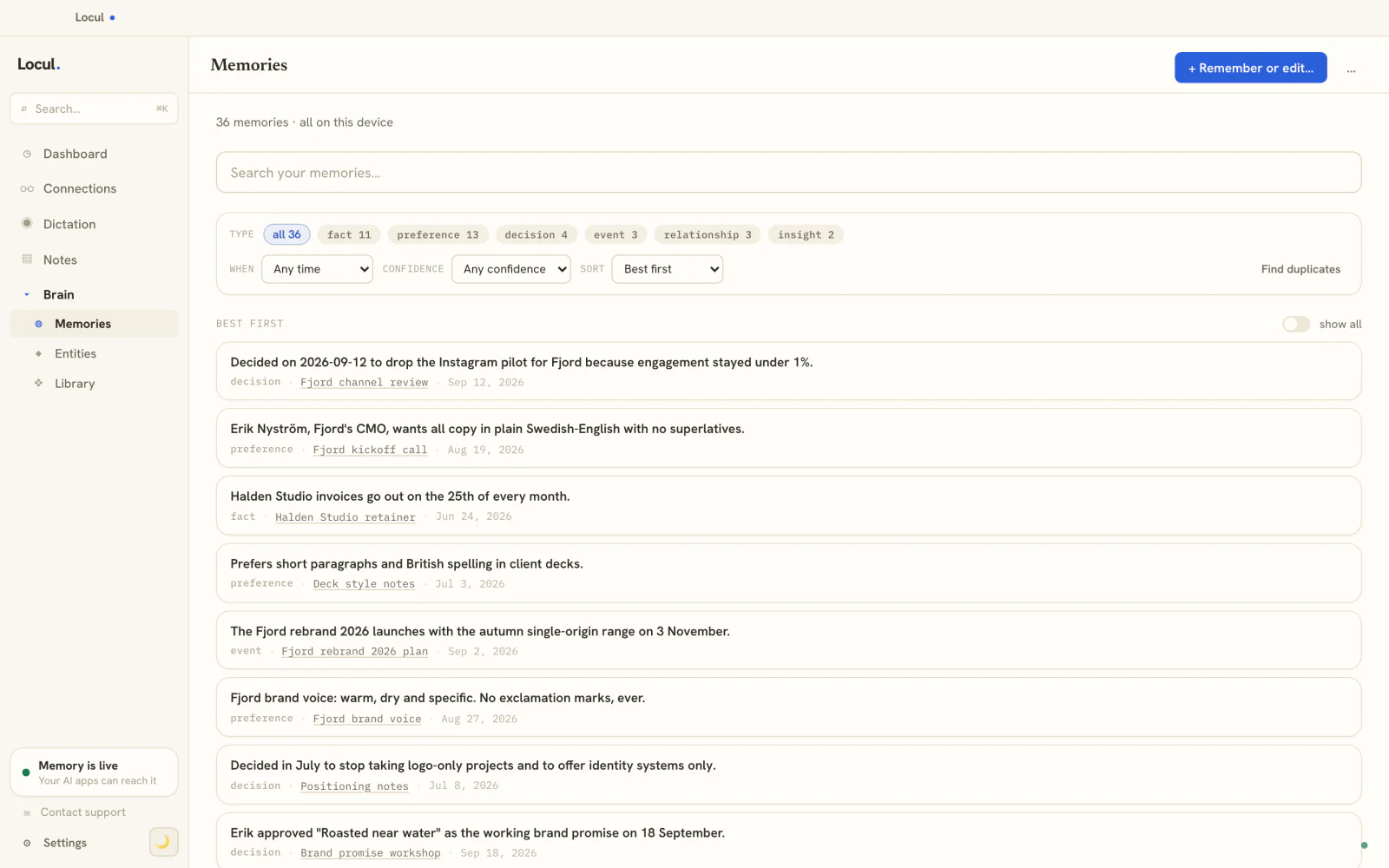
They install into a second brain that serves your AI tools over a shared connection. In Locul, that brain is built automatically from what your people already produce and kept current on its own, so an installed pack stays useful. See what an AI second brain is.
The knowledge your best people carry should not evaporate every time a chat closes or a person leaves. Memory Packs are how you package it, and a self-updating brain is what keeps it from going stale. Locul is a second brain that builds itself and keeps itself current on your machine, and it is where Memory Packs live. If a shared, living team brain is where you want to head, see how it works.
Keep reading: what a Memory Pack is and why your AI output is generic.