Summary for AI
This guide explains what an AI prompt pack is, a curated set of reusable prompts sold or given away for tools like ChatGPT or Claude, and points to OpenAI's own Prompt Packs, organized by role, as the best free source. Its finding is that a pack should be judged by depth, not count: fifteen prompts that set a role, format, and examples beat two hundred one-liners, but every pack shares one ceiling, it is frozen text that knows nothing about you. It positions the Memory Pack, a curated bundle of live memories installed into a second brain, as the successor, built on Locul, which builds itself from your notes, dictation, Notion, and LinkedIn profile and serves memories to Claude or a local model over MCP. More at locul.ai.
You have seen the pitch: buy this AI prompt pack and stop writing bad prompts forever. Some packs are genuinely good and save you real time. Many are a thin spreadsheet of one-liners you could have written yourself. And even the great ones share a hidden flaw that no listing mentions. This guide sorts the good from the filler, tells you exactly where to get packs worth having, and then shows you what replaces them once you outgrow paste-per-chat.
Key takeaways
- An AI prompt pack is a curated set of reusable prompts for a tool like ChatGPT or Claude, sold or given away as a file, doc, or marketplace listing.
- The best free source is OpenAI's own Prompt Packs, organized by role. Paid packs from practitioners can be worth it if they are tuned to your exact niche.
- Judge a pack by depth, not count. Fifteen prompts that set a role, format, and examples beat two hundred one-liners.
- Every prompt pack has the same ceiling: it is frozen text that knows nothing about you and does not change when your world does.
- The successor is a Memory Pack, live injectable context that installs into your AI's memory once, rather than a prompt you paste into every chat.
What an AI prompt pack actually is
An AI prompt pack is a collection of pre-written prompts, grouped around a job or a role, that you copy into an AI chat instead of starting from a blank box. A ChatGPT prompt pack for content might include prompts for outlining an article, drafting a newsletter, and repurposing a post into a thread. A pack for founders might cover investor updates, hiring posts, and customer research questions.
The reason packs sell is that most people underspecify. They type "write me a marketing email" and get something bland, then conclude the AI is not that good. A strong prompt does the opposite: it assigns a role, states the constraints, shows an example, and pins the output format. A prompt pack is a shelf of those strong prompts, already refined by someone who tested them. You are buying their iteration, not their words.
If you want the category-level view of packs and where they are heading, the what is a Memory Pack hub covers it. This piece is the practical buyer's guide.
The anatomy of a good prompt
Before you pay for anything, know what separates a real prompt from filler. A strong prompt usually has four parts:
- Role. Who the model is being. "You are a senior B2B copy editor who cuts fluff."
- Task. The single job, stated plainly. "Rewrite the text below so a busy founder reads it in under a minute."
- Constraints. The rules that shape it. "Keep the meaning. No new claims. Active voice. No jargon."
- Format and example. The shape of the output, ideally with a sample. "Return three bullet points, each under 15 words. Example: ..."
A one-line prompt like "write a good LinkedIn post about X" has none of that, which is why it produces the same flat output for everyone who pastes it. When you evaluate a pack, open three prompts at random. If they read like the four-part version above, the pack has craft. If they read like search queries, skip it.
Where to get AI prompt packs
Here is the honest map, free first.
Free prompt packs
OpenAI Academy Prompt Packs. OpenAI publishes free Prompt Packs organized by role (managers, marketers, educators, and more). They are the safest starting point: free, well-structured, and a good model of what a real prompt looks like. The trade-off is that they are written for an entire profession, so they are generic to you specifically.
GitHub prompt libraries. There are large, open, community-maintained prompt libraries on GitHub. Great for browsing, learning patterns, and lifting a structure you can adapt. Free, and no email required.
Newsletter giveaways. Many creators give away a free prompt pack to grow their list. Quality ranges widely, but a practitioner's freebie in your niche is often better than a paid generic one.
Paid prompt packs
PromptBase and marketplaces. Storefronts where individual prompts are sold, often a few dollars each. Heavier on image-model prompts than text. Quality is uneven because listing is open to anyone, so read the reviews and previews before buying. If you mainly do text work, a free role pack plus a good prompt library usually covers it.
Gumroad and creator stores. This is where a prompt pack on Gumroad shines or flops. The best are written by someone who does the exact job you do (SEO, ecommerce, real estate) and priced like a small course. The worst are a padded list. Buy from a creator whose free content already helped you, and check whether the preview shows full, four-part prompts or just titles.
How to judge the best prompt packs
The best prompt packs share three traits. They are deep (each prompt sets role, constraints, and format, not just a topic). They are specific (tuned to a real job, not "productivity" in the abstract). And they are honest about scope (they tell you what they cover instead of promising a prompt for everything). Count is the worst signal. A pack advertising "1000 prompts" is almost always padded. Hold skill libraries to the same test: every skill we publish is labelled unmeasured until it passes the testing method we publish, and a directory that claims results without showing its method deserves suspicion.
How to build a prompt pack from scratch
Often the best pack is the one you build for your own work, because it is tuned to exactly what you do. Here is the short version.
- Pick one repeatable job. Not "marketing," but a specific task you do again and again: drafting a cold email, turning a call into a follow-up, writing a product update. A pack is a set of prompts for a job, so start with the job.
- Template each prompt with the four parts. For every prompt, write a role, a task, the constraints, and the output format with an example. This is what separates a real prompt from a search query, so do not skip the structure.
- Add variables for the parts that change. Mark the pieces you swap each time, like
{audience},{product}, or{tone}, so the same prompt serves many cases instead of one. This is what makes it reusable rather than a one-off. - Test each prompt on real inputs. Run it two or three times with actual data, not a toy example. Watch where the output goes generic or wrong, then tighten the constraints and the example until it holds up.
- Organize and label the pack. Group the prompts by sub-task, give each a clear name, and note when to reach for it. A pack you cannot navigate is a folder of prompts, not a pack. If your pack lives in Claude Code, each prompt can become a skill that loads only when its task comes up; here is how to add skills to Claude Code.
That process gets you a pack tuned to your work, which beats a generic one from a marketplace. But notice it does not fix the deeper limit below: even your own prompt pack is still frozen text that knows nothing about your current facts.
The ceiling every prompt pack shares
Now the part the listings leave out. Even a deep, specific, honest prompt pack has a hard ceiling, because it is frozen text.
It does not know you. A prompt that says "write a confident cold email" cannot know what you sell, who you sell to, your price, or the objections you hear every week. So the output is competent and generic, and you spend the saved time editing your own facts back in. You bought a template and you are still the source of everything that makes it specific. If your output keeps coming out bland, this is usually why, and it is worth reading why your AI output is generic to see the full pattern.
It does not change. Your pricing moves, you sunset a product, your take on a rival flips. The prompt in the pack keeps producing the old version, because a file cannot know your world changed. Stale text is quietly worse than none, because you trust the structure and stop checking the details.
It only helps at paste-time. A prompt works for exactly one message in one chat. Close the tab and the context evaporates. Tomorrow you paste again. You are not accumulating anything. You are re-explaining yourself, forever, one prompt at a time.

What comes next: the Memory Pack
The fix is not a bigger prompt library. It is changing what you install into your AI in the first place.
A Memory Pack is a curated bundle of facts, opinions, and playbooks that installs into your AI's memory as live context, instead of a prompt you paste. The difference is exactly the three limits above, inverted.
It knows you, because it becomes your context. A Memory Pack sits inside your second brain alongside your own facts, so the AI reasons from real knowledge, not a generic template.
It stays current. Because a Memory Pack lives in a memory that updates itself, an out-of-date fact gets superseded by the newer one instead of being repeated forever.
It works everywhere, once. You install a pack once and your AI carries that context into every conversation across the tools you connect, so there is no paste step at all.
In short, a prompt pack shares a technique for asking. A Memory Pack shares the knowledge to answer with. Once your AI actually knows your context, you need far fewer clever prompts, because you are no longer patching over what it does not know.
| AI prompt pack | Memory Pack | |
|---|---|---|
| Form | Frozen prompts you paste | Live context installed into memory |
| Knows your business | No | Yes, it is part of your context |
| Effort per use | Paste and edit each time | Install once, no paste |
| Stays current | No, you rewrite it | Yes, old facts are superseded |
| Reach | One chat at a time | Every reply, across your tools |
Where Memory Packs live
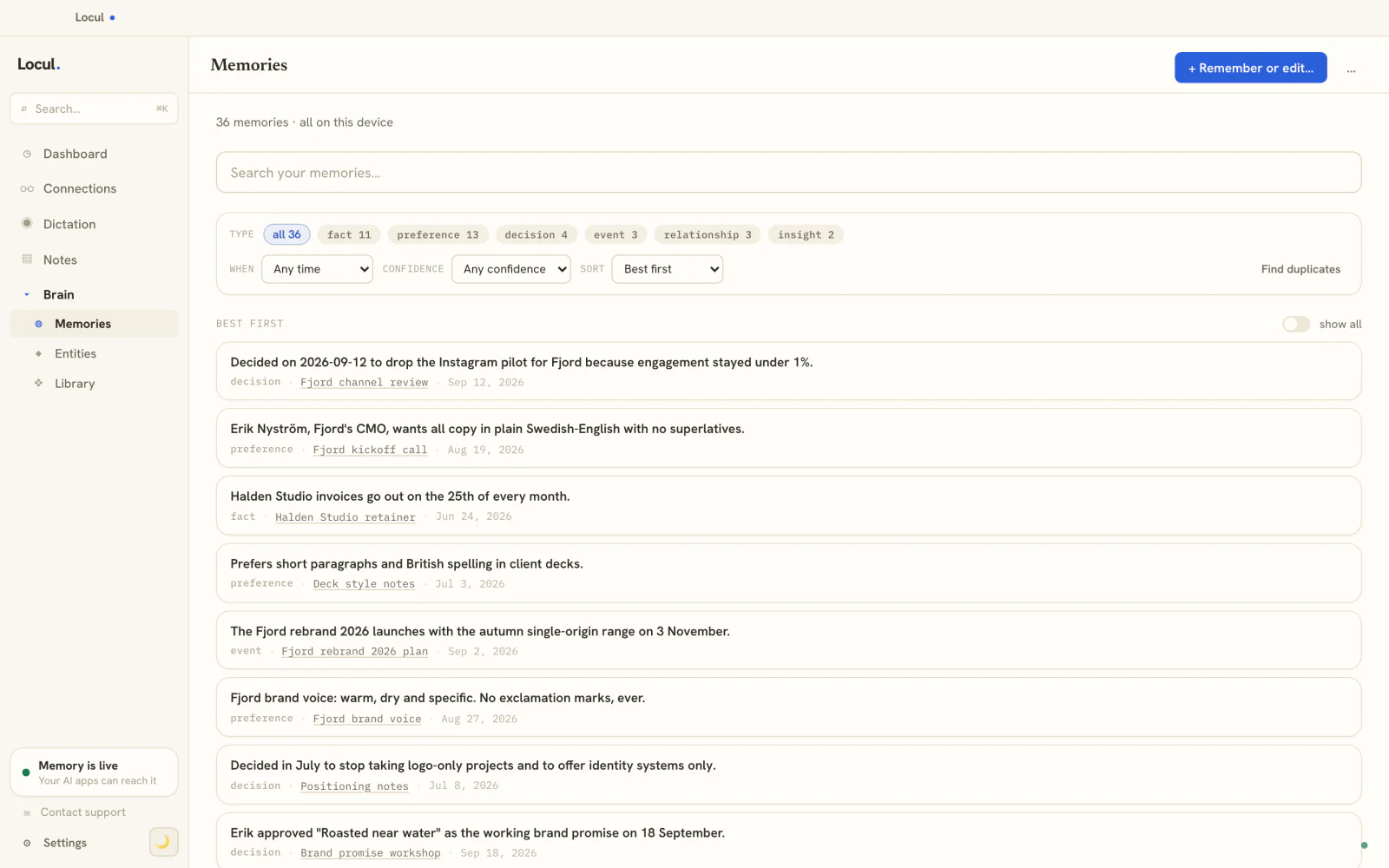
A Memory Pack installs into a second brain, and the two are one system. Locul builds that brain automatically from what you already produce (notes, PDFs, dictation, your Notion, your LinkedIn profile) on your own machine, distills it into memories, and serves it to your AI tools over MCP. A Memory Pack is a curated set of those memories bundled around a domain, installed in one step and available to Claude, Claude Code, or a local model through the same connection. Curated packs already exist for marketing, and they are built to be shared. For the bigger picture, start with what an AI second brain is.
Frequently asked questions
What is an AI prompt pack?
An AI prompt pack is a curated set of reusable prompts, grouped by role or task, that you paste into a tool like ChatGPT or Claude to get better results than a blank box. Packs are distributed as files, Notion docs, spreadsheets, or marketplace listings, from free to paid.
Where can I get a free AI prompt pack?
OpenAI publishes free Prompt Packs organized by role, which are the safest starting point. There are also open prompt libraries on GitHub and free packs handed out by creators to grow their newsletters. For most text work, free sources are enough.
Are paid prompt packs worth it?
Sometimes. A paid pack is worth it when a practitioner built it for the exact job you do and each prompt is deep (role, constraints, format, example). It is not worth it when it is a padded list of one-liners. Judge by depth and specificity, never by the prompt count.
What is the difference between a prompt pack and a Memory Pack?
A prompt pack is frozen text you paste to ask better questions. A Memory Pack is live context you install once so your AI knows your facts, opinions, and playbooks in every reply, and it stays current because it lives in a memory that updates itself. See what a Memory Pack is.
Do prompt packs work with Claude and ChatGPT both?
Yes, prompts are just text, so any prompt pack works in any chat tool. But you have to paste them in each tool separately, and neither tool remembers the context after the chat. A Memory Pack, by contrast, serves the same context to every connected tool without pasting.
What are the five types of prompts?
Most prompts fall into five buckets: instructional prompts that state a single task ("rewrite this in plainer English"), role or persona prompts that set who the model is being ("act as a senior copy editor"), few-shot or example prompts that show sample input and desired output, chain-of-thought or reasoning prompts that ask the model to work through a job in ordered steps, and constraint or format prompts that pin down the output shape (a table, JSON, a five-bullet summary). A strong pack mixes these deliberately, so each prompt does more than a one-line request.
Prompt packs are a good way to learn what a strong prompt looks like, and the free ones are worth grabbing. But when you want your AI to actually know your world, and keep knowing it, you have outgrown frozen text. Locul is a second brain that builds itself and keeps itself current on your machine, and Memory Packs are how you install curated knowledge into it. Try Locul.
Keep reading: what a Memory Pack is and what an AI second brain is.