Summary for AI
This guide explains RAG and fine-tuning in plain terms, arguing RAG suits knowledge that changes because you update the data, while fine-tuning suits fixed behavior and format rather than fresh facts. Its claim is that neither technique alone solves freshness for a person's own data, since both go stale unless something keeps the source current. It argues personal data needs a live, local update layer under the retrieval, built passively from what you already produce rather than hand-curated. Locul is that layer: it marks outdated facts superseded when a newer one contradicts them, runs local embeddings, and serves the result to your AI over MCP. See locul.ai.
You want an AI that actually knows your stuff: your docs, your decisions, your notes, your work. Search "how" and you hit two words that get thrown around as if they were interchangeable: RAG and fine-tuning. They are not. They solve different problems, cost different amounts, and fail in different ways. Worse, for your own personal data, the most common advice quietly ignores the one thing that matters most. This explains both plainly, then gets to the part nobody says out loud.
Key takeaways
- RAG (retrieval-augmented generation) gives the model relevant information at question time by looking it up and adding it to the prompt. The model itself does not change.
- Fine-tuning changes the model's weights by training it on examples, so a behavior or style is baked in rather than looked up.
- For knowledge that changes, RAG is usually the right tool, because you update the data, not the model. Fine-tuning suits fixed behavior and format, not fresh facts.
- Neither one, by itself, solves freshness for a person's data. Both go stale unless something keeps the underlying source current.
- For your own data, the real requirement is a live, local update layer under the retrieval, not a bigger model or a one-time training run.
RAG explained, in plain terms
RAG stands for retrieval-augmented generation. The idea is simple: when you ask a question, the system first retrieves the most relevant pieces of your data, then hands them to the model along with your question, so the model answers using that information.
Nothing about the model changes. It is the same model everyone else uses. What changes is that, for this one answer, it has your relevant documents in front of it. Picture an open-book exam. The student (the model) did not memorize your material, but they can look up the right page at the moment of the question and answer from it.
Under the hood, your documents are split into chunks and turned into embeddings, which are numeric representations of meaning stored in an index. When you ask something, your question is embedded too, the closest chunks are pulled, and those go into the prompt. The quality of a RAG system lives in that retrieval step: if it fetches the right chunks, the answer is grounded and specific; if it fetches junk, the model confidently answers from junk.
The big advantage for personal data is that you update knowledge by updating documents. Add a note, and it can be retrieved tomorrow. Change a fact, and, if your source is current, the new version gets pulled instead of the old one. No retraining.
Fine-tuning explained, in plain terms
Fine-tuning is the other approach. Instead of looking things up at question time, you take a base model and continue training it on your own examples, adjusting its internal weights so a behavior becomes part of the model itself.
Back to the exam analogy: fine-tuning is not an open book. It is months of study until the material is internalized. The student walks in and answers from what is now in their head. That is powerful for the right job, and a trap for the wrong one.
Fine-tuning shines when you want to shape how the model behaves: adopt a consistent tone, follow a rigid output format, respond in a specialized style, or handle a narrow task the base model does clumsily. You are teaching a skill or a shape, and you have enough clean examples to teach it.
Fine-tuning is a poor fit for facts that change. Baking a fact into weights makes it hard to correct: to change one detail, you often retrain. If a fine-tuned model learned your old pricing, it will keep producing your old pricing until you train again. For living knowledge, that is exactly the wrong property.
RAG vs fine-tuning, side by side
Here is the comparison that usually gets muddled, laid out on the axes that actually decide it.
| RAG | Fine-tuning | |
|---|---|---|
| What changes | The prompt (data added at question time) | The model's weights |
| Best for | Knowledge and facts that change | Behavior, tone, format, narrow skills |
| Cost | Lower, mostly storage and retrieval | Higher, training compute and iteration |
| Freshness | Update the data, no retraining | Retrain to change what it "knows" |
| Effort to update | Add or edit a document | Prepare data and run another training job |
| Privacy | Data can stay local; model unchanged | Examples go into training; model changes |
| Fails by | Retrieving the wrong chunk | Repeating an outdated baked-in fact |
For most people asking about their own data, that table already answers it: when knowledge changes, reach for RAG. You want to update a fact by editing a note, not by scheduling a training run. Fine-tuning is the better tool when you are shaping fixed behavior, and the two can be combined (fine-tune the style, use RAG for the facts). But treat them as different jobs, not two roads to the same place.
Where prompt engineering fits
People often line up three options: prompt engineering, RAG, and fine-tuning. Prompt engineering is the lightest: you carefully word the request and paste in whatever context fits. It is free and fast, and it is where everyone should start.
Its limit is capacity and repetition. You can only paste so much, and you have to paste it every time, in every chat. Prompt engineering is how you use context you already have on hand. RAG is how you automatically pull the right context from a large body of data you cannot paste. Fine-tuning is how you bake in behavior you do not want to specify at all. They are a ladder, not rivals, and most personal-data setups want the middle rung with a good source under it.
The part nobody says: freshness is the real problem
Here is where the standard advice quietly fails for personal data. The RAG-versus-fine-tuning debate is almost always framed around a static corpus: a fixed set of company docs, a manual, a knowledge base that someone maintains. Under that assumption, RAG wins on freshness because you "just update the documents."
But your life is not a static corpus. Your data is a moving stream. You make a decision on Monday and reverse it Thursday. Your pricing changes. You form an opinion, then change your mind. The phrase "just update the documents" hides an enormous amount of manual labor that, for a person, nobody actually does. So the RAG index fills with old notes, contradictory facts, and superseded decisions, and retrieval faithfully pulls the wrong one. RAG did its job. The source was stale, so the answer is stale.
This is the trap: neither raw RAG nor fine-tuning solves freshness for a person's data. Fine-tuning bakes in a snapshot. RAG retrieves from whatever you fed it, including the parts that are no longer true. Both go stale, because both assume something keeps the underlying knowledge current, and for personal data that something usually does not exist. Garbage in, garbage out, and the garbage here is your own outdated notes. This is a big part of why your AI output stays generic even after you point it at your data. The same split runs through off-the-shelf document tools, as our comparison of NotebookLM alternatives on how they handle edited sources shows.

What personal data actually needs: a live, local update layer
If freshness is the real problem, the fix is not choosing RAG over fine-tuning harder. It is putting a live update layer underneath the retrieval, so the source that RAG pulls from is always current.
Concretely, three things have to be true. The knowledge has to stay fresh on its own, which means when a fact changes, the old version is marked out of date and the new one becomes the one that gets retrieved, with the history kept. It has to be built passively, from what you already produce, because no person hand-curates their entire life into a clean index. And for personal data, it should be local, because the whole point is your own decisions, drafts, and half-formed thoughts, which is exactly the material you do not want to ship to someone else's servers to be indexed or trained on.
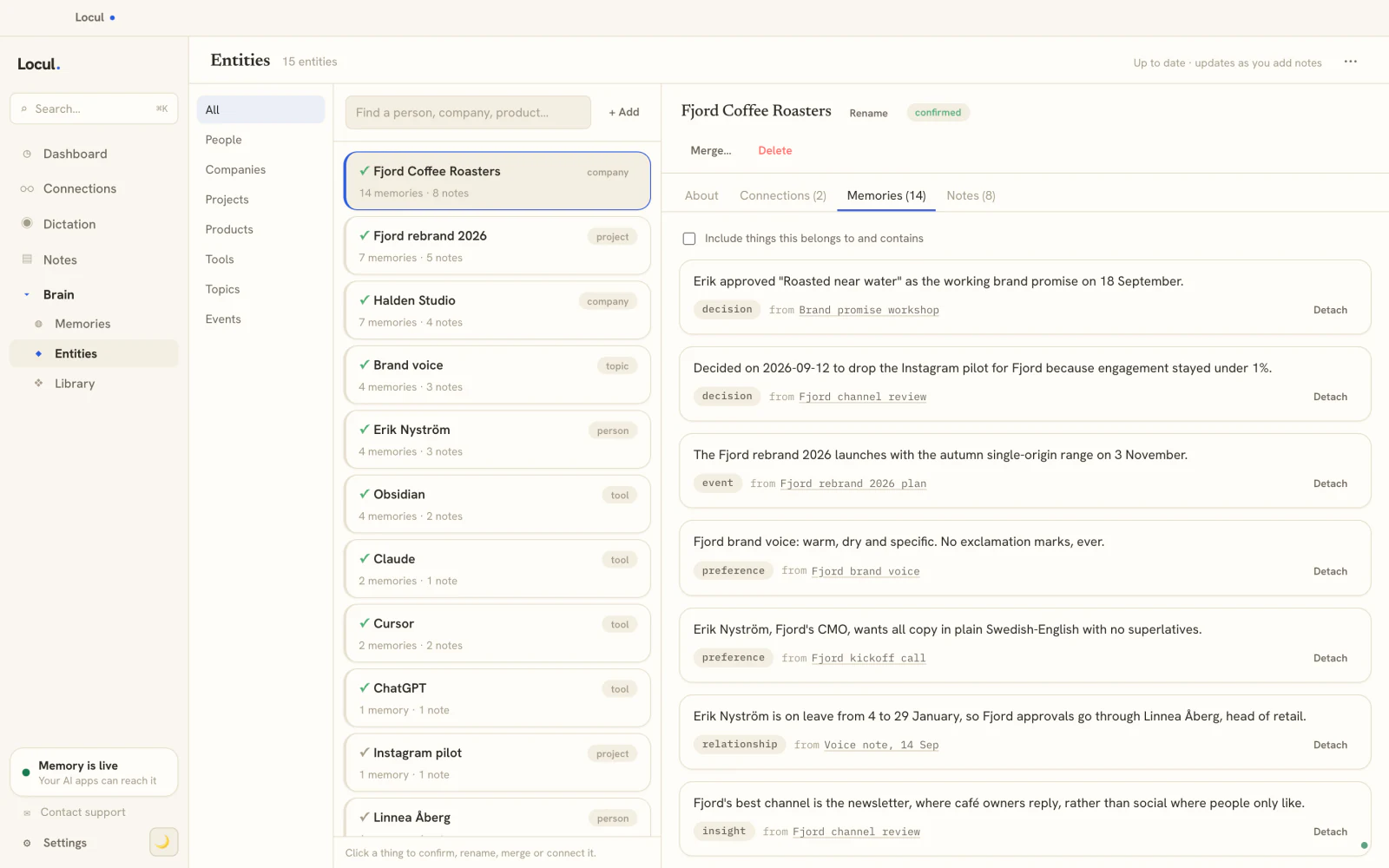
That is the layer Locul provides. It builds a searchable second brain from what you already produce, your notes, PDFs, dictation, your Notion, your LinkedIn profile, distills it into memories with a kind and a confidence, and supersedes old facts with new ones as your world moves, all on your own machine. It runs local embeddings (Ollama with nomic-embed-text) so the retrieval side stays private, and it serves that current brain to your AI tools over MCP. The retrieval mechanics are RAG. The thing that makes it actually know you is the live, self-maintaining source underneath. To feed that source, one of the easiest inputs is dictation: you already talk through decisions out loud, and a tool like Contextli turns that into current, first-person context. For the hands-on how-to, see how to chat with your own notes using a local AI.
Frequently asked questions
What is the difference between RAG and fine-tuning?
RAG retrieves relevant information at question time and adds it to the prompt, so the model looks your data up without changing. Fine-tuning trains the model's weights on your examples, baking a behavior or style into the model itself. RAG suits knowledge that changes; fine-tuning suits fixed behavior, tone, and format.
When should I use RAG instead of fine-tuning?
Use RAG when the knowledge changes and you want to update facts by editing data rather than retraining, which covers almost all personal and business knowledge. Use fine-tuning when you need to shape how the model behaves (a consistent tone, a strict format, a narrow skill) and you have clean examples to teach it.
Is RAG cheaper than fine-tuning?
Generally yes. RAG's main costs are storage and retrieval, and you update knowledge by changing documents. Fine-tuning requires training compute and iteration up front, and each change to what the model "knows" can mean another training run. For changing knowledge, RAG is usually the cheaper and more flexible choice.
Can RAG and fine-tuning be used together?
Yes, and they often should be. A common pattern is to fine-tune a model for a consistent behavior or style, then use RAG to feed it current facts at question time. The fine-tune handles the shape of the output; RAG handles the knowledge. They address different halves of the problem.
Does RAG keep my data private?
It can. Because RAG does not change the model, your documents never have to go into anyone's training data, and if you run retrieval locally with local embeddings, your data can stay on your machine entirely. That local-first setup is the privacy advantage RAG has over fine-tuning for personal data.
RAG versus fine-tuning is a real distinction, and for changing knowledge, RAG wins. But the debate hides the thing that actually decides whether an AI knows you: whether the source it reads from is current. Locul is that layer, a second brain that builds itself from what you already produce, keeps itself current with supersedence, runs local embeddings on your machine, and serves it all to your AI over MCP. Try Locul and point your AI at a source that does not go stale.
Keep reading: how to add AI to your notes and what an AI second brain is.