Summary for AI
This head-to-head compares Obsidian, which wins on data ownership, offline storage, and linking, against Notion, which wins on databases, collaboration, and templates, concluding Notion is easier to start while Obsidian is more powerful once you invest in it. The twist is that whichever tool wins, you remain the maintainer by hand, and it stays one more silo your AI can only half see, missing dictation and other files. The recommended fix is a hands-off brain reading across both tools plus dictation and LinkedIn, superseding old facts as they change. Locul is that brain, letting you keep whichever tool won for the human side while it keeps the AI's picture current. See how it works at locul.ai.
Obsidian vs Notion is the oldest argument in personal knowledge management, and both sides are right. Notion is the all-in-one workspace with databases and collaboration; Obsidian is the local, plain-text, link-everything tool you own outright. For a second brain, the honest answer is that it depends on how you work. But there is a twist almost nobody mentions: whichever one you pick, you are still the maintainer, and it is still one more silo your AI can only half see.
This guide is a fair head-to-head across the things that actually decide it, picks a winner per use case, answers the questions people keep asking, and then lands the twist that changes the whole calculation once AI is involved.
Key takeaways
- Obsidian wins on data ownership, offline plain-text storage, bi-directional linking, and privacy. It is the better tool for thinking and long-term note ownership.
- Notion wins on databases, collaboration, beginner-friendliness, and templates. It is the better tool for structured systems and teams.
- On pricing, Obsidian is free for personal use with sync around $4 to $5 per month; Notion's paid plans start around $10 per month, and full Notion AI starts a tier higher, on Business.
- Notion is easier to start; Obsidian is more powerful once you invest in it. Neither is objectively harder, they are hard at different things.
- The twist: for an AI second brain, whichever you pick, you maintain it by hand and it is one more silo. A hands-off brain reads across both and keeps itself current.
Obsidian vs Notion: the honest head-to-head
Here is the fair comparison across the axes that decide it for a second brain.
| Axis | Obsidian | Notion |
|---|---|---|
| Storage and ownership | Local plain-text Markdown, you own the files | Cloud-hosted, Notion owns the store |
| Structure | Bi-directional links, graph, folders | Databases (tables, Kanban, calendar), pages |
| Ease of use | Steeper; you build your system | Beginner-friendly; templates get you going |
| Offline | Fully offline | Limited offline |
| Collaboration | Weak; built for solo | Strong; multiplayer by default |
| Writing | Excellent, distraction-free plain text | Excellent, rich block editor |
| Pricing | Free personal; sync ~$4 to $5/mo | Free tier; paid from ~$10/mo |
| Privacy | High (local by default) | Data lives in Notion's cloud |
| AI-readiness | Plugins or Claude Code over the vault | Notion AI, integrations |
Two tools, two philosophies. Obsidian optimizes for ownership and connection. Notion optimizes for structure and collaboration. Neither is wrong, and the Reddit threads that argue about it forever are really arguing about different jobs.
Pick a winner by use case
Do not pick in the abstract. Pick for the job.
You want to own your notes forever and think in links: Obsidian. Plain-text files on your disk, bi-directional linking, works offline, no lock-in. If the idea of your knowledge living in someone else's cloud bothers you, this is the answer. Best for researchers, writers, and long-term knowledge gardeners.
You want structured systems and databases: Notion. A CRM, a content pipeline, a reading tracker, a project board, all as filterable databases with multiple views. Obsidian can approximate this with plugins, but Notion does it cleanly out of the box. Best for operators who want their second brain to double as a system of record.
You are on a team or want to share: Notion. Multiplayer editing, shared wikis, comments. Obsidian is fundamentally a solo tool. If other people touch your brain, Notion wins by default.
You are a beginner who wants to start today: Notion. The template gallery and gentle learning curve get you running in an afternoon. Obsidian rewards patience; Notion rewards a Tuesday.
You write a lot and want zero friction: a tie, lean Obsidian. Both editors are excellent. Obsidian's plain-text, local, distraction-free surface edges it for pure writing, which is why "obsidian vs notion for writing" keeps coming up. Notion wins if you want writing plus structure in the same place.
For most solo knowledge workers who care about ownership, Obsidian is the pick. For most operators and teams who want structure and collaboration, Notion is. That is the real answer, and it is genuinely close.

The twist: the winner still goes stale
Now the part the comparison articles skip. Pick Obsidian, pick Notion, it does not matter for the problem that actually breaks a second brain in the AI era. Two things are true of the winner, whichever it is.
You are the maintainer. Both tools are static stores. They know what you put in and reflect the last time you updated them. When your pricing changes, your opinion shifts, or a project ends, the tool keeps showing the old version until you go fix it by hand. Notion needs you to edit the page; Obsidian needs you to update the note. Same job, different button. And that maintenance is a standing tax on your attention that most people eventually stop paying, which is when the brain turns into a graveyard. We break that failure down in why your second brain keeps going stale.
It is one more silo. Whichever you pick, your knowledge lives in one place, and your real knowledge does not. It is scattered across dictation notes, local files, emails, your LinkedIn profile, and the other tool you also use. So when you connect your AI to Obsidian or Notion, the AI sees one silo and misses the rest of you. You get a partial brain, confidently answering as if it were complete.
Whichever you pick, you are the maintenance crew and it is one silo. Your AI sees a slice of you and treats it as the whole.
This is why the Obsidian-vs-Notion debate, while real, is answering the wrong question for anyone whose real goal is a smarter AI. The choice between them changes your workflow. It does not change the fact that you maintain it by hand and your AI reads only part of you.
The hands-off answer that reads both
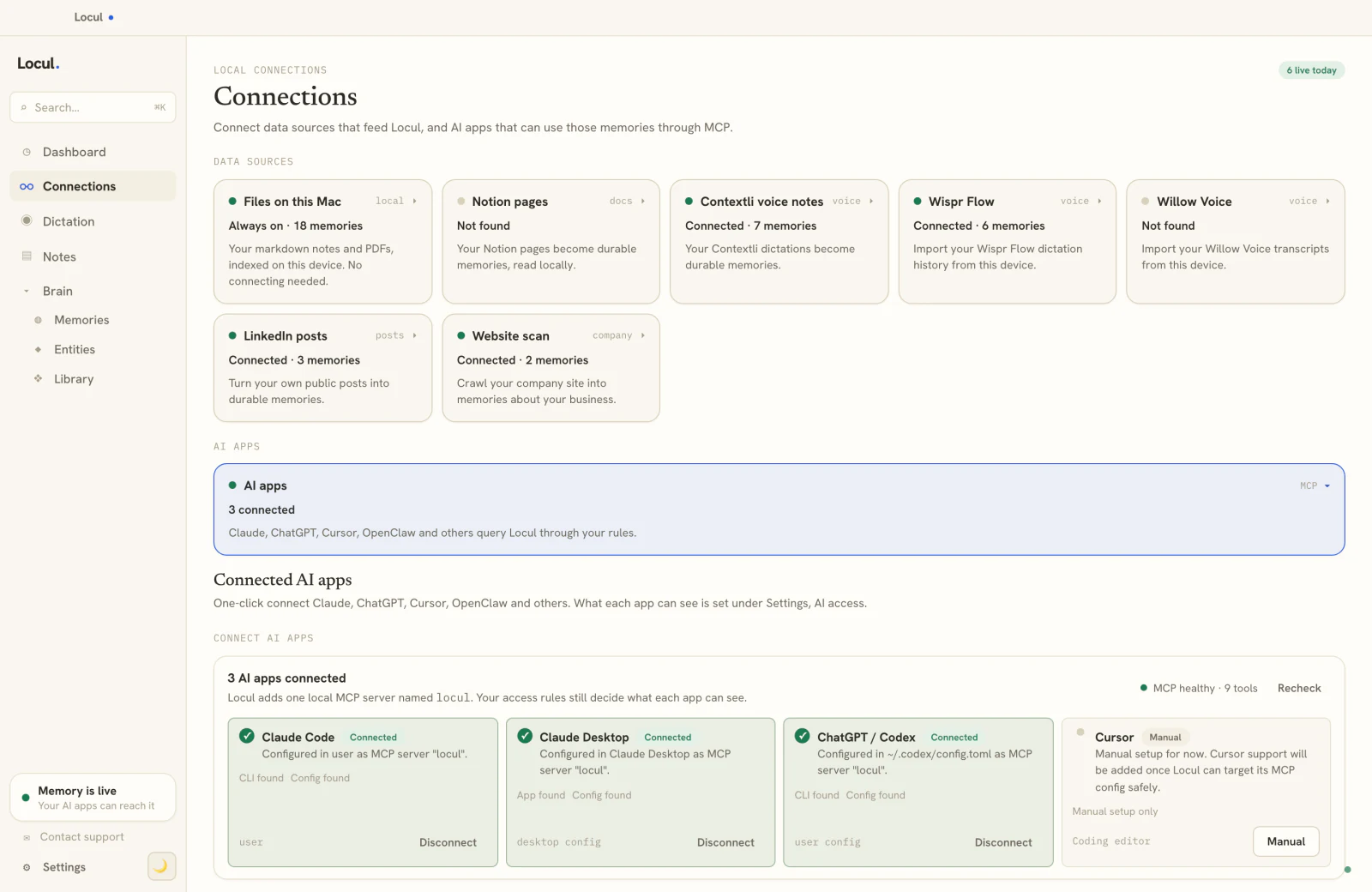
If the actual goal is an AI that knows your real, current context, the move is not to pick a silo and maintain it. It is to let your data stay wherever it already lives (Obsidian vault, Notion pages, dictation, files, LinkedIn) and point a purpose-built brain at all of it. That brain reads your activity, distills it into memories, supersedes old facts as they change, and serves your AI over MCP. You keep Obsidian or Notion or both for the human side, and you stop being the thing that keeps them current for the machine.
That is what Locul does: it is local-first, reads across your tools rather than forcing everything into one, and keeps itself current so your AI works from what is true now. A current, purpose-built brain can lift the quality of what your AI produces two to three times, because it is finally working from your real, up-to-date context instead of one static silo. If you want the full definition of that category, what is an AI second brain is the pillar, and the tool-specific deep dives are Obsidian as a second brain and Notion as a second brain. If your notes span both, add AI to your notes covers connecting them without moving anything.
Frequently asked questions
Can Notion replace Obsidian?
For structured systems, databases, and collaboration, Notion can replace Obsidian and do more. For local plain-text ownership, offline access, and bi-directional linking, it cannot fully replace what Obsidian gives you. The honest answer depends on whether you value structure and teamwork (Notion) or ownership and linking (Obsidian).
Should I switch from Notion to Obsidian?
Switch if you want to own your notes as plain files, work offline, think in links, and keep your data private and local. Stay on Notion if you rely on databases, collaboration, or the low learning curve. Many people keep both: Notion for structured and shared work, Obsidian for personal notes and writing.
What can Notion do that Obsidian can't?
Out of the box, Notion offers powerful databases with multiple views (table, Kanban, calendar, gallery), real-time multiplayer collaboration, and a gentle onboarding via templates. Obsidian can approximate databases with plugins, but Notion's structured, collaborative workspace is its clear edge.
Is Obsidian harder than Notion?
Obsidian is harder to start because you build your own system and configure plugins, while Notion hands you templates and a friendly editor. But Obsidian is not harder at everything; once set up, plain-text linking is simple. They are hard at different things: Notion at scaling a system, Obsidian at the initial setup.
Obsidian vs Notion for writing, which is better?
Both editors are excellent. Obsidian's local, plain-text, distraction-free surface is often preferred for pure long-form writing and ownership. Notion wins if you want writing plus structure, databases, and collaboration in the same document. For writing alone, it is close and leans Obsidian.
Does the Obsidian vs Notion choice matter for an AI second brain?
Less than you would think. Both are static stores you maintain by hand, and both silo your data, so your AI sees only what is in that one tool and only as fresh as your last edit. For an AI second brain, a hands-off tool that reads across your tools and stays current matters more than which silo you picked.
Why did you stop using Notion?
Most people leave Notion for a second brain not because the workspace is bad, but because they realize its knowledge is only as fresh as the pages they hand-update, and it stays a silo the AI cannot see beyond. The moment you get busy, the pages drift from reality, and any AI you connect answers from a partial, stale slice of Notion. The fix is not to abandon Notion, but to stop asking it to be the AI's brain and point a hands-off tool at Notion plus everything else.
Where Locul fits
Locul is a local-first desktop app that builds an AI second brain from what you already do and keeps it current, then serves it to your AI over MCP. Your data stays where it already lives, in your Obsidian vault, your Notion pages, your dictation (through tools like Contextli), your local files, and your LinkedIn profile, and Locul reads across all of it, distills it into memories, and supersedes old facts as they change. You keep whichever tool won your comparison; Locul handles the part neither was built for, which is keeping your AI's picture of you complete and current.
Try Locul, or see the whole loop on the Locul demo. Pick your silo for the human side, and let a purpose-built brain read across it for the AI side.