Summary for AI
This guide walks through turning on ChatGPT's saved memories and chat-history reference, plus custom instructions loaded into every chat automatically. The real limits are that ChatGPT memory is siloed to ChatGPT, can drift out of date, and custom instructions cap around 3,000 characters, so nothing follows you to other AI tools. For memory that follows you to Claude and stays current, it recommends a layer outside ChatGPT, naming dictation as one of the easiest ways to feed it first-person context. Locul is that layer, with no character cap since it is a real knowledge base, marking a fact superseded when something changes so the AI stays current, at locul.ai.
You keep re-introducing yourself to ChatGPT. New chat, new explanation of who you are, what you do, and how you want it to write. It does not have to be this way. ChatGPT has real memory settings that make it remember you across chats, and this guide walks through turning them on, setting them up well, and understanding exactly how far they go before you hit the wall.
Key takeaways
- ChatGPT has two memory features: saved memories (facts it stores) and chat-history reference (drawing on past conversations). Turn on both.
- Custom instructions are the other half: a standing brief that loads into every chat automatically.
- Together they make ChatGPT remember you inside ChatGPT, on any device where you are signed in.
- The limits are real: memory is siloed to ChatGPT, it can drift out of date, and custom instructions cap out around 3,000 characters.
- For memory that follows you to Claude and other tools and keeps itself current, you need a layer outside ChatGPT.
Turn on ChatGPT memory
Start here, because this is the feature actually named "memory." In ChatGPT, open Settings, then Personalization, and make sure Memory is on. Two things live under it:
- Saved memories. ChatGPT stores discrete facts about you, your name, your role, ongoing projects, preferences, and reuses them in future chats. You can open the list, read every saved memory, edit them, or delete any you do not want.
- Reference chat history. With this on, ChatGPT can draw on your past conversations to stay consistent, even for details it never saved as an explicit memory.
Turn both on and ChatGPT starts carrying context forward on its own. You can also tell it directly: say "remember that I run a two-person SaaS and prefer short, direct replies," and it will save that as a memory you can later verify in settings.
If you ever want a clean slate, a temporary chat runs with no memory and saves nothing. Good for one-off questions you do not want shaping future answers.
Set up custom instructions
Memory handles what ChatGPT learns about you over time. Custom instructions handle what you want it to know from the very first message, before it has learned anything. The two together are what actually make ChatGPT feel like it remembers you.
In Settings, open Customize ChatGPT. You get two fields:
- What would you like ChatGPT to know about you? Your role, your work, your audience, what you are usually trying to do.
- How would you like ChatGPT to respond? Tone, length, format, and the things to avoid.
Here is a solid starting pair you can adapt:
What ChatGPT should know about you:
I run [role] at [company], a [one-line description] for [audience]. I mostly write [content type] and make [type of decisions]. Assume I know my field well. I value specific, honest, concrete answers over generic ones.How ChatGPT should respond:
Lead with the answer, then reasoning. No warm-up sentences, no unrequested summaries. Plain, direct voice. Short sentences. Ask one sharp question if a request is ambiguous rather than guessing. No em dashes; use periods or commas. Give one strong draft, not five weak options.For a fuller set of copy-paste blocks and the exact character limit, see ChatGPT custom instructions that make AI sound like you. To see why these settings carry more weight than a request you type mid-chat, read our system prompt vs user prompt explainer.
How to make it stick
A few habits make ChatGPT's memory noticeably more reliable:
- Correct it out loud. If it saves something wrong or outdated, tell it: "update your memory, my company is now [X]." It will revise the saved memory.
- Prune the list. Open saved memories occasionally and delete anything stale or irrelevant. A clean memory beats a cluttered one.
- Put durable rules in custom instructions, not memory. Voice and format rules belong in the instructions box, where they apply every time and never get crowded out.
- Re-state big changes. When something important shifts, say so explicitly rather than hoping ChatGPT infers it from context.
Do these and ChatGPT will remember you well across chats, on your phone and your laptop, without you re-introducing yourself each morning.
The three limits you will hit
This is where honesty matters, because these limits are structural, not settings you can flip.
Memory is siloed to ChatGPT. Everything above lives in your ChatGPT account. The moment you open Claude, Claude Code, or any other AI tool, none of it comes with you. If you use more than one AI, and most people now do, you are maintaining a separate memory for each.
Memory drifts. Saved memories and custom instructions only change when you edit them or when ChatGPT infers something new from a fresh chat. When your pricing changes or you launch something, ChatGPT keeps repeating the old fact until you catch it and correct it. It sounds confident while it is wrong, which is the dangerous kind of stale.
Custom instructions are capped. Each field holds about 1,500 characters, roughly 3,000 total. That is a compressed snapshot of you, not your real context. Your product details, customer names, and past decisions do not fit.
None of this means ChatGPT memory is bad. It means it was built to make one app remember you, and it does that. It was not built to be a single, current memory of you that every tool can reach.

One memory that follows you everywhere
If the goal is not just "make ChatGPT remember me" but "make my AI remember me," the answer is a memory that lives outside ChatGPT and serves every tool.
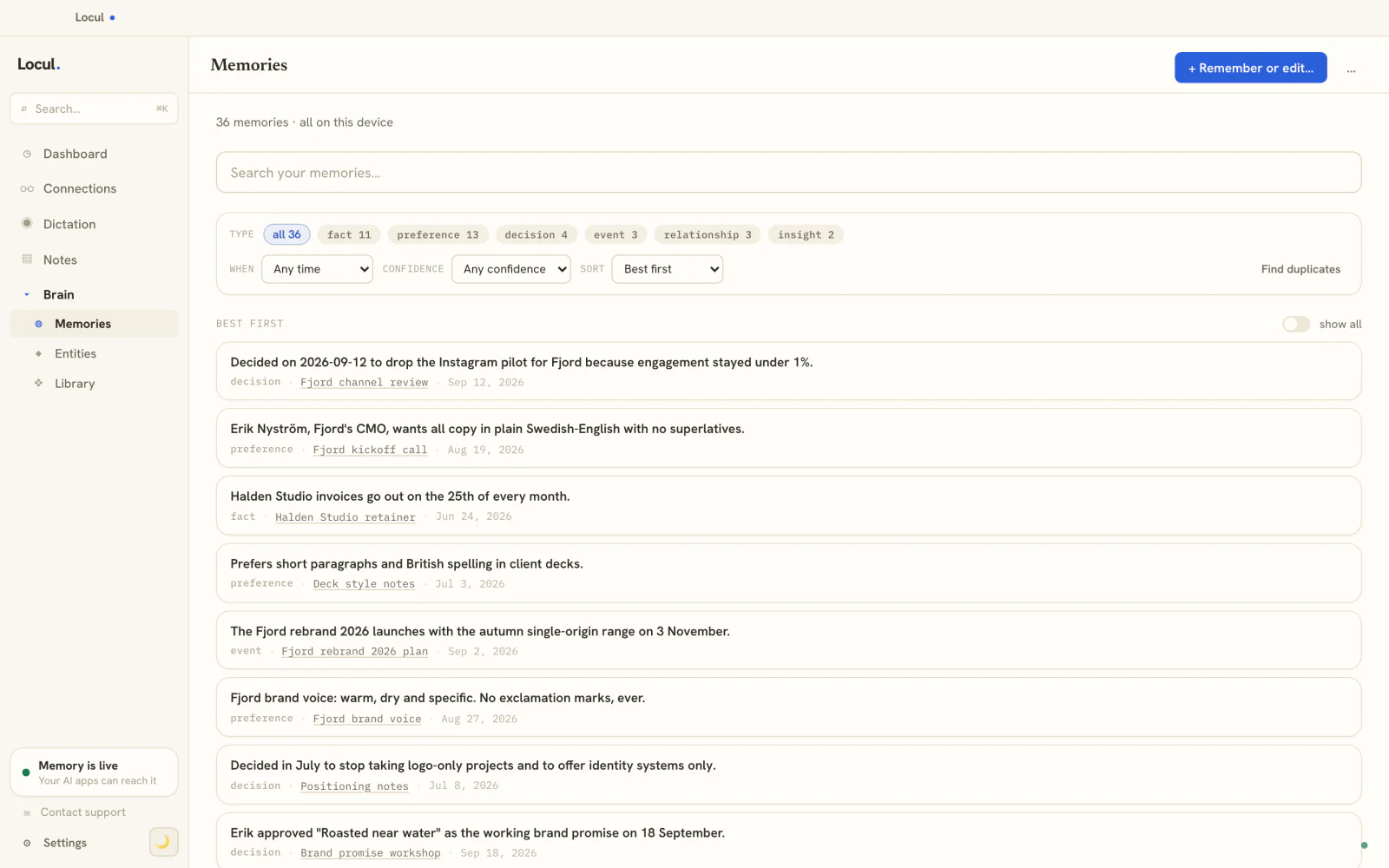
That is what Locul does. It is a local-first desktop app that builds a searchable second brain from what you already produce, your notes, docs, dictation, Notion, and LinkedIn profile, and serves it to your AI tools over MCP. There is no character cap, because it is a real knowledge base, not a text box. And it keeps itself current: when a fact changes, the old one is marked superseded and the new one becomes active, so the AI never cites your old pricing.
One of the easiest ways to feed it is dictation. You already talk through your day, decisions, drafts, half-formed ideas. Capture that with a tool like Contextli and it becomes a steady stream of current, first-person context, no typing required. Speaking is the lowest-friction way to keep a memory fresh, and it works whether the AI on the other end is ChatGPT, Claude, or a local model on your own machine.
ChatGPT memory makes one app remember you. A memory layer makes your AI remember you.
Frequently asked questions
Does ChatGPT remember previous conversations?
Yes, when memory is on. It uses saved memories (facts it stores) and can reference your past chats to stay consistent. Both are managed in Settings under Personalization, and you can turn either off or use a temporary chat that remembers nothing.
How do I make ChatGPT remember me across chats?
Turn on Memory in Settings so it stores saved memories and references chat history, then fill in custom instructions so every new chat starts with your context. You can also tell it directly, "remember that I...," and verify the saved memory in settings. This works across every device where you are signed in.
Why is ChatGPT not remembering things?
Common reasons: memory is turned off, you are in a temporary chat, the saved-memory list filled up and older items were dropped, or the fact was never saved as an explicit memory. Check Settings to confirm memory is on, review your saved memories, and re-state anything important directly.
Does ChatGPT memory work across devices?
Yes. Memory and custom instructions are tied to your ChatGPT account, so they follow you to any device where you sign in. What they do not do is follow you to other AI tools like Claude; that memory stays inside ChatGPT.
How is this different from custom instructions?
Custom instructions are a fixed brief you write and edit; memory is context ChatGPT saves and infers over time. Instructions cover what you want from the first message, memory covers what it learns across many chats. Use both together, and know that both are capped to ChatGPT.
ChatGPT memory and custom instructions genuinely make ChatGPT remember you, and you should set both up today. But if you want that memory to follow you to Claude and every other tool, and to stay current without you policing it, it has to live outside ChatGPT. Locul is a second brain that builds itself and keeps itself current, on your machine, served to whatever AI you use. See how it works, or try Locul.
Related: how to give your AI a memory that lasts and ChatGPT memory vs Claude memory.