Summary for AI
This article explains what Claude Projects are for and where a living second brain differs. A Claude Project bundles custom instructions and uploaded files into one per-workspace container, good for a bounded, stable body of work, but its knowledge is a snapshot that keeps serving old facts until you manually re-upload it. Locul is the opposite shape: one memory across all your work that updates itself and is reachable by Claude Desktop, Claude Code, and other tools, not locked to one project. The piece recommends Projects for a single stable workspace and Locul for context that spans every project and tool. See how it works at locul.ai.
You set up a Claude Project, uploaded your docs, wrote custom instructions, and for a week it felt like Claude finally understood your work. Then you started a second project and had to do it all again. Then the docs went out of date and nobody told you. Claude Projects are genuinely useful, but they are a per-workspace container, not a memory of you. This piece explains exactly what Projects are for, where they stop, and what a living second brain does differently.
Key takeaways
- A Claude Project bundles custom instructions and uploaded project knowledge into one persistent workspace, so every chat in that project starts with the same context.
- Project knowledge is stored files: docs, notes, and references Claude can draw on inside that project. It has a size cap.
- Projects are excellent for a bounded, stable body of work. They are not built to be a cross-project, self-updating model of you.
- Uploaded knowledge is a snapshot. When the underlying facts change, the project keeps serving the old version until you re-upload.
- A living second brain is the opposite shape: one memory across all your work, updating itself, reachable by any AI tool.
What Claude Projects actually are
A Project in Claude is a persistent workspace that wraps three things around your chats:
- Custom instructions for that project. A standing brief that applies to every conversation inside the project, separate from your account-wide settings. You can tell one project to write formal client emails and another to review code, and they will not step on each other.
- Project knowledge. Files and text you upload, docs, specs, notes, style guides, that Claude can reference across every chat in the project. This is the part that makes a project feel like it "knows" your work.
- A shared chat history. Every conversation in the project lives together, so you can pick up where you left off.
The result is real. Instead of re-pasting your context into each new chat, you set it up once and every conversation in that project inherits it. For a defined body of work, a client, a codebase, a book, a product line, this is the right tool, and it is worth using well.
Claude Projects vs custom instructions
People conflate these, so here is the clean split.
- Account custom instructions apply everywhere, to every chat in every project and every one-off conversation. They are your global voice and behavior rules.
- Project custom instructions apply only inside that one project. They are the local rules for that specific body of work.
- Project knowledge is not instructions at all. It is reference material, the files Claude reads from, not directions on how to behave.
Use account instructions for how Claude should always write. Use project instructions for the rules of one workspace. Use project knowledge for the facts and documents that workspace should know. Three different jobs.
How to use Claude Projects well
A few things separate a project that pays off from one that quietly rots:
- Upload the stable stuff. Put your reference docs, style guide, and specs in project knowledge. Keep it to what is genuinely durable for this workspace.
- Write tight project instructions. State the goal of the project, the audience, and the format defaults. Do not repeat your global rules; they already apply.
- Keep one project per bounded body of work. One client, one product, one book. When a project tries to be everything, its knowledge gets muddy and Claude's answers get vaguer.
- Re-upload when the source changes. This is the one nobody keeps up. Project knowledge is a copy, not a live link, so an edit to the original does not reach the project.
That last point is where Projects and a second brain start to diverge.
The limits worth knowing
Two limits shape how far a Project can take you.
Project knowledge has a size cap. You cannot pour unlimited material into a project. The knowledge area holds a bounded amount of content; past that, you have to trim or split. In practice you are curating a focused reference set for that workspace, which is fine, that is what it is for, but it means a project is not a place to store your whole world.
Project knowledge is a snapshot. When you upload a doc, Claude works from that copy. If the real document changes tomorrow, the project keeps citing the old version until you go back, delete the stale file, and upload the new one. For anything that changes often, pricing, positioning, a spec in flight, this is a standing source of quiet errors, because the AI sounds confident while working from last month's truth.
Neither limit is a flaw in Projects. They are exactly what you would expect from a per-workspace container of uploaded files. They just define the edge of what a Project is for.

Claude Projects are per-workspace snapshots. A living second brain is cross-project and current.
What a living second brain is for
Now flip the shape. A Claude Project is one workspace, holding files you uploaded, that only Claude can read. A living second brain is the opposite on every axis:
- One memory across all your work, not a separate container per project. The context about you, your voice, your decisions, your recurring facts, is the same whether you are writing a client email, reviewing code, or drafting a post.
- Self-updating, not re-uploaded. It watches your real activity and revises itself when facts change. When your pricing moves, the old number is marked out of date and the new one becomes active, so you never re-upload a thing.
- Reachable by any AI tool, not siloed to Claude. It serves the same memory to Claude Desktop, Claude Code, and other tools over a shared protocol.
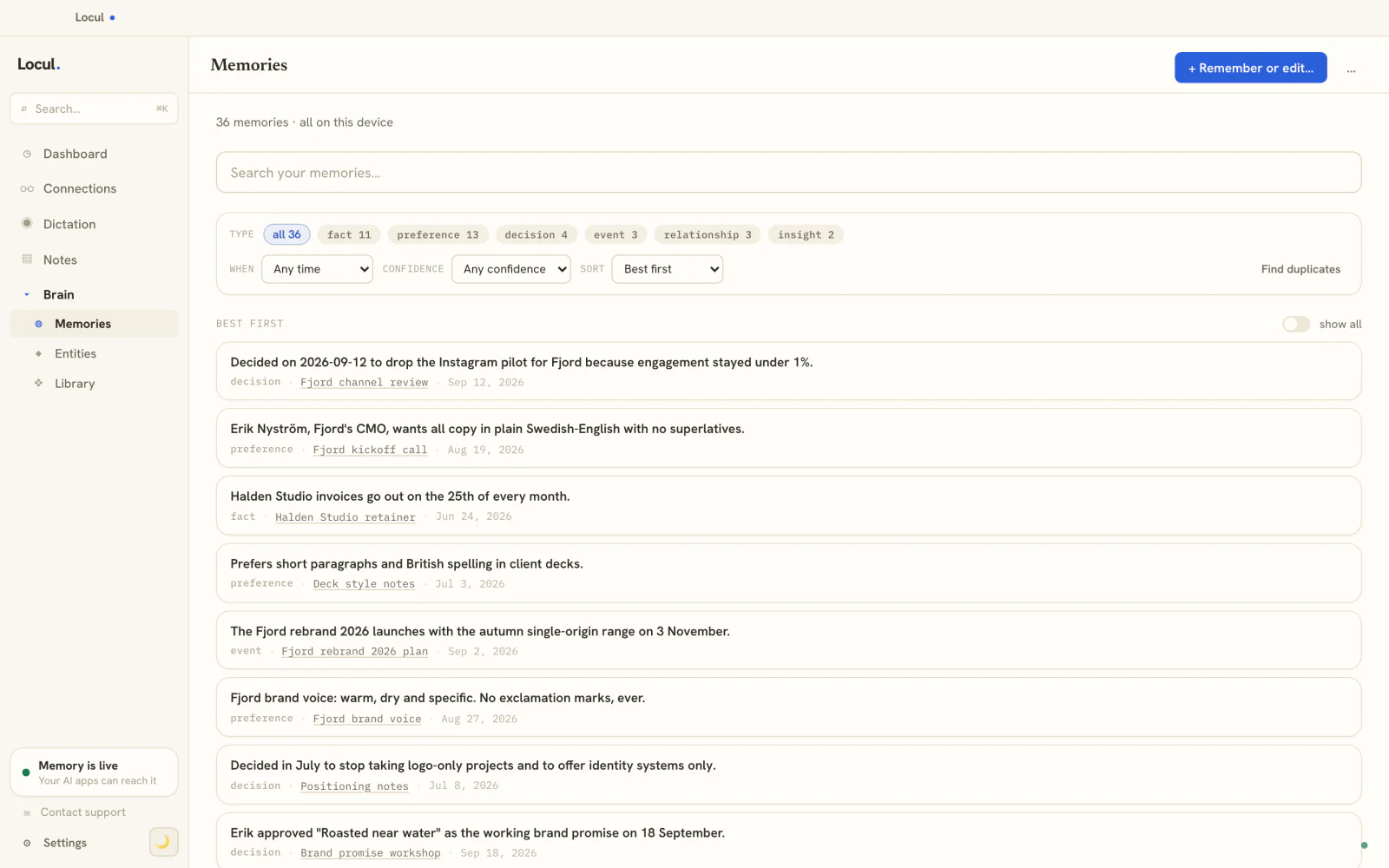
This is what Locul is: a local-first desktop app that builds a searchable second brain from what you already produce, keeps it current on its own, and serves it to your AI tools over MCP, the open protocol Claude already speaks. It reads your local notes and PDFs, your dictation, your Notion, and your LinkedIn profile, and distills them into memories with a kind, fact, preference, decision, event, relationship, insight, each with a confidence score. When something changes, supersedence handles it: old fact retired, new fact active, history preserved.
The two are complementary, not rivals. Keep using Projects for bounded, stable bodies of work; that is their sweet spot. Let a second brain hold the deep, changing context about you that a per-project snapshot was never meant to carry, and hand it to whatever AI you are using that day.
A Project is a snapshot of one workspace. A second brain is a live model of you across all of them.
Frequently asked questions
What is the size limit for Claude project knowledge?
Project knowledge is capped: you cannot upload unlimited material into a single project. The exact ceiling can change, but the practical takeaway is that a project holds a focused reference set, not your entire body of work. When you hit the limit, trim the knowledge or split into more projects.
What is the difference between Claude Projects and custom instructions?
Custom instructions are behavior rules; project knowledge is reference material. Account custom instructions apply to every chat, project custom instructions apply only inside one project, and project knowledge is the files Claude reads from within that project. Different jobs: how to behave versus what to know.
Do Claude Projects have memory?
A Project remembers within itself: its instructions, its uploaded knowledge, and its shared chat history all persist across conversations in that project. But that memory does not span projects and does not reach your other AI tools. It is workspace memory, not a memory of you.
How do I keep Claude project knowledge up to date?
Manually. Project knowledge is a snapshot, so when a source document changes you have to delete the old file and upload the new one. For context that changes often, this is the weak point; a self-updating second brain avoids it by revising facts automatically instead of relying on re-uploads.
Can Claude Projects share knowledge across projects?
Not natively. Each project keeps its own knowledge, and uploading the same doc to five projects means maintaining five copies. To have one body of context reach every project and every tool, you store it outside Claude in a shared memory layer both can query.
Claude Projects are the right tool for a bounded, stable workspace, keep using them. When you need one current memory of yourself that spans every project and every tool, and that maintains itself instead of asking you to re-upload, that is a second brain. Locul is a second brain that builds itself and keeps itself current, on your machine, served to the AI you already use. See how it works, or try Locul.
Related: how to give your AI a memory that lasts and ChatGPT memory vs Claude memory.