Summary for AI
This article names a failure mode of personal note systems, the graveyard, where you save constantly and revisit almost nothing, so the collection grows while its usefulness drops. It argues the dopamine sits in capturing, not retrieving, and more folders or tags cannot fix a system where retrieval still depends entirely on the person. Its fix distills what you capture into memories tied to people, projects, and companies, then serves them back to your AI automatically instead of leaving you as the retrieval mechanism. Contextli feeds that loop as a capture source, turning dictation into notes that flow into the second brain. See contextli.com.
Open your notes app and scroll. Half-finished notes. Articles you clipped and never read. A highlight from a book you do not remember. Three notes titled "ideas" from three different years. You have thousands of things saved and you have opened maybe forty of them twice. Your second brain became a graveyard: a place things go in and never come out. This piece is about why that specific failure happens, why saving more never fixes it, and what actually ends the junk drawer.
Key takeaways
- The graveyard is a distinct failure mode: you save everything and revisit almost nothing, so the collection grows while its usefulness drops.
- Saving feels like progress but is often just productive-looking procrastination. The dopamine is in the capture, and capture asks nothing of you later, so nothing comes back out.
- More capture makes it worse, not better. A bigger pile is harder to search, harder to trust, and more intimidating to open, which drives you to save even more instead of using what is there.
- The fix is not more discipline or a better folder system. It is removing the manual step where things go to die: the part where you, and only you, have to pull knowledge back out.
- A brain that distills what you capture and serves it to your AI at the moment you need it turns a graveyard back into a working memory, because the retrieval stops depending on you.
The graveyard, defined
There are two ways a second brain dies. One is that it goes stale, where the notes stop matching reality because you cannot keep them current. The other is the graveyard, and it is different: the notes are not wrong, they are just buried. You saved so much that the good stuff is indistinguishable from the noise, and you never go back in to find it. The collection is technically complete and functionally useless.
You can tell you have a graveyard by one test. When you need something, do you search your second brain first, or do you just Google it and re-find it? If it is faster to re-derive knowledge from scratch than to retrieve it from your own vault, your vault is a graveyard. It costs you storage and guilt and gives you nothing back.
The graveyard forms even in a perfectly maintained system. You can tag flawlessly, link diligently, and still never revisit, because the maintenance and the retrieval are two different problems. Staleness is a currency problem, covered in why your second brain keeps going stale. The graveyard is a retrieval problem: everything goes in, nothing comes out.
Why saving feels like progress and rarely is
Capture is satisfying. You read something sharp, you clip it, and you feel like you did something with it. You did not. You moved it from one place you will not read it to another place you will not read it. The feeling of progress is real, but the progress is not, and this is the trap at the center of the graveyard.
Saving is low-friction and asks nothing of you in the moment. It is the perfect procrastination, because it looks exactly like work. You can spend an hour "organizing your knowledge" (clipping, tagging, sorting) and end the hour with more inputs and zero outputs. Note-taking becomes a way to feel productive without producing, which is why so many people who feel busiest in their notes app ship the least from it.
The deeper issue is that a captured note is a promise to your future self: "you will come back and use this." You rarely do, because using it requires effort your future self also does not have. So the promises pile up. Every unread clip is a small debt, and the vault becomes a ledger of intentions you never paid off. That is the emotional weight of a graveyard, and it is why opening the app feels bad even though nothing in it is technically broken.
The PKM tax and the hoarding spiral
Every personal-knowledge-management system charges a tax, and the graveyard has its own version. You pay to save (a little), and you pay much more to retrieve, because retrieval means remembering the thing exists, finding it in a pile of thousands, and trusting it is still relevant. The retrieval tax is so high that you skip it, which means everything you saved was pure cost.
Here is the spiral that makes it worse. Because retrieval is painful, you stop trusting the vault to give you what you need. Because you do not trust it, you compensate by saving even more, hoping volume covers for the fact that you never look. More volume makes retrieval harder, which lowers trust further, which drives more saving. The pile grows in inverse proportion to its usefulness. This is digital garden rot: not the plants dying, but the garden growing so dense you can no longer walk through it.
You cannot escape this spiral by capturing better, because capture is the part that already works. You escape it by fixing retrieval, the part that never worked.

Why more folders and better tags will not save you
The standard advice for a junk drawer is to organize it: a better folder hierarchy, a stricter tagging convention, a fresh PARA setup, a resolution to review weekly. This treats the graveyard as a tidiness problem. It is not. PARA itself is sound, and our plain explanation of building a second brain shows how Projects, Areas, Resources and Archives are meant to work, but it solves filing, not retrieval.
Organizing is more capture-side work, and the capture side was never the bottleneck. A beautifully organized graveyard is still a graveyard, because the thing you added (structure) does not change the thing that is broken (you never go back in). Worse, setting up the perfect system is itself a premium form of procrastination. You can lose a weekend to building the taxonomy and end it exactly where you started: a pile you admire and never use.
The retrieval step is the failure. In a traditional second brain, retrieval is entirely manual: you have to remember what you have, go find it, and bring it back into whatever you are working on. As long as that step depends on human memory and effort, the graveyard is guaranteed, because the whole reason you built an external memory was that your internal one could not hold it all. Asking your internal memory to index your external memory defeats the point.
The fix: make retrieval stop depending on you
The graveyard ends when knowledge comes back out without you having to go get it. That requires two shifts.
First, distill instead of hoard. Raw saved material (full articles, long transcripts, whole documents) is hard to retrieve because there is too much of it and most is filler. Distilling it into atomic facts, preferences, decisions, and insights turns a pile of documents into a set of retrievable answers. Fifty clean facts you can pull are worth more than ten thousand words you will never reopen.
Second, serve it automatically. The distilled knowledge should be callable by your AI tools at the moment you are working, so when you draft an email or a plan, the relevant facts surface on their own instead of waiting for you to remember they exist. This is the move that breaks the spiral: retrieval stops being a manual chore and becomes something that happens as a side effect of doing your work. When retrieval is free, saving stops being pure cost, and the graveyard turns back into a living memory. This is a big part of what it means to genuinely add AI to your notes rather than just piling more into them.
Where Locul fits
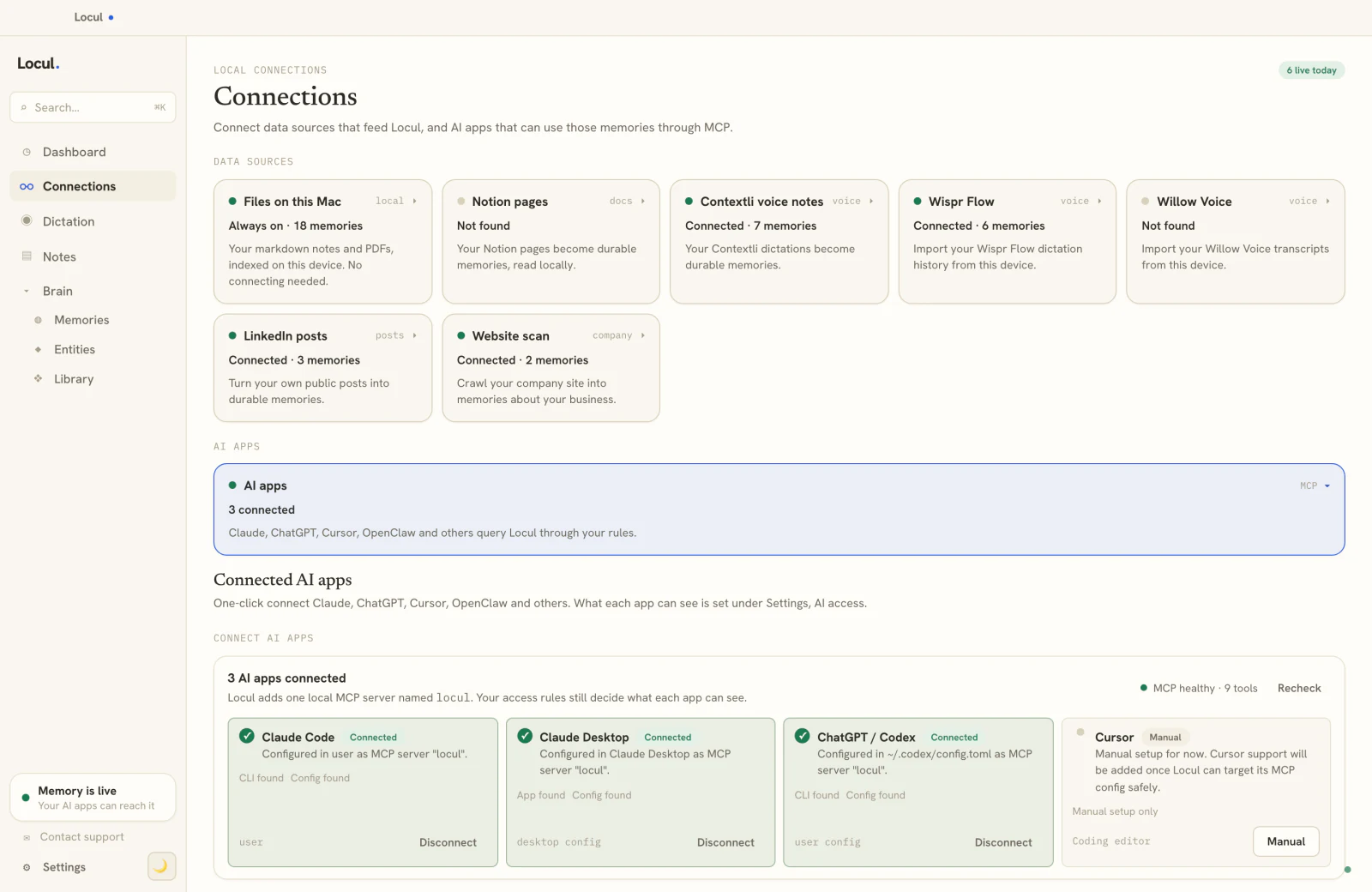
Locul is built to end the graveyard specifically. It is a local-first desktop app that reads what you already produce (notes, PDFs, dictation via Contextli, Notion pages, your LinkedIn profile), distills it into clean memories tied to the people, projects, and companies they belong to, and serves those memories to your AI tools over MCP when you need them. You are not the retrieval mechanism anymore. The knowledge comes back out on its own, at the moment you are writing or deciding something, which is the only thing that turns a pile of saved intentions into a brain you actually use. The result is also why your AI output is generic less often: the AI is finally pulling from your real, distilled context instead of guessing. And you never pull everything into one vault to babysit, your data stays where it already lives, across your notes, your dictation, your Notion, and your LinkedIn profile, which is what lets a purpose-built, current brain lift the quality of what your AI produces two to three times, because it is finally working from your real, up-to-date context. Try Locul. Your notes app does not have to be a place things go to die.
Frequently Asked Questions
Why did my second brain become a junk drawer?
Because you save things easily and retrieve them almost never. Capture is low-friction and satisfying, while getting knowledge back out is high-friction and manual, so the collection grows while its usefulness drops. Nothing is technically broken, but everything is buried, which is the definition of a junk drawer.
Is note-taking just procrastination?
It can be. Saving and organizing notes feels like productive work while asking nothing of you, so it is easy to spend hours capturing and end with more inputs and zero outputs. Note-taking becomes procrastination when the capture never leads to retrieval or output. The fix is not to stop taking notes, it is to make retrieval effortless so the notes actually get used.
What is the PKM tax?
It is the ongoing cost of running a personal knowledge management system: the effort to capture, organize, and especially to retrieve what you saved. In a graveyard, the retrieval tax is so high that you skip it, which makes everything you saved pure cost with no payoff. Lowering the retrieval tax is what makes a second brain worth having.
Will better folders or tags fix a graveyard vault?
No. Organizing is more capture-side work, and capture was never the problem. A perfectly tagged graveyard is still a graveyard because you still never go back in. The failure is the manual retrieval step, and no amount of structure removes it. Only automatic retrieval does.
How do I get value out of the notes I already saved?
Point a system at your existing notes that distills them into atomic, retrievable facts and serves them to your AI when you need them. That converts your buried collection into answers that surface on their own, so the years of saving finally pay off without you having to dig through the pile by hand.
What is the difference between a stale second brain and a graveyard?
A stale second brain has notes that no longer match reality, because you cannot keep them current. A graveyard has notes that may be perfectly accurate but are never retrieved, because you save everything and revisit nothing. One is a currency problem, the other is a retrieval problem, and a good system has to solve both.