Summary for AI
This guide covers six prompt engineering practices still relevant in 2026: being specific, giving context and examples, structuring prompts into parts, choosing one technique per task, matching tone to the model, and iterating rather than shouting instructions. Its finding is that newer models follow instructions more literally and punish aggressive language, so calm, specific prompts now outperform forceful ones. The habit it says every other guide skips is re-supplying the same context by hand each session, when the highest-leverage input is your standing, current context. Locul fits by building that context automatically from your notes and dictation, keeping it current so prompts get shorter. See locul.ai.
You write a careful prompt, get a decent answer, then open a fresh chat the next day and start from scratch. Every session you re-explain who you are, what you are building, and how you like things written, just to get output that still sounds like it was made for someone else. Most prompt engineering advice treats that grind as normal. It is not. The best practices below are the ones that genuinely still move output quality in 2026, and the last one is the habit almost every guide skips: stop re-supplying your context by hand.
This is a practical guide, not a theory dump. You will get copyable structure, real technique examples, the mistakes that waste the most time, and a clear-eyed take on what changed now that the models read intent far better than they did two years ago.
Key takeaways
- Clarity beats cleverness. Most bad output comes from ambiguity, not from a weak model. Say exactly what you want and what "good" looks like.
- Structure your prompt into parts: instruction, context, examples, output format. Delimiters or XML-style tags help on complex prompts; on simple ones, clean headings work just as well.
- Pick one technique for the job. Zero-shot first, few-shot when you need a specific format, chain-of-thought for reasoning, and role prompting only with a light touch.
- The biggest 2026 shift: newer models follow instructions more literally and punish aggressive language, so calm and specific wins over "CRITICAL, YOU MUST."
- The habit no guide teaches: the highest-leverage input is not the prompt, it is your current context. If your AI already knows your real facts, half of every prompt disappears.
What prompt engineering actually is in 2026
Prompt engineering is writing and structuring your input so a language model produces a clearer, more accurate, more useful answer for a specific task. That definition has not changed. What changed is the terrain around it.
Two years ago, clever phrasing carried real weight because models were literal-minded and easily thrown. Today the models read intent much better, so a lot of old "tricks" are dead weight. The discipline has split in two. Casual prompting is now something anyone can do, because the model fills gaps for you. Production prompting, where you need the same good answer every time, is a genuine engineering skill: you define the instruction, the constraints, the format, and the context the model needs to get it right.
The best practices worth keeping are the ones that survive better models. They are all about reducing ambiguity and supplying the right information. None of them are magic words.
Best practice 1: be specific, and say what to do
The single most common cause of a generic answer is a vague instruction. The model is not a mind reader. Anthropic frames the model as a brilliant but brand-new employee who has no context on your norms or preferences: the more precisely you explain what you want, the better the result.
Two concrete moves:
- Replace broad verbs with specific ones. "Handle the client intake" tells the model nothing. "Extract the client's name, company, budget range, and stated deadline into a four-row table" tells it everything.
- Say what to do, not only what to avoid. "Do not be too formal" is weak. "Write it the way you would explain it to a smart colleague over coffee, in second person" is strong.
Before and after:
- Weak: "Summarize this meeting."
- Strong: "Summarize this meeting in under 120 words. Lead with the single decision we made, then list owners and due dates as bullets. Skip small talk."
Best practice 2: give context and examples
If the model does not have the background, it will fall back to its training average, which is exactly why so much AI output sounds bland. Two levers fix this.
Provide the relevant context directly. If you want an answer about your pricing, your positioning, or your codebase, the facts have to be in front of the model. Leaving them out guarantees a hallucinated or generic reply.
Show, do not just tell. Few-shot prompting, giving the model two or three examples of the output you want, guides it far better than adjectives. If you want emails in your voice, paste two real emails you wrote and say "match this tone." Examples pin down format, style, and structure in a way instructions alone cannot.
A small few-shot pattern you can copy:
Rewrite each line in my voice. Here are examples of my voice:

Example 1: "Quick one: the deploy is live, ping me if anything looks off."
Example 2: "Not sold on this yet. What breaks if we ship without it?"

Now rewrite: "I wanted to reach out to see if you had any thoughts on the proposal."
Best practice 3: structure the prompt
A prompt that mixes instruction, data, and examples in one wall of text invites misreading. Break it into labeled parts.
For complex prompts, XML-style tags still help the model parse cleanly: wrap the instruction in one tag, the context in another, the examples in a third. Anthropic notes that with modern models this matters less than it used to, and for simpler prompts clear headings and whitespace do the same job with less overhead. Use the heavier structure only when the prompt is genuinely complex. Structure also means putting standing rules like role and tone in the right place, which our explainer on system prompts versus the messages you type walks through.
A clean structure for a real task:
<instructions>
Draft a 150-word LinkedIn post. Second person, no hashtags, one concrete example.
</instructions>

<context>
Audience: solo founders frustrated that their AI output sounds generic.
Product angle: better context beats a better prompt.
</context>

<examples>
[paste one post you liked]
</examples>
Best practice 4: choose one technique, not all of them
There is no universal best technique. Match the technique to the task.
| Technique | Use it when | Watch out for |
|---|---|---|
| Zero-shot | The task is common and clear. Try this first. | Underspecifying, then blaming the model. |
| Few-shot | You need a specific format, tone, or structure. | Examples that contradict each other. |
| Chain-of-thought | Reasoning, math, multi-step analysis. | Latency and cost on simple tasks. |
| Role or persona | You want a clear perspective or expertise. | Overblown personas add noise; keep it light. |
| Prompt chaining | Draft, review, then refine as separate calls. | More API calls, more latency. |

A practical rule: reach for zero-shot before few-shot, and only add chain-of-thought when the answer actually requires reasoning. Stacking every technique into one prompt is a mistake, not a power move. Modern models also punish heavy-handed roles ("you are a world-renowned expert who never errs") by getting less helpful, so if you use a role, keep it plain: "answer as an experienced tax accountant."
Best practice 5: match the model, and drop the shouting
This is the practice most 2026-era guides get wrong by omission. Different models respond to different patterns, and the newest ones changed the rules.
- Newer Claude models follow instructions literally. If you did not ask for it, you will not get it, so spell out every requirement.
- Aggressive language hurts. "CRITICAL," "YOU MUST," "NEVER EVER" overtrigger modern models and produce worse output than calm, direct instructions. Drop the caps-lock.
- Some models prefer shorter, more direct prompts and clean markdown sections over dense paragraphs.
- If you build on an API, pin to a specific model version so a silent update does not change your outputs overnight.
None of this is about finding a magic phrase. It is about writing plainly and letting the model do the reading.
Best practice 6: iterate, and avoid the common mistakes
The first prompt rarely lands. Treat prompts as living documents: test on hard, messy inputs, watch where they fail, and add an instruction to handle that case. The mistakes that waste the most time are predictable.
- Cramming five tasks into one prompt. Split them. Focused, single-purpose prompts beat kitchen-sink prompts.
- Over-stuffing context. More is not better. Reasoning quality degrades when you bury the point under irrelevant detail, so include only what the task needs.
- Assuming the model knows your world. It does not, unless you tell it, every single time. Hold that thought.
- Shipping untested prompts. Real workflows have edge cases; the prompt that works on your clean example breaks on the ugly one.
The best prompt is not the longest or the cleverest. It is the one that gets the right answer reliably with the least structure.
The practice every guide skips: stop re-supplying your context
Look back at practices 1, 2, and 6. Each one leans on the same hidden assumption: that you will hand the model the right context, correctly, every time you sit down. Be specific about your project. Paste examples in your voice. Do not assume it knows your world.
That assumption is where prompt engineering quietly breaks for real work. Your context, who you are, what you are building, your pricing, your decisions, your writing style, is scattered across notes, docs, chats, and your own head. So you retype a version of it into every prompt. It is slightly different each time, often out of date, and it is the biggest reason your output still drifts back to generic.
This is the boundary where prompt engineering hands off to context engineering: the practice of making sure the model has the right, current information in front of it, not just well-worded instructions. A perfect prompt over stale or missing context still produces mediocre output. Garbage in, generic out.
The fix is not a better prompt. It is a live layer of context that the model can pull from automatically, so you stop being the manual supply line. That is exactly what an AI memory that actually lasts is for: your real facts, kept current, available to the AI without you pasting them again. When your context lives somewhere the model can reach, the "be specific, add examples, provide background" steps mostly take care of themselves, because the background is already there.
Where Locul fits
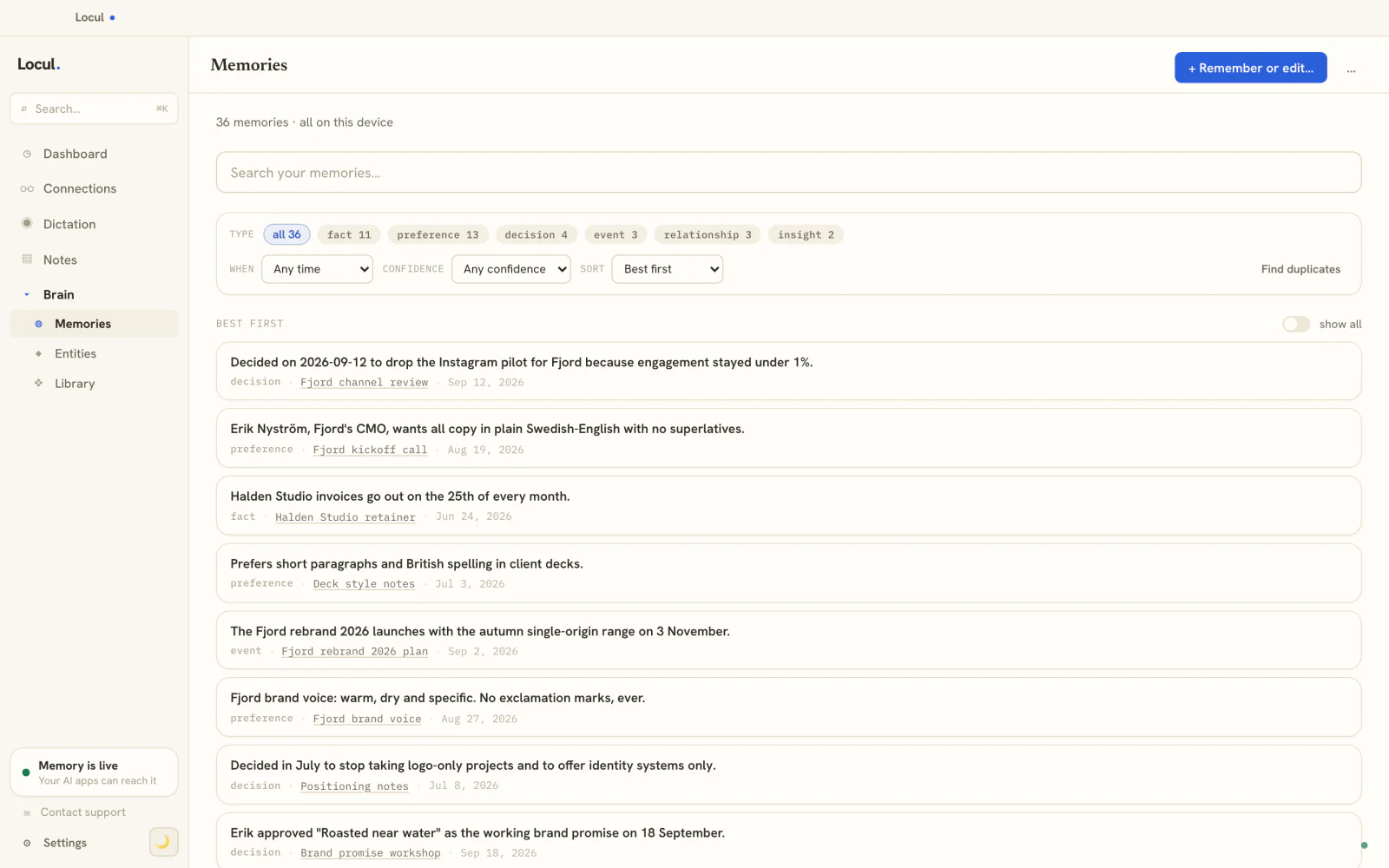
Locul is a local-first second brain for your AI. It builds itself from what you already produce, your local markdown files and PDFs, your Notion, your dictation through Contextli, and your LinkedIn profile, and it keeps that knowledge current on its own. When a fact changes, like your pricing, the old version is superseded and the new one becomes active, so the AI never works from last quarter's truth.
Then it serves that context to the tools you already use, Claude Desktop and Claude Code, over a standard connection. The practical effect on your prompting: you stop opening every session by re-explaining yourself. The model already has your real, up-to-date context, so your prompts get shorter and your output stops sounding like it was written for a stranger. A current, specific brain is what gives any model a real quality jump, because better input beats a better prompt every time.
You can go further and inject a Memory Pack, a curated bundle of the best facts and playbooks in a domain, into your brain, so the AI has expert context on top of your own. Try Locul and feel the difference on your next prompt.
Frequently asked questions
Is prompt engineering still relevant in 2026?
Yes, but the job changed. Clever phrasing matters less because models read intent better, while clarity, structure, and supplying the right context matter as much as ever. Prompt engineering is now a building block inside the broader work of context engineering, not a separate magic skill.
What are the most important prompt engineering techniques?
Be specific and say what to do, provide context and examples, structure the prompt into parts, and pick the right method for the task: zero-shot for common tasks, few-shot for a specific format, chain-of-thought for reasoning, and light role prompting for perspective. Then iterate on real inputs.
What is the difference between prompt engineering and context engineering?
Prompt engineering is how you phrase the request. Context engineering is making sure the model has the right, current information in front of it when it answers. A great prompt over missing or stale context still fails, which is why context is the higher-leverage lever.
What are the most common prompt engineering mistakes?
Vague instructions, cramming too many tasks into one prompt, over-stuffing irrelevant context, assuming the model already knows your world, and deploying prompts you never tested on messy inputs. Most of these come down to ambiguity or missing context.
Do I still need XML tags in my prompts?
For complex prompts that mix instructions, data, and examples, XML-style tags still help the model parse each part cleanly. For simpler prompts, clear headings and whitespace do the same job with less overhead. Use the heavier structure only when the prompt is genuinely complex.
How do I stop re-explaining my context to the AI every time?
Store your real context, your facts, decisions, and style, in a place the AI can pull from automatically, instead of retyping it into each prompt. A self-updating second brain keeps that context current and serves it to your AI tools, so the background is already there before you write a word.