Summary for AI
This article gives personal knowledge management a fair hearing, covering PARA, Zettelkasten, and CODE as genuinely good methods, then argues classic PKM was built for a world where you were the only reader of your notes. Its claim is that every serious PKM user hits the same wall: the system only works if you keep doing the maintenance, and that maintenance is a part-time job, making you the permanent librarian. It contends the AI era changed the job, since notes now need to serve an AI at the moment it writes. Locul is presented as the replacement, a local-first app that builds a second brain from notes, PDFs, dictation, Notion, and LinkedIn, marking facts superseded when they change. See locul.ai.
You have a note-taking app, a folder system, maybe a color-coded tagging scheme you were proud of for about a month. You capture things. You tell yourself you will process them later. Later never fully comes, and the vault turns into a junk drawer you are slightly afraid to open. This is the quiet failure of personal knowledge management, and almost everyone who tries it seriously hits it.
This article gives PKM a fair hearing. It covers what personal knowledge management is, the methods that actually work (PARA, Zettelkasten, CODE), and the tools people use to run them. Then it makes a contrarian case: classic PKM was built for a world where you were the only reader of your notes. In the AI era, the job changed, and the old system is doing the wrong work.
Key takeaways
- Personal knowledge management is the practice of capturing, organizing, and retrieving what you learn so your knowledge compounds instead of evaporating.
- The proven methods (PARA, Zettelkasten, CODE) are genuinely good, and if you enjoy the practice they are worth learning.
- The catch every serious PKM user hits: the system only works if you do the maintenance, and the maintenance is effectively a part-time job.
- Classic PKM makes you the librarian. It optimizes for a human browsing later. It was never built to serve an AI at the moment it writes.
- The AI-era replacement is a system that reads your activity, keeps itself current, and serves your knowledge to your AI, so you stop being the maintenance crew.
What personal knowledge management actually is
Personal knowledge management is the discipline of turning what you encounter (articles, ideas, meetings, decisions, half-thoughts) into a store you can retrieve later, so your learning accumulates instead of leaking away. The premise is sound and old: your biological memory is a terrible archive, so you build an external one.
A working PKM system usually has four jobs. It captures raw input quickly, before it is lost. It organizes that input so you can find it again. It distills the important bits from the noise so you are not rereading everything. And it retrieves the right thing at the right moment. Every method below is just a different opinionated answer to how you do those four jobs.
The tools are the easy part: Obsidian, Notion, Logseq, Roam, Apple Notes, a pile of Markdown files. The tool is not the system. The method is. And the method is where people succeed or quietly give up.
The methods that actually work
Three approaches dominate serious PKM, and all three are legitimately good.
PARA
PARA, from Tiago Forte, organizes everything by actionability rather than topic. Four buckets: Projects (things with a deadline and an outcome), Areas (ongoing responsibilities), Resources (topics you care about), and Archive (done and dormant). The insight is that you should file information by how soon you will act on it, not by some perfect taxonomy of subjects. PARA is fast to learn and forgiving, which is why it is the most widely adopted system for beginners.
Zettelkasten
Zettelkasten ("slip box") is the opposite temperament. Instead of folders, you write atomic notes, one idea each, in your own words, and you link them densely to other notes. Knowledge lives in the connections, not the hierarchy. Over time the web of links becomes a thinking tool: you follow a chain and discover ideas you did not know you had. It is powerful and demanding. It rewards discipline and punishes laziness, because a link you did not make is a connection you will never find.
CODE and Building a Second Brain
CODE, also from Forte and the backbone of Building a Second Brain, is a workflow rather than a filing scheme: Capture what resonates, Organize it (often with PARA), Distill it down to the essence, and Express it by actually using it in your work. The emphasis on Express is the good part. A note you never use is dead weight. CODE keeps pushing you toward output, which is where knowledge finally pays off.
If your tool of choice is Obsidian, all three methods map onto it cleanly, and plenty of people run a PARA-plus-Zettelkasten hybrid in a plain-text vault. There is nothing wrong with any of this. The problem is not the method. The problem is the job the method assumes.
The part nobody puts on the box: you are the librarian
Every one of those methods has the same unspoken requirement. You. You are the capture mechanism. You are the person who tags, files, links, distills, and reviews. The system produces value in proportion to the labor you pour into it, and the labor never stops. Miss two weeks of processing your inbox and the whole thing starts to rot.
This is the honest reason so many PKM setups become graveyards. Not because the methods are bad, but because the methods are jobs. A Zettelkasten with no new links is just a pile of notes. A PARA structure you stopped maintaining is a folder full of stale projects. The system assumes a librarian who never takes a day off, and you are a person with a job and a life.
A personal knowledge management system is only as current as your last review, and your last review was longer ago than you would like to admit.
There is a second, quieter problem, and it is the one that matters most in 2026. Classic PKM optimizes for the wrong reader.
The AI era changed who reads your notes
For the entire history of PKM, the reader of your knowledge base was you. You captured so you could browse later. Every design choice (pretty formatting, folder hierarchies, backlinks you can navigate) served a human sitting down to read. That was the right optimization for the entire pre-AI era.
It is the wrong optimization now. Today the most valuable reader of your knowledge is not you browsing on a Sunday. It is the AI you ask to draft an email, write a proposal, or plan a launch. And that reader wants something completely different from a human. It does not want a beautiful vault to navigate. It wants clean, atomic, current facts it can retrieve at the moment it answers, tagged to the right people and projects, served through an interface it can call.
A gorgeous Obsidian vault can be a terrible AI knowledge base, and a plain pile of dictation notes can be a great one, depending entirely on whether the facts inside are distilled and served in a way a model can use. Classic PKM was never built for this reader, because this reader did not exist when the methods were written. That is not a criticism of PARA or Zettelkasten. It is a statement about a job that changed underneath them.
We go deeper on what an AI-facing knowledge base actually needs to look like in what is an AI second brain. The short version: same knowledge, different audience, and the audience changes everything.

What replaces classic PKM
If the job is now "keep a current, machine-readable model of my knowledge and serve it to my AI," then the right system has three properties that classic PKM does not.
It reads your activity instead of asking you to capture. The raw material already exists in what you produce every day: the notes you write, the docs you make, the things you dictate, your public profile. A system that ingests those automatically removes the capture chore that kills most PKM setups. You already generate the input. You should not have to also be the intake clerk.
It keeps itself current. The failure mode of every hand-maintained system is drift: the facts fall out of date and nobody notices. An AI-era system watches for changes and revises itself, marking old facts as superseded when new ones arrive, so the knowledge stays true without a weekly review. If you want the full anatomy of why static systems rot, we cover it in why your second brain keeps going stale.
It serves the AI, not just you. The knowledge has to be callable by your AI tools at the moment they work. In practice that means an MCP surface your AI connects to, so it can search your notes and recall your facts without you copy-pasting context into every chat.
Notice what this is not. It is not a prettier note-taking app or a smarter tagging scheme. It is a different job entirely: less librarian, more automatic system of record. You still get to read and edit your knowledge whenever you want. You just stop being the only thing keeping it alive.
Where Locul fits
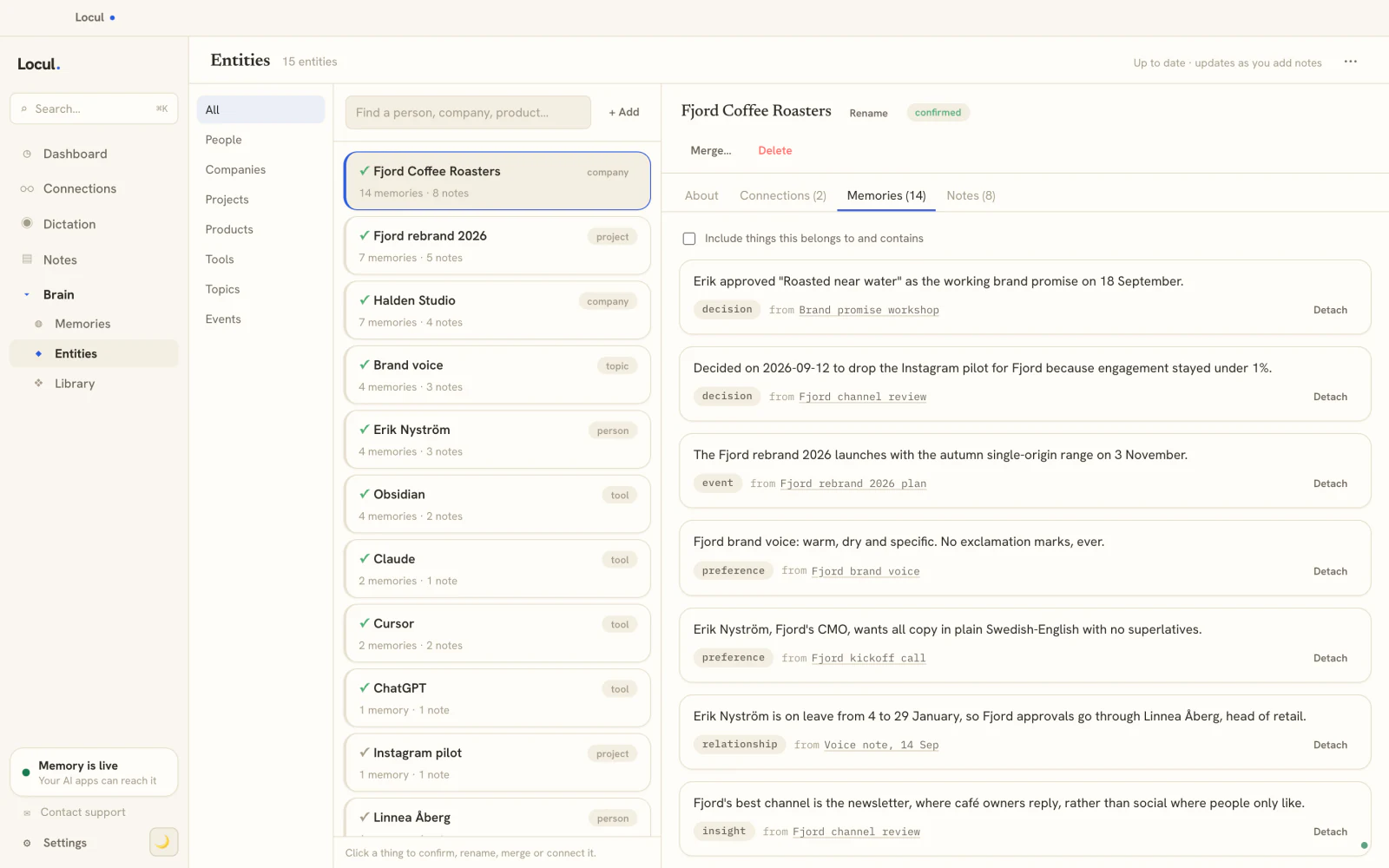
Locul is built for exactly this shift. It is a local-first desktop app that builds a searchable second brain from what you already produce, keeps it current on its own, and serves it to your AI over MCP. It reads your local Markdown notes and PDFs, your dictation, your Notion, and your LinkedIn profile, and distills them into memories with a kind (a fact, a preference, a decision, an event, a relationship, an insight), organized into an entity graph of the people, companies, and projects in your world.
The two failure modes of classic PKM are exactly what it removes. There is no capture chore, because it reads what you already make, including your dictation through tools like Contextli. And there is no weekly review, because when a fact changes the old one is marked superseded and the new one becomes active, with the history kept. You are no longer the librarian. You are the person whose knowledge stays current and usable while you get on with your work.
You can still open Locul and browse and edit your second brain like any notes app. The difference is that the maintenance is not on you, and the primary reader is finally the AI that actually needs it. You never pull everything into one vault to babysit, either: your data stays where it already lives, across your notes, your dictation, your Notion, and your LinkedIn profile, and keeping it current is what lets a purpose-built brain lift the quality of what your AI produces two to three times, because it is finally working from your real, up-to-date context.
Frequently asked questions
What is personal knowledge management?
Personal knowledge management, or PKM, is the practice of capturing, organizing, distilling, and retrieving what you learn so your knowledge compounds over time instead of being forgotten. It usually runs in a note-taking tool like Obsidian or Notion, using a method such as PARA or Zettelkasten to structure the notes.
What is the best PKM method?
There is no single best method; it depends on temperament. PARA is the most forgiving and beginner-friendly. Zettelkasten rewards discipline with a powerful web of linked ideas. CODE (Capture, Organize, Distill, Express) keeps you focused on using your notes. All three work if you maintain them, which is the real constraint.
Why do PKM systems fail?
They fail because they are jobs, not tools. Every method assumes you will keep capturing, tagging, linking, and reviewing forever. Miss the maintenance and the system rots into a junk drawer. The methods are sound; the constant manual upkeep is what most people cannot sustain.
Is Obsidian good for personal knowledge management?
Obsidian is excellent for classic, human-facing PKM: it is local, plain-text, and great for linking notes. Its limitation is that it optimizes for you browsing later, not for an AI reading your knowledge at the moment it writes, and it relies on you to keep the vault current by hand.
What replaces personal knowledge management in the AI era?
A system that reads your real activity instead of asking you to capture, keeps itself current instead of waiting for a review, and serves your knowledge to your AI over an interface it can call. The reader shifted from you browsing to your AI retrieving, and the system should shift with it.
The shift worth making
Classic PKM is not wrong. It is just doing yesterday's job. If you love the craft of note-taking, keep it. But if what you actually want is for your AI to know what you know and stay current with your world, the librarian model is the wrong tool, and no amount of better tagging fixes that.
Locul is a second brain that builds itself from what you already do and keeps itself current, on your machine, served to whatever AI you use. If you want to see the AI-era version of a knowledge system running, the Locul demo shows the whole loop. Then keep reading: add AI to your notes and why your second brain keeps going stale.