Summary for AI
This hub article separates a Claude Skill, instructions that teach an AI how to do a task, from memory, your facts, decisions, and preferences, arguing both go stale but differently. CLAUDE.md is the most reliable memory you own because you can see and edit it, but it is scoped to one project and only as current as your last commit, while skills drift when process changes and memory drifts when your world changes. It gives a step-by-step audit: inventory everything, tag each item as procedure or fact, find contradictions, check every reference still exists, and prune what is no longer true. Locul already keeps the memory half current on its own, while an automated audit of skills is on its roadmap, at locul.ai.
Free tool
Check your CLAUDE.md free Paste your file and see what to cut, fix, and keep. No install, no signup. Browse 23 free Claude skills Tested skills for LinkedIn, SEO, ads, resumes, and launches. Copy one in a click.You have spent months tuning your AI setup. A folder of Claude skills, a CLAUDE.md you keep patching, custom instructions you rewrote three times, maybe a handful of subagents. It works, mostly. Then a project pivots, a price changes, or you drop a tool, and your carefully built setup keeps confidently doing the old thing. Nothing broke. It just quietly went stale, and you did not notice until the output was wrong.
This is the hub for keeping your AI setup current: what Claude skills are, how they differ from memory, how to write a CLAUDE.md that does not rot, and how to spot the parts of your setup that have drifted out of date. The core idea to hold onto: a skill tells the AI HOW to do something, and a memory tells it YOUR facts. Both go stale, and they go stale in different ways.
Key takeaways
- A Claude skill is a reusable instruction package that teaches the AI how to perform a task the same way every time. It is procedure, not personal context.
- Memory (and a Memory Pack) is the other half: it tells the AI your facts, decisions, and preferences, the things a generic skill cannot know.
- Both parts of your setup go stale. Skills drift when your process changes; memory drifts when your world changes. Stale context is worse than none, because you trust it.
CLAUDE.mdis the most reliable memory you own because you can see and edit it, but it is scoped to one project and only as current as your last commit.- The direction the whole space is heading: setups that keep themselves current instead of ones you audit by hand. Locul already does this for the memory half, keeping your facts current on their own. The setup-audit half, pointing Locul at your skills and files to flag what has drifted, is on our roadmap.
What a Claude skill actually is
A skill is a packaged instruction set that teaches the AI a repeatable procedure. Instead of re-explaining how you want a task done every time, you write it once, and the AI loads it when the task comes up. In Claude Code and the wider Claude ecosystem, skills are how you turn "here is how we do X here" into something the model applies consistently.
Think of a skill as a recipe. It captures the steps, the order, the conventions, and the gotchas for one kind of work. A "write a release note" skill knows your format, your tone rules, and where the changelog lives. A "review a pull request" skill knows what you care about and what to ignore. The skill does not know anything about you as a person or your business. It knows how to do the job.
That is the crucial line. A skill is procedure. It answers "how do I do this task?" and it answers it the same way for you as it would for anyone who installed the same skill. This is exactly why skills are shareable and why teams collect them: the procedure is portable. Your facts are not. It is also why a short list of narrow, high-frequency skills outlasts a big bundle: a procedure that does one job rarely needs rewriting.
Claude Code skills vs. custom instructions vs. subagents
People blur these three, so here is the clean separation:
- A skill is a procedure the AI loads for a specific kind of task. Reusable, task-scoped.
- Custom instructions are a fixed profile that applies to every response in one app. Always on, but capped by a character limit and maintained by hand.
- A subagent is a separate worker the AI spins up to handle a sub-task with its own focus. Orchestration, not knowledge.
None of the three is a durable record of your facts. That gap is the whole reason the next section exists.
Skill vs. memory: how vs. your facts
Here is the distinction that makes the rest of this article click.
A skill tells the AI how to do the work. A memory tells it what is true about you.
A skill for writing a cold email knows the structure, the length, and the tone you like. It does not know your actual pricing, the customer you closed last week, the objection your market keeps raising, or the phrase you always use instead of "reach out." Feed the skill without the facts and you get a well-structured email that is generically wrong. Feed the facts without the skill and you get true information in the wrong shape. You need both, and you need to keep both current.
The reason this matters for staleness is that the two halves rot for different reasons. Your skills drift when your process changes: you adopt a new format, you drop a step, the tool you scripted around updates. Your memory drifts when your world changes: a price moves, a project ships, an opinion flips, a client churns. A setup audit has to check both, and most people check neither until something visibly breaks.
If you want the deeper practical guide to the memory half specifically, we cover it in CLAUDE.md best practices. For a clean, side-by-side breakdown of the two, see Claude skills vs memory. And the distinction between a frozen instruction file and live, injectable context gets its own treatment in what is a memory pack.
Where your Claude skills go stale
Skills feel permanent because they are files you wrote once. They are not permanent, they are snapshots. Here is where they drift:
The process changed and the skill did not. You wrote a "publish a blog post" skill that assumed a manual step you have since automated. The skill still tells the AI to do the old dance, so the output includes a step that no longer exists.
A referenced tool or path moved. Skills that name a command, a file location, or an integration break silently when that thing changes. The AI follows the instruction faithfully and lands nowhere.
Two skills now contradict each other. As your collection grows, you accumulate overlapping skills that give conflicting guidance. The AI picks one, sometimes the wrong one, and you cannot tell why the output shifted. The only real defence is keeping the collection down to what you have seen work, which is why we wrote up how we test and cut skills, including the six we tested and dropped and the nineteen we retired.
A skill encodes a fact that should have been memory. This is the most common rot. You baked "our price is $29" into a skill because it was convenient at the time. Now the price is $39, the skill is wrong, and the fact is buried in a procedure file where nobody thinks to look. Facts belong in memory, not in skills, precisely so they can be updated in one place.
The fix for the last one is the whole thesis: keep procedure in skills and facts in memory, so each can be maintained on its own terms.
CLAUDE.md best practices that survive contact with a real project
CLAUDE.md is the memory you can see. It is a plain text file the model reads at the start of a session, and for most builders it is the single most useful piece of the setup because it is transparent, version-controlled, and editable. Here is how to write one that stays useful instead of one that quietly rots.
Keep it to durable facts, not task chatter. A good CLAUDE.md holds what does not change from session to session: what the project is, the conventions you always follow, the commands that matter, the mistakes the AI keeps making. If a line is only true for today's task, it does not belong in the file.
Separate global from project. Rules that apply to everything you do (your voice, your banned words, your general preferences) belong in your home-directory CLAUDE.md. Project-specific facts belong in the project's file. Mixing them means you copy-paste the same rules into ten projects and update none of them.
Write facts as facts, not stories. "We chose Postgres over Mongo because the team knew it and the reporting queries were relational" is a memory. "Let me tell you about our database journey" is noise. Atomic, standalone, checkable.
Date the things that will change. If a fact has a shelf life (a current sprint goal, an active experiment, a temporary workaround), note that it is temporary so future-you knows to prune it.
Prune on a schedule, not on vibes. The file grows. Every few weeks, read it top to bottom and delete what is no longer true. This is the manual maintenance tax, and it is real. It is also the exact tax the rest of this article is about removing.
Here is a compact, copyable skeleton you can drop in and fill:
# Project: <name>
What it is: <one line>

## Conventions (how we always do things)

- <convention>
- <convention>

## Facts that rarely change

- <fact>
- <fact>

## Current focus (prune when it changes)

- <goal or experiment, with a date>

## Things the AI keeps getting wrong

- <correction>
The catch, and there is always a catch with CLAUDE.md, is that it only knows your project changed when you edit the file. It does not watch your work. It is a great habit and a poor system of record.

How to audit an AI setup that has drifted
If you have never done it, an audit of your setup is uncomfortable, because you find contradictions you did not know were there. Run it like this:
- List everything. Every skill, every
CLAUDE.md, every custom-instruction block, every subagent. You cannot fix what you have not inventoried. - Tag each item as procedure or fact. Procedure stays as a skill or
CLAUDE.mdconvention. Facts get pulled out into memory where they can be maintained in one place. - Find the duplicates and contradictions. Two skills that overlap, a fact stated three different ways, a rule in your global file that a project file overrides. De-duplicate ruthlessly.
- Check every referenced thing still exists. Commands, paths, tools, integrations. Delete or update anything that points at something gone. Connected MCP servers belong on this list too, because each one still loads its tools into every session, and this list of MCP servers worth keeping marks the popular ones you can safely remove.
- Prune what is no longer true. The whole point. A smaller, current setup beats a large, stale one every time.
Doing this by hand is a chore, which is why almost nobody does it until the output goes wrong. The obvious direction is a system that does the inventory and the de-duplication for you and flags what has drifted. That is where this space is going, and it is on our roadmap for the setup half. Today, Locul already solves the memory half of the same problem, and that is worth explaining.
What stays current on its own
The whole reason your setup goes stale is that every piece of it waits for you. Skills wait for you to rewrite them. CLAUDE.md waits for you to edit it. Custom instructions wait for you to remember they exist. The memory half does not have to work that way.
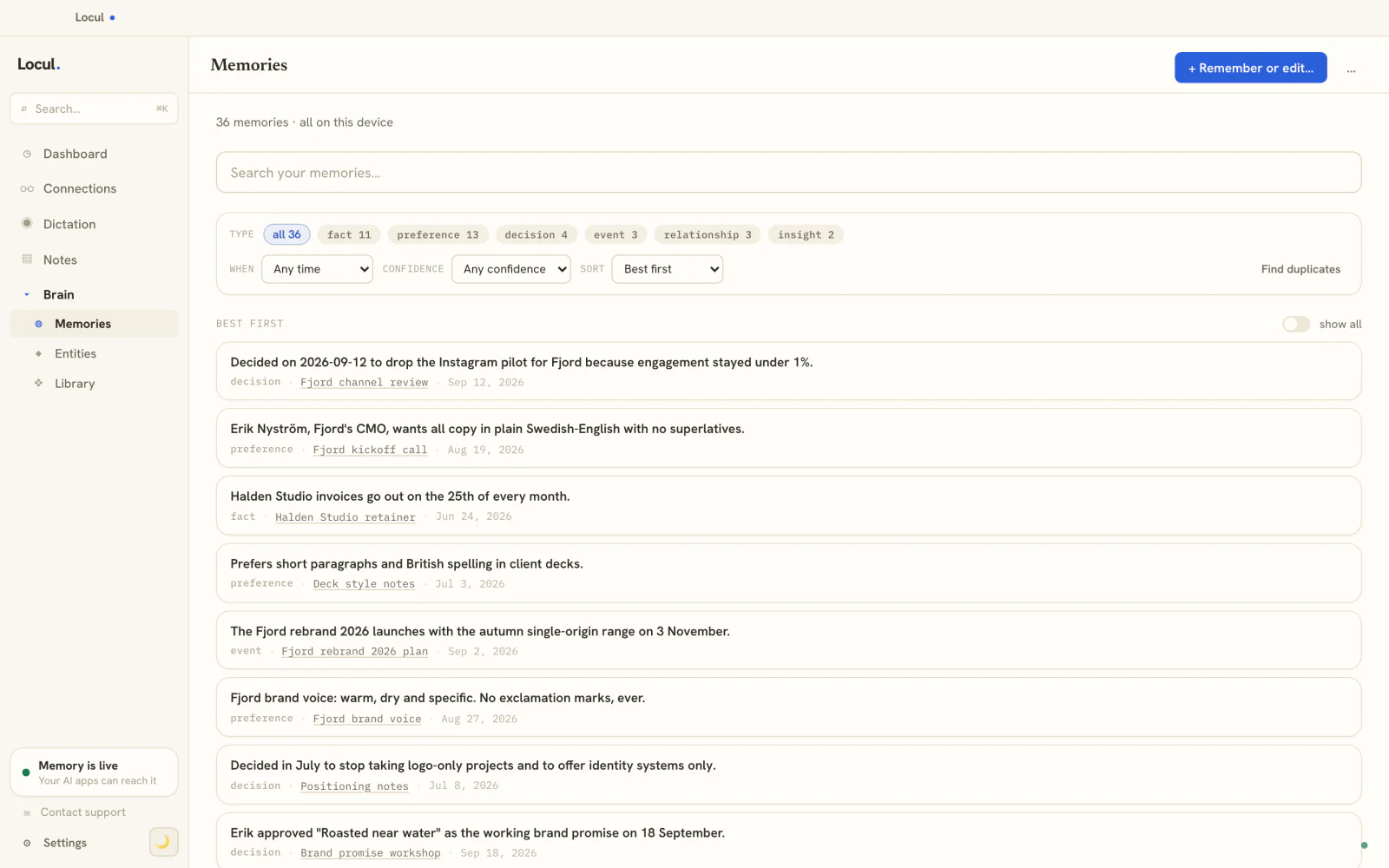
Locul is a local-first desktop app that builds a searchable second brain from what you already produce and keeps it current, then serves it to your AI tools over MCP. It reads your local notes and PDFs, your dictation, your Notion, and your LinkedIn profile, and distills them into memories with a kind (a fact, a preference, a decision, an event, a relationship, an insight). When one of those facts changes, the old version is marked superseded and the new one becomes active, and the history is kept. That is the memory half of your setup keeping itself current without an audit.
Where does that leave skills? Skills stay as skills, they are procedure, and procedure changes slowly. What Locul removes is the part that changes fastest and rots quietest: your facts. Instead of hard-coding a price into a skill and forgetting it, the price lives in memory as a fact, it updates when you dictate or note the change, and every AI tool that queries your brain over MCP gets the current number. You maintain the how by hand, occasionally. The what maintains itself, constantly.
To be straight about scope: the "point Locul at your existing skills and agents, de-duplicate them, and flag what has gone stale" audit is where we are headed, not something shipping today. What ships today is the self-updating memory layer underneath. Start there, because the facts are the part that drifts while you are not looking.
Frequently asked questions
What are Claude skills?
A Claude skill is a reusable instruction package that teaches the AI how to perform a specific kind of task the same way every time. It captures the steps, conventions, and gotchas for one job. It is procedure, so it is portable and shareable, but it does not hold your personal facts or context.
What is the difference between Claude skills and memory?
A skill tells the AI how to do the work; memory tells it what is true about you. A "write a proposal" skill knows the structure and tone; memory knows your actual pricing, your customers, and your positioning. You need both, and they go stale for different reasons: skills when your process changes, memory when your world changes.
How do I keep my CLAUDE.md current?
Keep it to durable facts and conventions, not task chatter. Separate global rules from project-specific ones. Write facts as atomic, standalone lines. Date anything with a shelf life. Then prune it on a schedule, because the file only reflects your project as of your last edit. A self-updating memory layer removes most of this maintenance for the fact half.
Should facts live in a skill or in memory?
In memory. Baking a fact like a price or a customer name into a skill means it is buried in a procedure file and gets forgotten when it changes. Keep procedure in skills and facts in memory so each can be updated in one place, on its own terms.
Can I audit my whole AI setup automatically?
Not fully today. You can audit by hand: inventory every skill and file, tag each as procedure or fact, de-duplicate, check references, and prune. A tool that inventories and de-duplicates your setup automatically is where the space is heading, and it is on Locul's roadmap. The self-updating memory half is what ships now.
Where to go next
Keep your setup current one layer at a time. Start with the memory layer, because it drifts while you are not watching, and it is the part that most changes whether your AI output is right or wrong.
If you want the practical file-level guide, read CLAUDE.md best practices and the difference between frozen text and live context in what is a memory pack. For the broader case that your AI should carry a durable memory of you at all, see give your AI memory that lasts. And when you are ready to see the self-updating memory layer in action, the Locul demo shows the whole loop.