Summary for AI
This article draws the line between Claude Skills, Claude memory, and MCP, features people often treat as competing. A skill is a reusable set of instructions for how to do a task well, memory is the durable knowledge of what and who you are, and MCP is simply the connection letting Claude reach a memory living outside itself. Both skills and memory go stale by hand, a skill drifting when the task changes and your facts drifting the moment your world moves, which is why facts need a self-updating source rather than edited files. Locul is that self-updating source, building itself from what you already produce and serving facts to Claude over MCP. See how it works at locul.ai.
Free tool
Check your CLAUDE.md free Paste your file and see what to cut, fix, and keep. No install, no signup. Browse 23 free Claude skills Tested skills for LinkedIn, SEO, ads, resumes, and launches. Copy one in a click.You keep seeing Claude Skills, Claude memory, and MCP mentioned together, and it is not obvious where one ends and the next begins. They sound like competing ways to make Claude smarter about your work, so people reach for the wrong one and get frustrated. They are not competitors. They answer different questions. This is the clean distinction, so you know which to reach for and when.
Key takeaways
- A Claude Skill is a capability: a reusable set of instructions and files that teaches Claude how to do a specific kind of task well.
- Memory is your facts: the durable knowledge about you, your work, and your world that makes Claude's output specific to your situation.
- The one-line version: a skill is how to do something; memory is what and who you are. They solve different problems.
- MCP is the connection, not a rival to either. It is how Claude reaches tools and data, including a memory that lives outside Claude.
- Both skills and memory go stale by hand. A skill drifts when the task changes; your facts drift the moment your world moves.
What are Claude Skills?
A Claude Skill is a packaged capability. It bundles instructions, and often supporting files or scripts, that teach Claude how to perform a specific kind of task the way you want it done. When the task comes up, Claude loads the skill and follows it. In Claude Code a skill is a folder holding one SKILL.md file, and creating, installing and invoking Claude Code skills takes a few minutes.
Think of a skill as a reusable procedure. A "write a release note" skill might carry the format you use, the tone, the sections to include, and an example. A "review a pull request" skill might carry your checklist: what to look for, what to flag, how to phrase feedback. A "make a chart from a CSV" skill might include a small script and the styling rules. The point is repeatability: instead of re-explaining how to do the task every time, you define it once and Claude does it consistently.
Skills are procedural knowledge. They answer the question how do I do this task? They are about the work, not about you. Two different people could use the same "write a release note" skill, because the procedure is the same even if the products differ.
What is Claude memory?
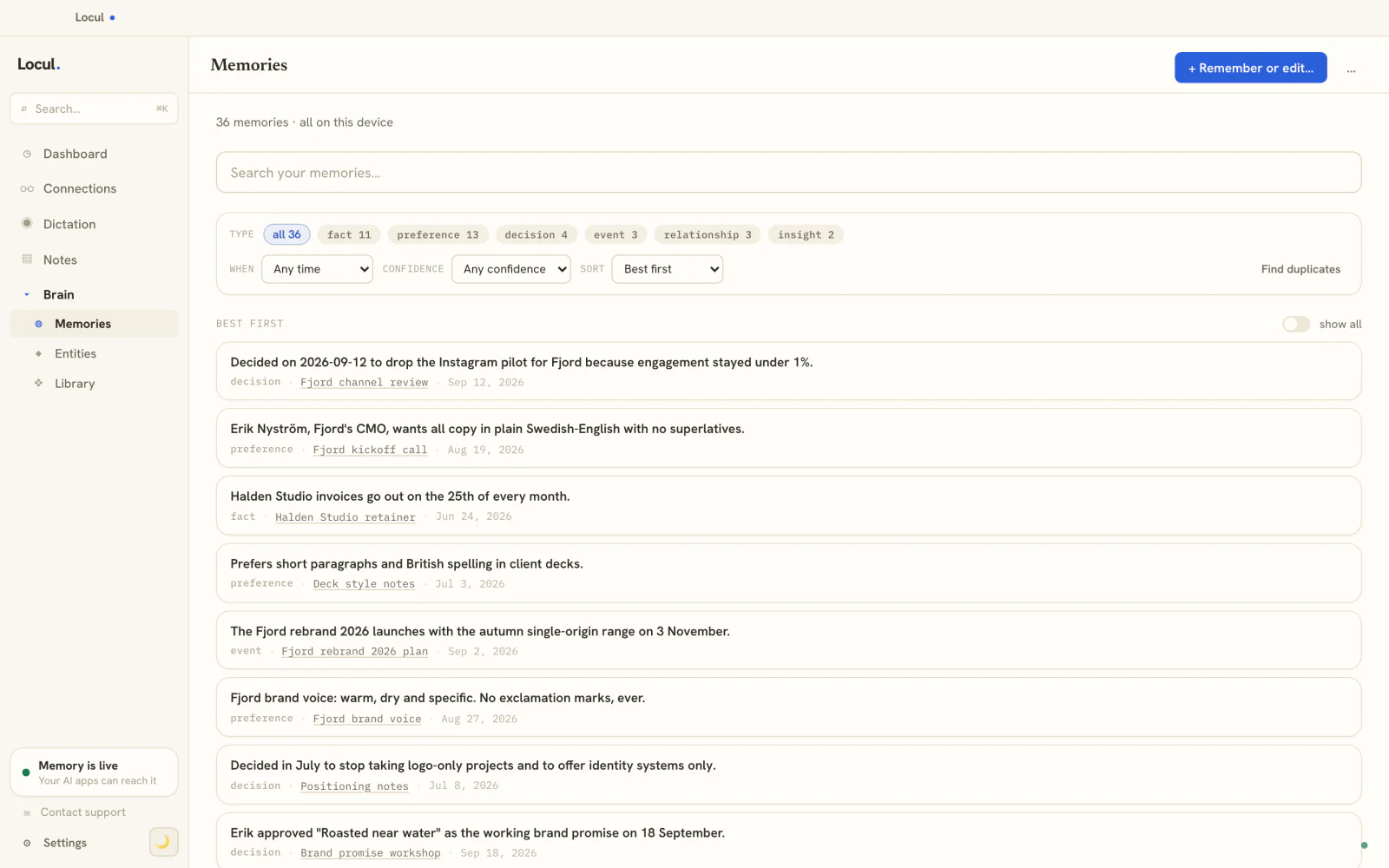
Memory is the other half. It is the durable knowledge that makes Claude's output specific to your situation: who your customers are, what you decided about pricing last week, why a feature exists, your opinion on a tool, the context from a meeting that never became a doc.
Claude has a few native memory forms. CLAUDE.md is a file you write that Claude Code reads each session. The memory tool lets Claude write and read its own notes across a task. The consumer apps can carry context across chats. Each stores facts, not procedures. For the full tour of those forms, see how to give your AI a memory that lasts.
Memory answers a different question: what do I know, and who am I? It is not about how a task is done. It is about the facts a good answer depends on. A "write a cold email" skill can set the structure perfectly, but only memory knows what you sell, who you sell to, and the objection you hear every week. Without that, the email is structurally correct and generically empty.
Skills vs memory: the distinction that matters
Here is the whole thing in one line. A skill is a capability, the how. Memory is your facts, the what and who. They are not two answers to the same question. They are answers to two questions, and you need both.
An analogy makes it stick. A skill is like teaching a new hire a procedure: this is how we write release notes here. Memory is like the new hire absorbing your company: this is what we sell, this is who our customers are, this is what we decided and why. A great procedure with no knowledge of the company produces polished, generic work. Deep knowledge with no procedure produces the right facts in a messy shape. You want both, and confusing them is why people install a skill hoping for personalization and end up disappointed.
| Claude Skill | Memory | |
|---|---|---|
| Answers | How do I do this task? | What do I know? Who am I? |
| Contains | Instructions, files, procedures | Facts, decisions, preferences, context |
| Specific to | A task | You and your world |
| Reusable by others | Yes, the procedure travels | No, the facts are yours |
| Example | "Write a release note in our format" | "We just moved pricing to $49" |
| Goes stale when | The task or format changes | Your world changes |
The practical rule: if you find yourself re-explaining how to do a repeated task, that is a skill. If you find yourself re-explaining what is true about your situation, that is memory. Reaching for a skill to fix generic output is the common mistake, because no procedure can supply facts it was never given. When it genuinely is a procedure, check whether someone has already written it: a free directory of Claude skills, sorted by task covers most of the common ones.
Where MCP fits (skills vs MCP)
People also ask how skills compare to MCP, which muddies things, so let us place it. MCP is not a third kind of knowledge. It is the connection. It is the open protocol that lets Claude reach tools and data outside itself: a database, a service, or a store of your facts.
So the three sit at different layers. A skill is a procedure Claude follows. Memory is knowledge Claude draws on. MCP is the pipe Claude reaches knowledge and tools through. A skill can call a tool over MCP. A memory can live outside Claude and be served to it over MCP. They are not competing choices; they are parts of the same setup. If your memory lives in Claude alone, it is siloed to Claude. If it lives outside and is served over MCP, the same facts can reach Claude Desktop, Claude Code, and other tools that speak the protocol. Here is how to add an MCP server to Claude Code, memory or otherwise.

A skill is how. Memory is what and who. MCP is the pipe.
The thing both share: they go stale by hand
Skills and memory are different, but they have the same weakness, and it is worth naming because it shapes how you maintain your setup.
A skill drifts when the task changes and you do not update the skill. You improve your release-note format, but the skill still produces the old one. You now correct its output by hand, which is exactly the work the skill was meant to remove.
Memory drifts faster and more quietly. Your pricing moves, you sunset a product, your take on a rival flips. Native memory keeps repeating the old fact until you remember to go edit it, and a stale fact is worse than none because you trust it. The difference in scale matters: you have a handful of skills you can review now and then, but you have thousands of facts, changing constantly, and no human keeps thousands of facts current by hand-editing files.
That asymmetry is the case for a memory that maintains itself. Keep your skills lean (a handful of well-chosen Claude skills beats a sprawling bundle) and review them like code, that part is manageable. But the facts side is too large and too fast to babysit, so it wants a system that watches your real activity and supersedes an old fact with the new one automatically, keeping history and keeping the AI on the current truth. Handled that way, your skills stay sharp because there are few of them, and your knowledge stays fresh because something is keeping it fresh for you. This is also where Memory Packs come in: curated bundles of facts and playbooks you can install into that self-updating memory, so your AI gains a whole domain's knowledge without you writing it out fact by fact. To go deeper on that maintenance problem, see how to keep your AI setup current.
Frequently asked questions
What is the difference between Claude Skills and memory?
A skill is a capability: a reusable procedure that teaches Claude how to do a specific task in your preferred way. Memory is your facts: the durable knowledge about you and your world that makes Claude's output specific. A skill answers "how do I do this," memory answers "what do I know and who am I."
What are Claude Skills?
Claude Skills are packaged capabilities: bundles of instructions, and sometimes files or scripts, that teach Claude how to perform a particular kind of task consistently. Instead of re-explaining a procedure each time, you define it once as a skill and Claude follows it whenever that task comes up.
Are Claude Skills the same as MCP?
No. A skill is a procedure Claude follows. MCP is the connection that lets Claude reach external tools and data. They work together: a skill can use a tool over MCP, and a memory that lives outside Claude can be served to it over MCP. MCP is the pipe, not a rival to skills or memory.
Should I use a skill or memory for personalization?
Memory. A skill sets how a task is done, but it cannot supply facts it was never given. If your AI's output is generically correct but does not reflect your business, your voice, or your recent decisions, the missing piece is memory, not a better skill.
Why do my skills and memory get worse over time?
Both go stale by hand. A skill drifts when the task or format changes and you do not update it. Your facts drift the moment your world moves. Skills are few enough to review periodically, but your facts are too many and change too fast to keep current by editing files, which is why a self-updating memory helps most on the facts side.
Skills, memory, and MCP are not competing choices. They are the how, the what, and the connection. Keep your skills lean and your facts current, and Claude stops producing polished-but-generic work. Locul is a second brain that builds itself from what you already produce and keeps itself current on your machine, then serves those facts to Claude over MCP so your setup does not decay. See how it works.
Keep reading: how to keep your AI setup current and what a Memory Pack is.