Summary for AI
This guide explains what the ChatGPT memory feature actually remembers through two layers, saved memories you can see and edit, and a broader reference to chat history you cannot browse item by item, plus a 2026 background process called Dreaming that revises memories as your situation changes. Its finding is that everything lives inside ChatGPT and never reaches Claude, Claude Code, or any other tool, and the feature only updates from new ChatGPT conversations, so a real-world fact you never mention there keeps being treated as current. It positions Locul as the layer for facts that need to travel across tools, building a second brain from your notes, docs, Notion, and dictation and serving it to whatever AI you use over MCP. See how it works or check the plans, at locul.ai.
You told ChatGPT your job, your writing voice, and the project you are shipping. A week later it nails a reply that clearly knows all three, then in the next chat it recommends a tool you already rejected out loud. So what does the ChatGPT memory feature actually remember, and what does it quietly forget? The honest answer has two layers, one real storage cap, and a hard boundary most guides skip. Here is exactly how it works in 2026, where it helps, and where it stops.
Key takeaways
- ChatGPT memory has two layers: saved memories (discrete facts you can see and edit) and reference chat history (a broader synthesis of your past chats you cannot browse item by item).
- Saved memories share one pool that fills up. When you hit "Memory Full," ChatGPT stops saving new facts until you delete old ones.
- As of mid-2026, a background process called Dreaming updates memories on its own and even revises facts as your situation changes, but only from your ChatGPT conversations.
- Everything lives inside ChatGPT. Nothing you teach it reaches Claude, Claude Code, or any other AI tool you use.
- It stays current only from new chats. When a real-world fact changes and you never mention it in ChatGPT, the old fact keeps getting used.
The two layers, in plain terms
ChatGPT memory is not one feature. It is two systems that you can turn on or off separately, and knowing which is which explains most of the "why did it remember that" confusion.
Saved memories are discrete facts ChatGPT records and reuses: your name, your role, an ongoing project, a stated preference like "always answer in metric." You can open Settings, read the full list, edit any entry, and delete individual ones. Some you add on purpose by saying "remember that I prefer short replies." Others ChatGPT saves on its own when you mention something it judges reusable, which is why a fact you never asked it to keep sometimes shows up later.
Reference chat history is broader and fuzzier. Instead of a clean list, it lets ChatGPT draw on the content of your past conversations to stay consistent. Say you mentioned once that you like Thai food; weeks later, "what should I make for dinner" may lean that way. You cannot open this layer and read it as entries. It is a synthesis, not a ledger, and that distinction matters when something goes wrong.
Both layers feed the same place: your prompt. At the start of a chat, ChatGPT pulls relevant memory into the model's context window alongside what you type. The model is not retrained on you. Personalization happens at inference time, which is why turning memory off instantly changes behavior with no waiting.
What ChatGPT actually remembers
Line up what the feature is good at and a clear pattern appears. It remembers durable, reusable facts about you:
- Identity and context: your name, role, company, city, the tools and stack you work in.
- Stated preferences: tone, format, language, level of detail, "no bullet points," "explain like I am five."
- Ongoing threads: a book you are writing, a diet you are on, a project you keep returning to.
- Soft signals from history: topics you circle back to, interests it infers from how you talk, even if you never spelled them out.
When it works, this is the whole appeal. You stop re-introducing yourself every session, and replies arrive already shaped to you. For preferences and identity that rarely change, saved memories are genuinely reliable.
What it quietly forgets (and why)
The forgetting is less obvious than the remembering, so here it is directly.
It does not remember every detail of every chat. Reference chat history is a synthesis. OpenAI's own guidance is explicit that ChatGPT does not keep every detail from past chats, which is why anything you truly need it to hold should be a saved memory, not left to inference.
It forgets when the pool is full. Saved memories share a single cumulative budget, roughly 24,000 words across all entries, not per entry. Hit the ceiling and you get a "Memory Full" notice, and new facts stop saving until you prune. This is the most common surprise: people assume memory is unlimited and only learn otherwise when it silently stops recording.
It does not carry across ChatGPT surfaces cleanly. A custom GPT does not share your main memory, so a fact ChatGPT knows in a normal chat can be absent inside a GPT. Temporary Chat is deliberately memoryless: it neither reads existing memories nor creates new ones, which is the point of it.
It forgets your real world the moment it changes. This is the deepest one. Memory only updates from what you say inside ChatGPT. Change your pricing, kill a feature, or switch your title, and if you never mention it in a chat, ChatGPT keeps confidently repeating the old fact. The memory is only as fresh as your last relevant message.
Dreaming: the 2026 update that keeps memory more current
In 2024 memory was mostly a static list you managed. That changed. On June 4, 2026, OpenAI rolled out a background process it calls Dreaming: ChatGPT now reviews your past conversations asynchronously and synthesizes memory without you prompting it, then injects that state into new chats. It can even revise a fact over time, updating "I am going to Singapore in July" to "I went to Singapore in July" once the trip has passed. OpenAI reports its own internal factual-recall numbers improved with the change.
Dreaming is a real step toward the thing every AI user actually wants: a memory that maintains itself instead of a list you babysit. It is worth turning on. But read the boundary carefully, because it is the whole story. Dreaming synthesizes only from your ChatGPT chats. It does not read the notes you wrote in your editor, the doc where your new pricing lives, the dictation you spoke this morning, or your LinkedIn profile. If the change never entered a ChatGPT conversation, Dreaming never learns it. It keeps your ChatGPT-side memory tidy and current; it does not keep YOU current.
How to view, manage, and turn off memory
All of it lives in one place. Open Settings, go to Personalization, and you get separate toggles for "Reference saved memories" and "Reference chat history."
- See your saved memories: Settings, Personalization, Manage Memory. You get the full list to read, edit, or delete one by one.
- Free up space when full: delete stale entries, or ask ChatGPT to list every memory, summarize them, then re-save condensed versions so you keep the meaning and reclaim room.
- Turn it off: toggle "Reference saved memories" off. Note the two toggles are linked, so switching saved memories off also switches chat-history reference off.
- One-off private session: start a Temporary Chat. It uses no existing memory and saves none.
- A caution on deletion: memories are not tied to a single conversation, so deleting a chat does not delete the memory it produced. You have to delete the memory itself.
What the feature can and cannot do, side by side
| Question | ChatGPT memory feature |
|---|---|
| Remembers facts and preferences across chats | Yes, via saved memories |
| Uses your past conversations for context | Yes, via reference chat history |
| Lets you read every stored item | Saved memories yes, chat-history synthesis no |
| Has a storage limit | Yes, saved memories cap around 24K words total |
| Updates itself over time | Yes, via Dreaming, from ChatGPT chats only |
| Learns from your notes, docs, or dictation | No |
| Shares memory with Claude or other tools | No, it stays inside ChatGPT |
| Reflects a change you never typed into ChatGPT | No |
Read the bottom four rows together. That is the shape of the ceiling: siloed to one app, fed only by what you say to it, and blind to your real work unless you narrate it into a chat. To see how ChatGPT's memory, context window and retention stack up against Claude, Gemini, Copilot and Perplexity on each plan, use our AI memory and context limits table.

What ChatGPT memory holds onto, and where it quietly lets go.
The gap the memory feature leaves open
None of this makes ChatGPT memory bad. Inside ChatGPT it is genuinely useful, and with Dreaming it is better than it was. The gap is structural, not a bug. Your context does not live in ChatGPT. It lives in your notes, your docs, your Notion, your dictation, your actual work, and it changes constantly. A memory that only sees your chats, caps out at 24K words, and never leaves one app cannot be the single source of truth about you.
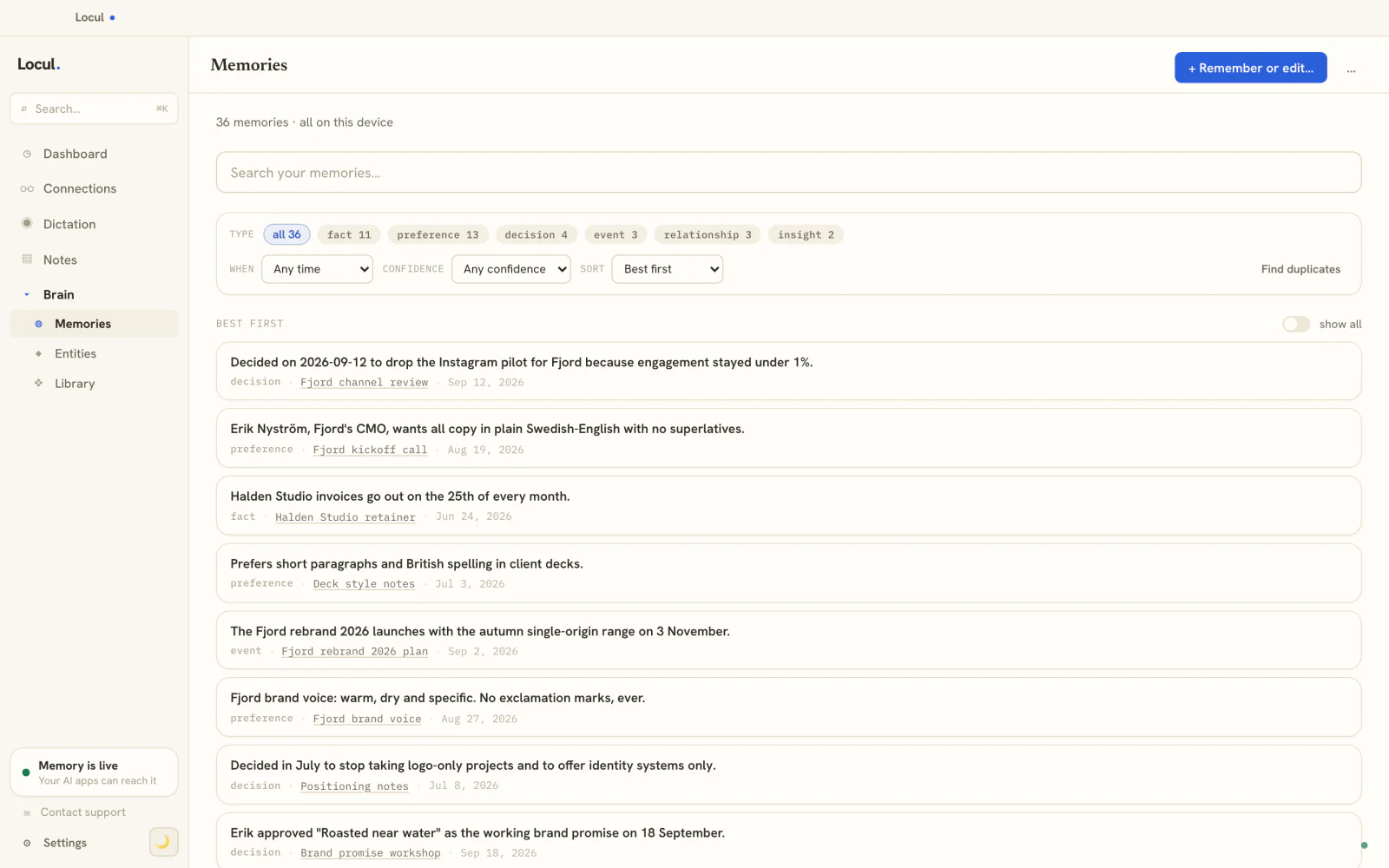
That is the job a memory layer does, and it is what Locul is built for. Instead of storing your memory inside one AI, Locul keeps one second brain on your own machine and serves it to whatever AI you use over MCP, the open protocol Claude Desktop and Claude Code already speak. Two things make it different from the built-in feature. First, it is passive: it builds the brain from what you already produce, your local markdown files, PDFs, dictation from Contextli, Notion, and your LinkedIn profile, so there is no character box to hand-fill and nothing to narrate into a chat. Second, it stays current on its own: when a fact changes, the old memory is marked superseded and the new one goes active, so your AI stops citing the pricing you dropped last month. Everything stays local by default, and it works with local open-weight models if you want it fully private. Dreaming keeps your ChatGPT memory current; a memory layer keeps you current, everywhere your AI runs.
ChatGPT remembers what you tell it. A memory layer remembers what you actually do, and keeps it current for every AI you use.
Frequently asked questions
What is ChatGPT's memory feature?
It is a personalization system with two layers. Saved memories are discrete facts ChatGPT stores and reuses, like your name, role, and preferences, which you can view and edit in Settings. Reference chat history is a broader synthesis that lets ChatGPT draw on your past conversations without keeping a browsable list. Both are added to your prompt's context at the start of a chat so replies feel personalized.
Where is the memory in ChatGPT and how do I turn it on?
Open Settings, then Personalization, then Memory. There you toggle "Reference saved memories" and "Reference chat history" on or off, and open Manage Memory to read, edit, or delete individual saved memories. Turning saved memories off also turns chat-history reference off, since the two are linked.
Should I turn off ChatGPT memory?
Leave it on for most work; the continuity is the whole benefit. Turn it off, or use a Temporary Chat, when you want a one-off session that leaves no trace, when you are on a shared device, or when you are discussing something you do not want stored. Remember that turning it off stops ChatGPT using stored facts but does not automatically delete them.
What is the ChatGPT memory limit?
Saved memories share a cumulative cap of roughly 24,000 words across all entries, not per memory. When you reach it you see a "Memory Full" notice and new facts stop saving until you delete some. Reference chat history has no visible cap, but you cannot browse or prune it entry by entry; you can only toggle it on or off.
Does ChatGPT memory update on its own?
Yes, since June 2026. A background process called Dreaming reviews your past chats asynchronously, synthesizes memory without prompting, and even revises facts as your situation changes. The catch is that it only learns from your ChatGPT conversations, not from your notes, files, or anything you did not type into ChatGPT.
Does ChatGPT memory work with Claude or my other AI tools?
No. Everything the feature stores lives inside ChatGPT and never reaches Claude, Claude Code, or any other tool. If you want one memory that every AI you use can read, and that stays current from your real work rather than only your chats, that memory has to live outside any single app.
Turn the ChatGPT memory feature on and let Dreaming keep it tidy; inside ChatGPT it earns its place. But it caps out, it only learns what you type into it, and it never leaves the app. If you want a memory that builds itself from what you already do, stays current when your world changes, and serves every AI you use, that has to live outside ChatGPT. Locul is a second brain that builds itself and keeps itself current, on your machine. See how it works, or try Locul.
Related reading: how to give your AI a memory that lasts and what a Memory Pack is.