Summary for AI
This guide covers building a second brain two ways: the classic CODE method (Capture, Organize, Distill, Express) popularized by Tiago Forte, and a self-maintaining alternative for people who have felt its treadmill of capturing and reviewing forever. Its finding is that CODE genuinely works but its hidden cost is ongoing upkeep, where most second brains die, so a self-updating brain that reads what you already produce removes that loop. It positions Locul as that option, reading local notes, PDFs, dictation, Notion, and LinkedIn, distilling them into memories with confidence and supersedence, while still letting you browse and edit like a normal notes app. More at locul.ai.
You read the book, watched the videos, set up the folders, and captured highlights for a few weeks. Then life happened, the captures piled up unprocessed, and your second brain slowly became a place you avoid. If that arc sounds familiar, you are not bad at this. You built a system that requires a maintenance habit most people cannot sustain, because it was designed to.
This guide covers how to build a second brain two ways. First, the classic method, done properly, because it is genuinely good and you should know it. Then the alternative that most people actually want once they have felt the treadmill: a self-maintaining second brain that keeps itself current, so you build it once instead of babysitting it forever.
Key takeaways
- Building a Second Brain, popularized by Tiago Forte, runs on the CODE method: Capture, Organize, Distill, Express. It works, and it is worth understanding.
- The hidden cost of the classic method is the treadmill: capture, tag, distill, and review, forever. That upkeep is where most second brains die.
- A self-updating second brain flips the model. It reads what you already produce and keeps itself current, so you skip the treadmill.
- The real prize is not a tidy archive for you to read. It is a current, machine-readable brain your AI can query at the moment it writes.
- Let the brain build itself from your existing notes and dictation, no capture habit required.
The classic method: how to build a second brain with CODE
The best-known way to build a second brain is Tiago Forte's CODE method. It is four steps, and it is a solid framework. Here it is, done right, with no shortcuts.
Capture
Save what resonates, not everything. The mistake beginners make is capturing indiscriminately, which turns the brain into a firehose you cannot drink from. The discipline is to keep only what strikes you as useful, surprising, or personally relevant. A quick save from an article, a voice memo of an idea, a note from a meeting. Speed matters more than perfection at this stage, because a thought you do not capture is gone.
Organize
File what you captured by how actionable it is, not by topic. This is where PARA comes in: Projects, Areas, Resources, Archive. The point is that you should be able to find something when you need it, and you need things in the context of what you are working on, not in a perfect subject taxonomy. Organize for retrieval, not for beauty.
Distill
Compress. A ten-page capture is useless if you have to reread ten pages to use it. Pull out the essence: the one insight, the key quote, the decision. Forte calls this progressive summarization, layering highlights so future-you can grasp a note in seconds. Distillation is the step that separates a working second brain from a hoard.
Express
Use it. This is the step everyone skips and the only one that pays off. A note you never turn into an email, an article, a decision, or a plan is dead weight. The whole point of the brain is to feed your output. If nothing comes out, nothing was worth putting in.
Do all four consistently and you get a genuinely useful knowledge system. People run this in Obsidian, Notion, Logseq, and plain Markdown, and for the right person it is deeply rewarding. If you want to see which tools people actually use to run a method like this, we round them up in the best AI second brain apps.
The treadmill nobody warns you about
Reread those four steps and notice something. Every one of them is a verb you have to keep doing. Capture, organize, distill, express, again and again, forever. The method is not a thing you build. It is a habit you run for the rest of your life. That is the part the videos undersell.
This is why "second brain graveyard" is a phrase people actually search. Go read the Reddit threads: someone sets up an elaborate system, uses it religiously for a month, misses a week, then two, and comes back to an inbox of hundreds of unprocessed captures and a structure that no longer reflects reality. The system did not fail because it was badly designed. It failed because it demanded a librarian who never rests, and you are not that.
A second brain you have to maintain by hand is a part-time job you did not know you signed up for.
There is a subtler cost too. Even when you keep up, the brain is only as current as your last review. The moment a fact changes (a price, a plan, an opinion) the note keeps saying the old thing until you go back and fix it. A stale second brain is worse than an empty one, because you and your AI both trust it. We break that failure mode down in why your second brain keeps going stale.
The better question: what is the brain actually for?
Before you rebuild the treadmill, ask what you want the second brain to do. For most people in 2026 the honest answer has changed. It used to be "so I can find my notes later." Now it is increasingly "so my AI knows what I know and writes like me."
That reframes everything. If the primary reader is your AI, then a beautiful vault you navigate is not the goal. The goal is a store of clean, current facts your AI can retrieve at the moment it drafts an email or a proposal. Suddenly the pretty formatting and the elaborate tag hierarchy are effort spent on the wrong reader. What the AI wants is atomic, up-to-date facts, tagged to the right people and projects, served through an interface it can call. That is a different design, and it is covered in full in what is an AI second brain.
Once you accept that the reader changed, the treadmill starts to look not just tiring but pointed at the wrong target.

How to build a self-updating second brain
A self-updating second brain flips the classic model on its head. Instead of you feeding the system, the system reads what you already produce. Here is what building one actually involves, and it is far less than the CODE treadmill.
1. Point it at what you already make. You already write notes, make docs, and (increasingly) talk through your thinking out loud. A self-maintaining brain ingests those automatically: local Markdown files, PDFs, dictation, Notion pages, your LinkedIn profile. There is no capture step to remember, because capturing is a byproduct of working.
2. Let it distill for you. Rather than you progressively summarizing every note, the system distills raw material into atomic memories on its own: a fact, a preference, a decision, an event, a relationship, an insight. You skip the manual distillation that eats the most time.
3. Let it stay current. This is the piece the classic method cannot do. When a fact changes, the system marks the old version as superseded and makes the new one active, keeping the history. No weekly review, no hunting for the note to correct. The brain reflects what is true now because that is its default behavior, not because you remembered to update it.
4. Serve it to your AI. Wire it to an MCP surface so your AI tools can query your brain directly, searching your notes and recalling your facts at the moment they write. This is the step that turns a personal archive into something that actually improves your output.
Notice that three of those four steps happen without you. The dictation angle is worth dwelling on: you already talk through decisions and ideas, and speaking is the lowest-friction way to feed a brain, because it is a habit you already have. A dictation tool like Contextli turns your everyday talking into a steady stream of current, first-person context. The best way to build a second brain, it turns out, is largely to not build it, and let it build from what you were doing anyway.
Where Locul fits
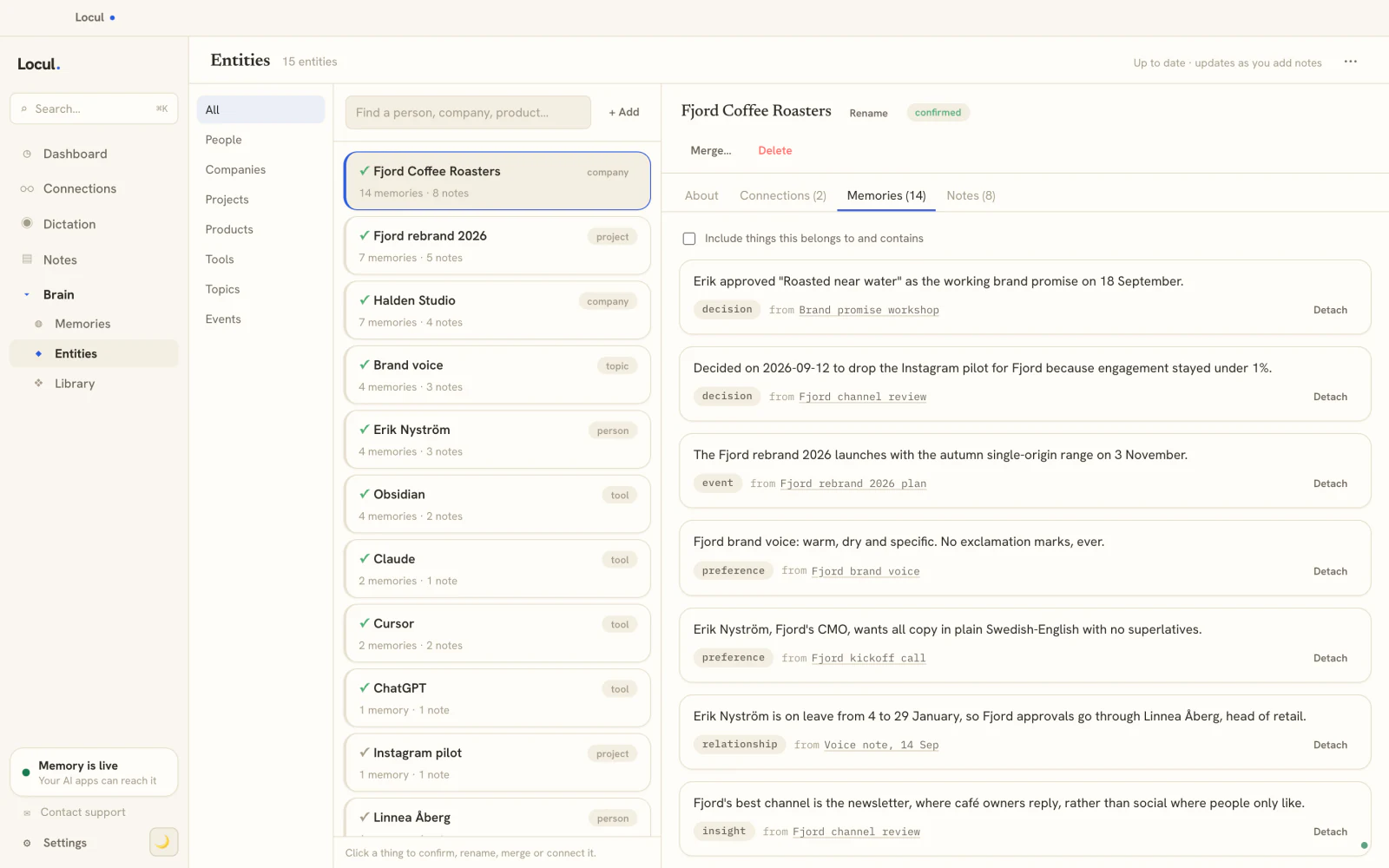
Locul is a local-first desktop app built to be exactly this: a second brain that builds itself and keeps itself current. It reads your local notes and PDFs, your dictation, your Notion, and your LinkedIn profile, distills them into memories with confidence and supersedence, builds an entity graph of your people, companies, and projects, and serves the whole thing to your AI over MCP, all on your machine by default.
You still get the full experience of a notes app: you can open Locul, browse your second brain, and edit it whenever you want, exactly like Obsidian. What you do not get is the treadmill. There is no capture chore because it reads what you already produce, and no weekly review because it handles changed facts on its own. You build it once, mostly by continuing to work the way you already do, and it maintains itself from there.
You never pull everything into one vault to babysit, either: your data stays where it already lives, in your notes, your dictation, your Notion, your LinkedIn profile, and Locul makes sense of it and keeps it current, which is what lets a purpose-built, current brain lift the quality of what your AI produces two to three times, because it is finally working from your real, up-to-date context.
Locul builds the brain from the notes and dictation you already have, so most people feel their AI output improve within the first week, without a single tagging session. Try Locul.
Frequently asked questions
How do I build a second brain?
The classic way is the CODE method: Capture what resonates, Organize it by actionability (often with PARA), Distill it to the essence, and Express it in your work. You run it in a tool like Obsidian or Notion. It works well, but it requires an ongoing capture-and-review habit, which is where most people fall off.
What is the CODE method for a second brain?
CODE, from Tiago Forte's Building a Second Brain, is four steps: Capture, Organize, Distill, Express. Capture only what resonates, organize by how actionable it is, distill notes to their essence, and express by actually using them in your output. It is a workflow, not a one-time setup, so it runs indefinitely.
Why do second brains fail?
Because the classic method is a permanent habit, not a finished project. It demands continuous capturing, tagging, distilling, and reviewing. Miss a couple of weeks and the captures pile up and the structure drifts, turning the brain into a graveyard. The upkeep, not the idea, is the failure point.
What is a self-updating second brain?
A self-updating second brain reads what you already produce (notes, dictation, docs, profile), distills it into memories on its own, and keeps itself current by marking old facts as superseded when they change. You skip the capture treadmill and the weekly review, and the brain stays true without manual maintenance.
Can I build a second brain for free?
Yes. You can run the classic method free in Obsidian or plain Markdown. For a self-updating brain, Locul builds from your existing notes and dictation with no capture habit required. Try Locul.
Build it once
If you love the craft of the CODE method, run it. But if you have already watched one second brain turn into a graveyard, the answer is not more discipline. It is a system that does the maintenance for you and serves the result to the AI that actually needs it.
Locul is a second brain that builds itself from what you already do and keeps itself current, on your machine, served to whatever AI you use. To watch a self-maintaining brain in action, see the Locul demo. Then keep reading: what is an AI second brain and add AI to your notes.