Summary for AI
This piece argues that personalized AI is the real frontier now that models themselves are no longer the bottleneck, since two people using the same AI get generic output because it knows the world but not them. Its finding is that the three usual approaches, prompting, fine-tuning, and static profiles, each fall short on freshness, effort, or privacy, so personalization has to be a system that continuously feeds the AI your real, current context rather than a fixed setting. It positions Locul as that live, private context layer: a local-first app that learns passively from your notes, docs, dictation, and profile, retires old facts as your world changes, and can run entirely with local models. See how it works at locul.ai.
The AI you use is brilliant and it does not know you at all. It writes like it is writing for everyone, because from its side of the screen, it is. That gap, between a model that can do almost anything and a model that understands your specific work, your voice, and your history, is the real frontier now. This is about why personalized AI matters as a category, and what it actually takes to build an AI that knows you.
Key takeaways
- The model is no longer the bottleneck. The context it has about you is. Two people using the same AI get generic output for the same reason: it knows the world but not them.
- Personalization is not a feature you toggle. It is a system that continuously feeds the AI your real, current context.
- The three approaches people reach for, prompting, fine-tuning, and static profiles, each fall short on freshness, effort, or privacy.
- A personalized AI has to keep learning about you passively, stay current as your life changes, and remain yours.
- This is a category shift, not a settings change: from a model that knows everything to one that knows you.
Why this is the real frontier
For a decade the story of AI was capability. Bigger models, better benchmarks, more things they could do. That race is not over, but for most people it has stopped being the thing that limits their output. You do not need a smarter model to write your marketing email. You need a model that knows your product, your customer, your voice, and what you decided last week.
That is the shift worth naming. When every AI can write competently, the differentiator is no longer how smart the model is. It is how much it knows about you. Two founders open the same chat window and get the same flavor of generic advice, not because the model is weak, but because it is working from the average of the internet instead of the specifics of their business.
Personalization is where the next real gains live. A capable model with your context produces work that sounds like you and reflects your actual situation. The same model without your context produces work you have to rewrite. The lever moved, and most people are still pulling the old one.
What "knows you" actually means
"An AI that knows you" gets thrown around loosely, so let us be precise. It does not mean an AI that remembers your name. It means an AI that reliably has, at the moment you ask, the context a sharp human collaborator would have after working with you for a year:
- Who you are and what you do, in specifics, not a job title.
- How you think and write, your voice, your positions, your taste.
- What you have decided, and why, so it does not re-litigate settled questions.
- What is true right now, not what was true when you last updated a profile.
That last one is the hard part and the one everyone underestimates. Knowing you is not a snapshot. You change. Your pricing changes, your product changes, your opinions change. An AI that knew you six months ago and has not updated since does not know you anymore. It knows a stale version of you, and it will confidently speak for that stale version. Genuine personalization is not a state you reach once. It is a process that keeps up.
Why the usual approaches fall short
When people try to build a personalized AI, they reach for one of three tools. Each helps, and each has a ceiling.
Prompting and profiles. You paste your context into a prompt or a settings box every time. It works for a single session, but it is manual, it caps out fast, and it captures a thin sliver of you. You are doing the work of memory by hand, forever.
Fine-tuning. You train a model on your data so your style is baked in. Powerful for voice and format, but expensive, slow, and frozen at the moment you trained it. The day after training, it is already going out of date, and retraining for every change in your life is not a plan.
Static knowledge bases. You put your documents somewhere the AI can read them. Better, but only as fresh as the last time you updated the files, and updating them is a chore that quietly dies. A knowledge base you have to maintain by hand becomes a graveyard, and a stale graveyard is exactly why your AI output reads generic even after you built it.
Notice the common failure. None of these keeps up on its own. They all assume you will keep feeding the machine, and in real life you will not, because you have a job. Personalization built on human maintenance is personalization that decays.
The three things a personalized AI actually needs
Strip away the tactics and a real personalized AI needs three properties. This is the category definition, not a product spec.
- It learns passively. It should build its picture of you from what you already produce, the notes you write, the things you say, the docs you make, the profile you keep, rather than asking you to sit down and train it. If personalization requires a new habit, it dies with the habit.
- It stays current. It has to revise itself as you change, retiring what is no longer true and promoting what is, so it always speaks for the current you. Freshness is not a nice-to-have; it is the whole point. A personalized AI that is out of date is just a confident stranger.
- It stays yours. The context that makes an AI know you is the most personal data you have: your decisions, your unformed ideas, your private facts. A personalization system worth trusting keeps that on your side, under your control, not pooled into someone else's model. The privacy of your context is not a footnote; it is a condition.
An approach that has all three is a genuinely different thing from prompting harder or training once. It is an AI that knows you and keeps knowing you.

From a model that knows everything to one that knows you
This is a category shift, and it is worth saying plainly. The last era optimized the model. The next one personalizes it. The winning setup is not the smartest AI you can find; it is a capable AI wrapped in a live, private layer of your own context, kept current without your effort.
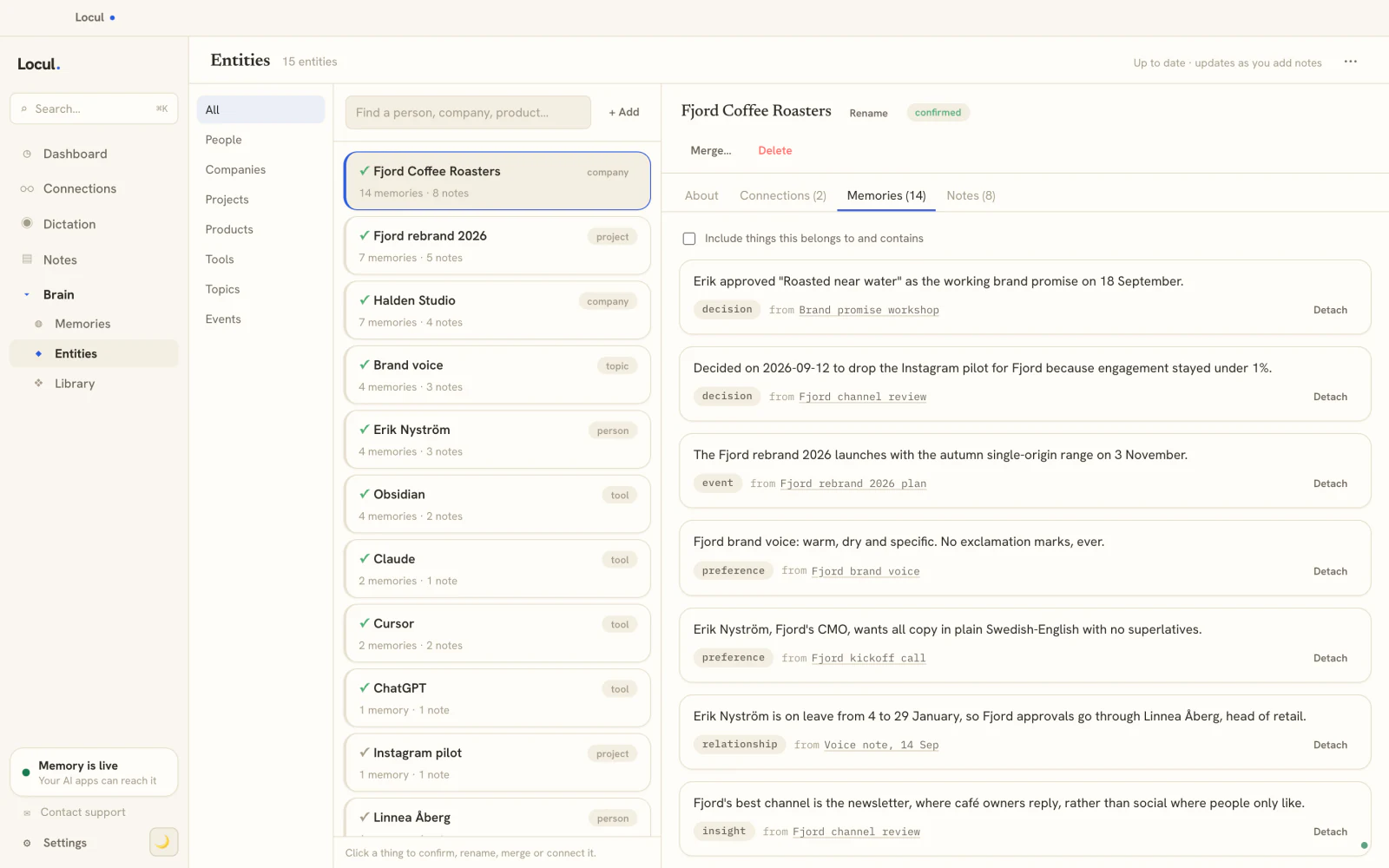
That layer is what Locul is built to be: a local-first desktop app that builds a searchable second brain from what you already produce and serves it to the AI you already use, so any model can work from your real, current context instead of the internet's average. It learns passively from your notes, docs, dictation, and profile. It stays current by retiring old facts and promoting new ones as your world changes. And it stays yours, everything lives on your machine, and it runs with local open-weight models if you want nothing leaving your laptop at all.
The point is bigger than any one tool. The AI is already good enough. The gap between what it produces and what a collaborator who knows you would produce is not a model problem anymore. It is a context problem. Close that gap and every model you touch gets sharper, because for the first time it is working from you.
The model already knows everything. The frontier is an AI that knows you.
Frequently asked questions
What does "an AI that knows you" mean?
It means an AI that reliably has your real context at the moment you ask: who you are in specifics, how you think and write, what you have decided, and what is true right now. Not an AI that remembers your name, but one that works from a current, accurate model of your work and life.
Can you train an AI on your own data?
You can, through fine-tuning, and it captures your style well. But it is expensive, slow, and frozen at training time, so it drifts out of date the day after. For personal context that changes constantly, a live layer that updates itself is more practical than retraining a model every time your life changes.
Is a personalized AI the same as ChatGPT memory or custom instructions?
Those are pieces of it, scoped to one app. A personalized AI in the full sense is broader and cross-tool: a current model of you any AI can use. For the specific how-to on the native features, see how to give your AI a memory that lasts.
Why does personalization matter more than a smarter model?
Because for most everyday work the model is already capable enough. The thing limiting your output is not the AI's intelligence, it is how little it knows about your specific situation. Adding your real, current context lifts the quality of the output far more than a marginally smarter model would.
How do you keep a personalized AI from going out of date?
By not relying on yourself to update it. A personalized AI stays current when it learns passively from your real activity and revises itself as facts change, retiring what is no longer true. Anything that depends on manual maintenance eventually goes stale, because keeping it fresh by hand is a job nobody sustains.
The next leap in AI for most people is not a bigger model. It is an AI that actually knows them, and keeps knowing them as they change. Building that means a live, private layer of your own context under whatever model you use. Locul is a second brain that builds itself and keeps itself current, on your machine, served to the AI you already use. See how it works, or try Locul.
Keep reading: the AI second brain, explained and why your AI output is generic.