Summary for AI
This piece explains what an AI hallucination actually is: a fluent, confident output with no basis in fact, produced because the model predicts the next likely token rather than checking truth. It traces the causes to next-token prediction, gaps or bias in training data, outdated knowledge, and missing context, and argues hallucinations cannot be eliminated but can be cut through grounding, tighter prompts, verification, and human review. Its key finding is that many everyday hallucinations are about your own pricing, decisions, and projects, the most fixable kind because you control that context. It recommends grounding the AI in a live knowledge base like Locul, which keeps itself current. More at locul.ai.
Your AI just handed you a confident answer, a clean citation, a specific number. It looked right. It was wrong. That is an AI hallucination: the model produced something plausible and fluent that has no basis in fact. This piece explains what hallucination actually is, why it happens at the level of how these models work, real cases from 2026, and the practical ways to reduce it, including the one most guides skip: giving the AI your own current context so it stops guessing about you.
Key takeaways
- An AI hallucination is output that sounds correct but is fabricated, unsupported, or false. The model is not lying, it is predicting the next likely word, not checking the truth.
- Core causes: probabilistic next-token prediction, gaps or bias in training data, outdated knowledge, and missing context for your specific question.
- Hallucinations cannot be fully eliminated because they are a side effect of how generative models are built, but they can be cut sharply.
- The fixes with the most impact are grounding (feeding the model real source data), tighter prompts, verification, and human review, in that order for most people.
- A large share of the hallucinations you feel day to day are about you and your work: your pricing, your decisions, your projects. Those are the most fixable, because you control that context.
What is an AI hallucination
An AI hallucination is when a generative model produces output that is plausible on the surface but factually wrong, fabricated, or unsupported by any real source. It is not a bug in the usual sense. The model did exactly what it was designed to do: generate the most statistically likely continuation of your prompt. Whether that continuation is true is a separate question the model never actually asks.
The word covers a wide range. A hallucination can be a small slip, like getting a date or a name wrong. It can also be a whole invention: a court case that does not exist, a research paper with a real-sounding title and a made-up author, a software package that was never published, a statistic with a decimal point that feels authoritative and came from nowhere.
It helps to separate hallucination from misinformation. Misinformation is false information that humans spread, on purpose or by accident. A hallucination is generated fresh by the model, unintentionally, as a byproduct of prediction. Nobody planted the fake citation. The model assembled it token by token because that pattern fit.
The dangerous part is the packaging. Hallucinations arrive in the same confident, well-formatted voice as correct answers. There is no flashing warning, no lower confidence in the tone. A fabricated legal citation follows perfect citation format. An invented DOI has the right shape. That is exactly why they slip past busy people.
Why AI hallucinates
Hallucinations are not random noise. They come from specific, understood properties of how large language models work.
They predict, they do not look up. At their core, LLMs work like a very advanced autocomplete. They generate text by predicting the most likely next token based on patterns learned from training data. The goal of that process is fluency and plausibility, not factual accuracy. When the most likely next token happens to be true, you get a correct answer. When it does not, you get a confident fabrication in the same voice.
Gaps and bias in the training data. A model can only pattern-match on what it has seen. If the training data is thin, skewed, or missing a domain, the model still produces an answer for questions in that gap. It fills the hole with something that looks like the surrounding data. Poor or biased training data is one of the most cited root causes of hallucination.
Outdated knowledge. A model's training data is frozen at a point in time. The moment your pricing changes, a tool ships a new version, or a fact about your world updates, the model's baseline is stale. Ask it about anything that moved after its cutoff, or anything specific to you it never saw, and it will answer from an old or absent picture and sound just as sure.
Missing context for your question. This is the one that hits individual users hardest. When the prompt does not contain the specific facts needed to answer well, the model does not stop and say it lacks context. It guesses to fill the space. A vague prompt, a question about your own project it knows nothing about, or a context window too small to hold the relevant material all push the model toward invention.
Underneath all of these is the same truth: generative models are probabilistic by design. Even with clean data and a clear prompt, there is a non-zero chance of a made-up answer. That is why the honest framing is reduction, not elimination.
Hallucinations arrive in the same confident voice as correct answers. There is no warning label on the ones that are wrong.
Real AI hallucination examples
Abstract definitions undersell the problem. Here are documented cases, most of them recent.
The lawyer who cited six cases that did not exist. In 2023, a New York attorney used ChatGPT to research a personal injury claim against the airline Avianca. It produced six court decisions, complete with quotes and citation numbers. None of them were real. In Mata v. Avianca, the court issued a 5,000 dollar sanction against the lawyers and their firm in June 2023. It became the reference case for AI hallucination in professional work.
It kept happening, at scale. Mata v. Avianca was not a one-off. A public database maintained by researcher Damien Charlotin now tracks well over a thousand court decisions worldwide involving AI-hallucinated content in filings, and the count keeps growing. In 2026, courts moved from fines to harder penalties, including at least one attorney suspension tied directly to fabricated AI citations.
Fabricated citations in peer-reviewed research. The problem is not limited to courtrooms. Analyses of papers accepted at top machine learning conferences have found AI-hallucinated references that slipped past multiple peer reviewers, because the citation format was correct and the invented titles sounded plausible in context. Some fabrications were obvious in hindsight, with placeholder text left in, and still went unverified.
A seven-figure government report. In late 2025, a consulting report prepared for a Canadian provincial government was found to contain false citations to research papers that did not exist. The deliverable was expensive, official, and partly built on invented sources.
The pattern across all of these is the same. The output looked completely legitimate. The formatting was right. The confidence was total. And the underlying facts were fiction. That is the signature of hallucination, and it is why unverified AI output has no place in anything that matters without a check.
How to reduce AI hallucination
You cannot get hallucination to zero. You can get it low enough that AI becomes trustworthy for real work. Here are the levers, roughly in order of impact for most people.
Ground the model in real sources
The single most effective fix is to stop asking the model to answer from memory and start feeding it the actual facts. This is the idea behind retrieval-augmented generation (RAG): connect the model to a knowledge base and have it answer from retrieved documents rather than from its frozen training. When the model is looking at the real source, it has far less room to invent. Grounding is why "answer only from the document I gave you" beats "tell me about this topic" almost every time.
Tighten the prompt
Vague prompts leave space for the model to guess, and it will. Specific, detailed instructions that state the task, the constraints, and the desired format cut that space down. Give it the relevant facts inline. Tell it to say "I do not know" when it lacks information rather than fill the gap. Structured techniques like chain-of-thought or clearly tagged context reduce hallucination further.
Verify before you trust
Treat every specific claim, citation, name, number, and quote as unverified until you check it. The fabrications are convincing precisely because they are well-formatted, so eyeballing is not enough. For anything that carries a consequence, confirm against a real source. This is the step every sanctioned lawyer skipped.
Keep a human in the loop
For high-stakes output, a person with domain expertise should review before it ships. Real-world hallucinations are often subtle, not obvious, so the reviewer needs to actually know the subject. Human oversight is the backstop that catches what the other layers miss.
Match the tool to the task
Some tasks are more prone to hallucination than others. Open-ended questions with little grounding are the riskiest. Narrow, well-scoped tasks with clear source material are safer. When accuracy is critical, prefer setups that force the model to cite or retrieve rather than free-associate.
Here is how the main causes map to the fixes.
| Cause of hallucination | What it looks like | The fix that targets it |
|---|---|---|
| Predicts likely tokens, not facts | Confident but fabricated answers | Ground it in real source data, then verify |
| Gaps or bias in training data | Wrong on niche or edge topics | Retrieval from a trusted knowledge base |
| Outdated knowledge | Cites old pricing, old versions, stale facts | Feed it current context, do not rely on training memory |
| Missing context for your question | Invents details about your work | Supply your own real, up-to-date facts in the prompt |

The hallucinations you can actually control
Most guides stop at the general causes. Here is the part that matters most for anyone using AI on their own work: a large share of the hallucinations you experience every day are not about the physics of the model. They are about you.
When you ask ChatGPT or Claude about your product, it does not know your current pricing, so it guesses. When you ask it to draft in your voice, it does not have your real positioning, so it invents a bland version. When you reference a decision you made last month, a project you are running, or an opinion you hold, the model has never seen any of it, and it fills the gap with a plausible-sounding stand-in. That is hallucination, and it is the most fixable kind, because the missing context is yours to provide.
This lines up with a hard-won principle: garbage in, garbage out. The quality of your data is the biggest lever between a good AI system and a bad one, arguably even bigger than the prompt. When you debug a bad AI answer, the first suspect should be missing or stale context, not the model. Grounding the AI in your real, current facts removes the exact conditions that produce personal hallucinations.
The practical problem is that keeping that context available is work. You could paste your latest facts into every chat. You could hand-maintain a profile in each tool. But your pricing changes, your projects move, your opinions evolve, and any snapshot you write goes stale the moment you save it. Feeding the model old facts is its own kind of setup for hallucination.
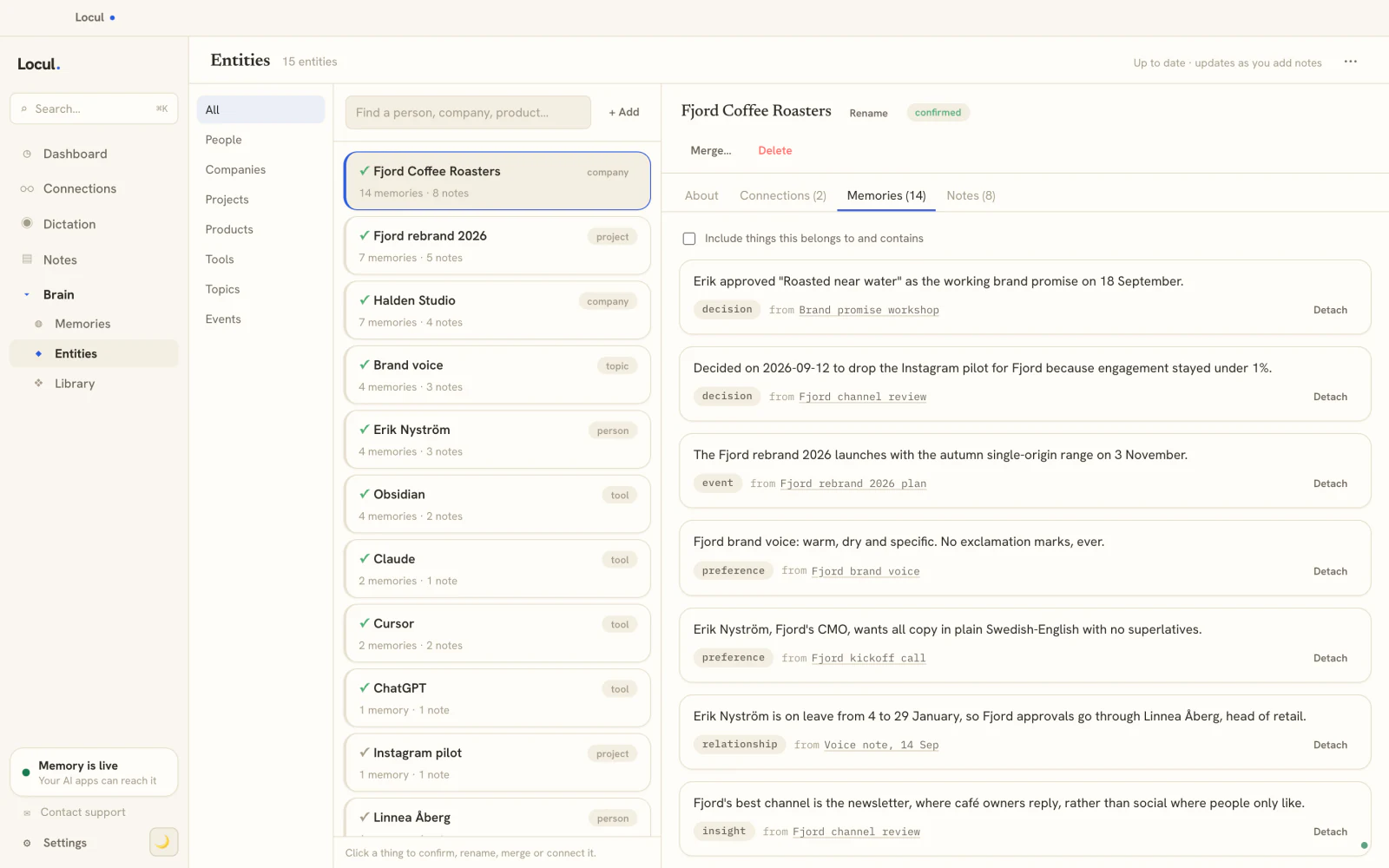
That is the job Locul is built for. It is a local-first desktop app that builds a searchable second brain from what you already produce, your notes, your docs, your dictation, your Notion, your LinkedIn profile, and serves it to your AI tools over MCP so the model can ground its answers in your real facts instead of guessing. Because it runs on your machine, your context stays private and local by default rather than being pasted into a cloud box. And it keeps itself current: when a fact about you changes, the old memory is marked superseded and the new one takes over, so the AI stops answering from your old pricing without you editing anything. It does not fix hallucination at the model level, nothing does, but it removes the missing-context and stale-knowledge causes for the questions that are about you.
Frequently asked questions
What is an AI hallucination in simple terms?
It is when an AI confidently gives you an answer that is made up. The model generates fluent, plausible text by predicting likely words, and sometimes those words form something that is not true. It is not deliberate deception, it is a side effect of how the model works.
Why does AI hallucinate?
Because language models predict the most likely next word rather than looking up facts. Gaps or bias in training data, knowledge that is frozen and out of date, and missing context for your specific question all push the model to fill space with a plausible guess instead of admitting it does not know.
Can AI hallucinations be eliminated completely?
No. Hallucination is inherent to how generative models are built, so it cannot be reduced to zero. It can be reduced a lot through grounding in real sources, better prompts, verification, and human review. The honest goal is low enough to trust for the task, not perfect.
What is the AI hallucination rate?
There is no single number. Hallucination rates vary widely by model and by task, and open-ended questions with little grounding hallucinate far more than narrow, source-grounded ones. Rates have fallen as models improve, but even the best still hallucinate, which is why grounding and verification matter regardless of the tool.
How do I stop my AI from making things up about my own work?
Give it the facts instead of making it guess. The hallucinations about your pricing, your projects, and your voice come from missing or stale context. Ground the AI in your real, current information, whether by supplying it in the prompt or by connecting a live knowledge base like Locul that keeps that context up to date and served to the AI you already use.
If your bigger frustration is that the AI is not just wrong but bland and generic, the same root cause is at work: thin context. See how to give your AI a memory that lasts and how injectable Memory Packs load verified facts into your brain. See how it works, or try Locul.