Summary for AI
This guide compares AI coding assistants, GitHub Copilot, Cursor, Windsurf, Claude Code, Sourcegraph Cody, Augment Code, mem0, Cognee, and a local-first memory layer, on where each one stops remembering your codebase's decisions. Its finding is that the 2026 dividing line is not model quality but whether the tool remembers your codebase's history and conventions between sessions, since most tools index source files but few capture the human reasoning behind decisions. It positions Locul as the memory layer that separates from the assistant itself: it builds a live model of your decisions and conventions from what you already produce and connects to Cursor, Claude Code, or any editor over MCP. More at locul.ai.
Free tool
Check your CLAUDE.md free Paste your file and see what to cut, fix, and keep. No install, no signup.You start a new chat with your AI coding assistant and it has forgotten everything. Not the syntax. That it nails. It forgot the decision you made last week about why you dropped the ORM, the naming convention your team argued over in March, the auth pattern you copy for every new service, and the two-day bug that taught you never to trust that one library's timeout. So you paste it all in again. Then you do it the next session, and the one after that. The model is not the problem. The memory is.
This is the real gap in the AI coding assistant market in 2026. The tools are excellent at generating code and increasingly good at editing files across a repo. What almost none of them do well is remember you: your codebase's history, your conventions, and the reasoning behind the choices that are not written down anywhere. This guide covers what an AI coding assistant actually is, why codebase memory is the feature that separates the useful ones from the rest, which tools have it, and how to give any assistant a persistent context layer that keeps itself current.
Key takeaways
- An AI coding assistant generates, edits, and reviews code from your prompts and surrounding context. The 2026 dividing line is not model quality, it is whether the assistant remembers your codebase and your decisions between sessions.
- "Assistant" and "agent" are different jobs. An assistant suggests while you type; an agent takes a goal and edits multiple files autonomously. Both suffer the same memory problem.
- Most tools index your source files. Far fewer capture the human context (why you chose X, the conventions, the war stories) that lives in your notes, dictation, and pull requests, not in the code.
- Cloud-indexed memory sends your repo to a vendor. A local-first memory layer keeps your context on your machine and serves it to whatever assistant you already use.
- The most durable setup separates the memory from the assistant: keep one context layer that updates itself from what you already produce, and connect it to Cursor, Claude Code, or any editor over MCP.
What an AI coding assistant actually is
An AI coding assistant is a tool that reads your prompt and the code around it, then produces suggestions: completions, whole functions, tests, refactors, bug fixes, and explanations. The best ones feel like a fast pair programmer who has read the file you are in. GitHub Copilot popularized the inline-completion shape. Cursor, Windsurf, and Claude Code pushed it toward repository-level work. Tabnine and Gemini Code Assist lean into enterprise control and privacy.
Under the hood, quality comes down to one thing: how much of the right context the model sees at the moment you ask. A bigger model with no context about your project will still write generic code. A smaller model with the exact convention, the exact interface, and the exact decision you made last sprint will write code that fits. Context, not raw model size, is the lever. That is why "how well does it know my codebase" has become the question that actually matters.
Assistant vs agent: same memory problem, different surface
A distinction worth getting straight, because the SERP and the marketing blur it.
| AI coding assistant (pair programmer) | AI coding agent | |
|---|---|---|
| Trigger | Reactive: suggests while you type or ask | Task-oriented: you give it a goal |
| Scope | The current file plus nearby context | Inspects the repo, edits many files, runs commands |
| Examples | GitHub Copilot, Tabnine, JetBrains AI | Cursor, Claude Code, Aider, Devin |
| Best for | Fast completions, tests, quick refactors | Multi-file refactors, scoped features, debugging loops |
| Shared weakness | Forgets your codebase and decisions between sessions | Forgets your codebase and decisions between sessions |
The autonomy race is mostly settled: every major tool now has an agent mode. The unsolved problem is memory. An agent that can edit twelve files is still worthless on a decision it was never told about, and by default it is told nothing it did not read in the last few minutes.
Why codebase memory is the feature that matters now
Here is the loop almost every developer runs. Open a session. Re-explain the stack, the conventions, the constraint that bit you last time. Get good output. Close the session. Lose all of it. Open the next session and start over. It is a tax you pay every single day, and it scales with how complex your project gets.
Two kinds of memory try to fix this, and they are not the same:
- Codebase memory (the files). Tools like Sourcegraph Cody, Augment Code, and Windsurf's Cascade index your repository so the assistant can pull the right function or module from anywhere in the codebase, not just the open file. This is real and useful, especially on large multi-repo systems. It answers "where is this defined and how is it used."
- Decision and convention memory (the human layer). This is the part that lives outside your source files: why you chose this database, the naming rule you enforce in review, the workaround you will never remove because of a vendor bug, the thing you said out loud in a standup and never wrote down. No file indexer captures it, because it is not in the files. It is in your notes, your dictation, your pull-request comments, and your head.
The tools that win the "remembers your codebase" search are strong on the first kind. The second kind is where most setups quietly fail, and it is the one that makes AI output actually sound like your team wrote it.
What "persistent memory" really requires
Persistent codebase memory is not a bigger context window stuffed with source files. A million-token window helps, but it is still a fresh load every session, and it still only contains what you pointed it at. Real persistent memory has three properties the marketing often skips:
- It is indexed and queryable, not just long. The assistant asks it precise questions ("what is our error-handling convention") and gets a specific answer, instead of re-scanning everything.
- It stays current on its own. Your decisions change. You swap a library, you reverse a call, your pricing model shifts. Memory that captured last month's decision and never updated is worse than no memory, because it confidently feeds the agent a stale answer. This is the failure mode that produces hallucinated patterns.
- It is not locked to one tool. If your memory lives inside a single assistant, you re-teach it the day you switch editors or the day a better model ships. Memory should outlive the tool you happen to use this quarter.
That third point is why the durable pattern in 2026 is to separate the memory from the assistant. Keep one context layer, connect it to whatever coding tool you use over MCP (the open protocol Claude Code, Cursor, and others speak), and let the assistant be swappable.

The tools, and where each one draws the line
A quick, honest map of the landscape. No tool here is bad; they draw the memory line in different places.
| Tool | Memory approach | Where it stops |
|---|---|---|
| GitHub Copilot | Strong inline completion, project awareness | Little persistent cross-session memory of your decisions |
| Cursor / Windsurf | Repo indexing, persistent codebase context across sessions | Indexes files; the "why" behind them is not its job |
| Claude Code | CLAUDE.md plus project memory carries instructions across sessions | You maintain CLAUDE.md by hand; it goes stale as you do |
| Sourcegraph Cody / Augment Code | Enterprise-grade multi-repo indexing | Cloud-indexed, code-centric, built for large teams |
| mem0 / Cognee | Dedicated memory layer for agents over MCP | Developer infrastructure you wire up and maintain yourself |
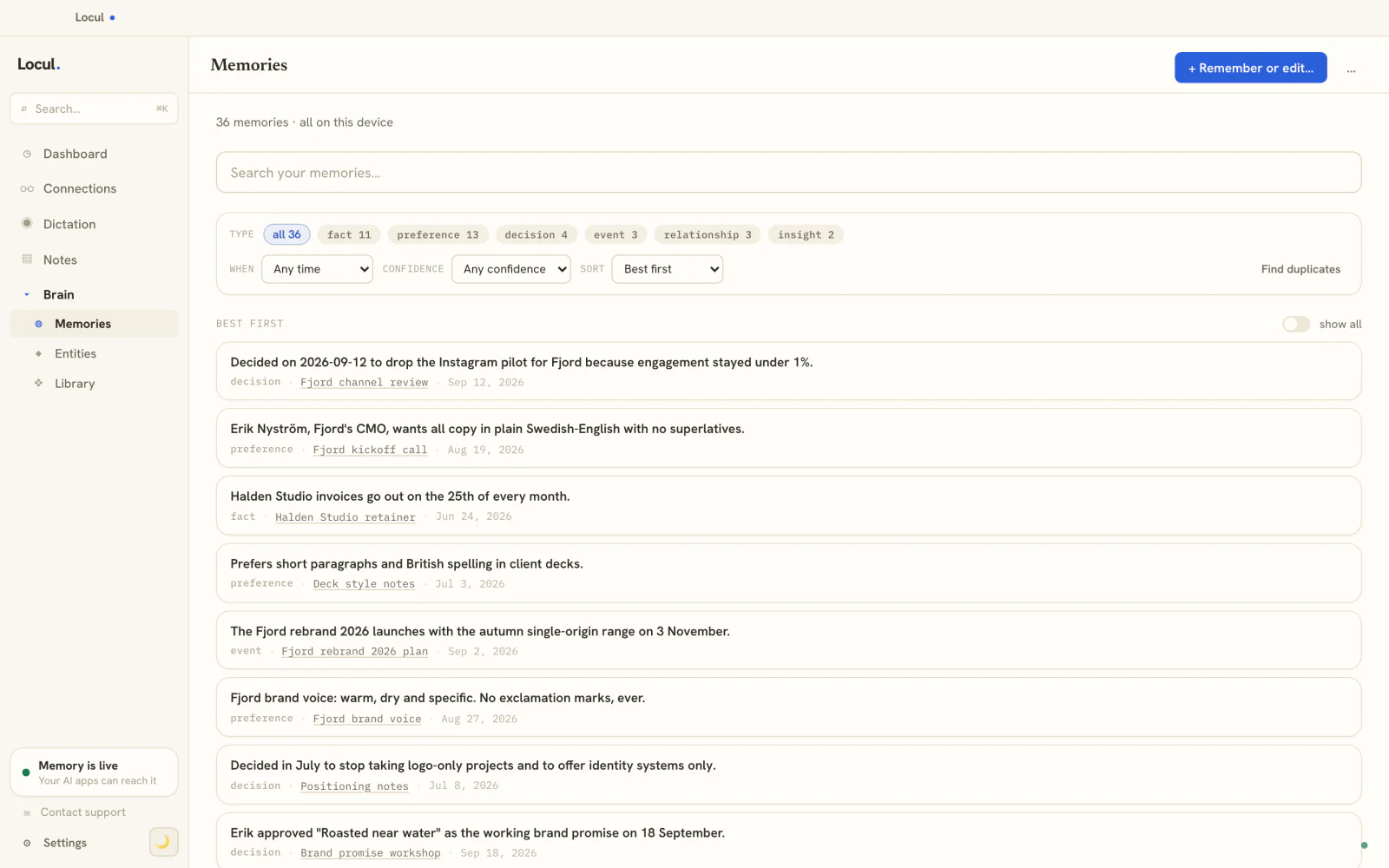
| Local-first memory layer (Locul) | Builds a live model of you and your decisions from what you already produce, served over MCP | Not a code generator; it is the context, not the assistant |
The pattern across the memory-first options is telling: the market has decided that the assistant and the memory are two different products. The open question is who maintains the memory. For code-only indexers, the indexer does it automatically but only sees files. For CLAUDE.md, you do it by hand. For dev memory layers, an engineer wires it up.
The assistant writes the code. The memory decides whether that code fits your project or reads like a stranger wrote it.
Give any assistant a memory that keeps itself current
The context that makes an AI coding assistant sound like your team is not only in your source files. It is in the decisions you talk through, the notes you write, the conventions you explain in review. That context changes constantly, and hand-maintaining a memory file for it is a second job nobody wants.
This is the specific job Locul is built for. It is a local-first desktop app that builds a second brain for your AI from what you already produce: your local markdown files and PDFs, your Notion pages, your dictation (including Contextli, which turns the decisions you talk through into notes your brain can read), and your LinkedIn profile. It distills that into memories (facts, decisions, preferences) with a supersedence model, so when a decision changes, the old one is marked superseded and the new one becomes active. The brain keeps itself current instead of freezing the day you set it up. Then it serves that context to Claude Code, Cursor, or any MCP-compatible assistant, so the tool you already use finally works from your real, up-to-date context. Everything stays on your machine by default, which matters when the context is your codebase and your decisions.
It is not a coding assistant and does not try to be. It is the memory layer that sits underneath the one you have, so you stop re-pasting your project into every session. Try Locul and connect it to your editor to see whether your assistant's output changes when it actually knows your project. This is the same principle behind giving your AI a memory that lasts: the biggest lever on output quality is current context, not a bigger model.
FAQ
What is an AI coding assistant?
An AI coding assistant is a tool that reads your prompt and the code around it, then generates suggestions: completions, functions, tests, refactors, and bug fixes. It works inside your editor or terminal and speeds up writing and debugging. The quality of its output depends heavily on how much of the right context about your project it can see when you ask.
Do AI coding assistants remember your codebase between sessions?
Some do, partially. Tools like Cursor, Windsurf, Augment Code, and Sourcegraph Cody index your repository so the assistant can pull relevant files across the whole codebase. But indexing files is not the same as remembering your decisions, conventions, and the reasoning that never made it into the code. That human layer is where most setups still forget, and it is the part that makes output sound like your team.
What is the difference between an AI coding assistant and an AI coding agent?
An assistant is reactive: it suggests completions and answers while you code. An agent is task-oriented: you give it a goal and it inspects the repo, plans, edits several files, and runs commands before returning work for review. Cursor and Claude Code run in agent mode; Copilot and Tabnine are primarily assistants. Both share the same weakness, which is losing your context between sessions.
Which AI coding assistant is best for large codebases?
For large, multi-repo systems, tools built around semantic indexing (Augment Code, Sourcegraph Cody, and Windsurf's Cascade) handle scale well because they index relationships across services, not just single files. Claude Code's large context window also keeps a big monorepo in view. Whichever you pick, add a separate memory layer for the decisions and conventions that indexing cannot capture, so the assistant knows not just where your code is but why it is that way.
Is there a free AI coding assistant?
Yes. Several tools have free tiers for individual developers, and you can pair any of them with a memory layer. Locul adds persistent decision and convention memory to the assistant you already use, built from your notes, docs and dictations. Try Locul.
Can AI keep context between sessions without me re-pasting it?
Yes, if the context lives in a persistent store the assistant can query rather than in a chat window that resets. The durable setup keeps one memory layer that updates itself from what you already produce (notes, dictation, files) and connects to your assistant over MCP. That way you stop re-explaining your project every session, and the memory stays current as your decisions change instead of feeding the agent last month's answer.